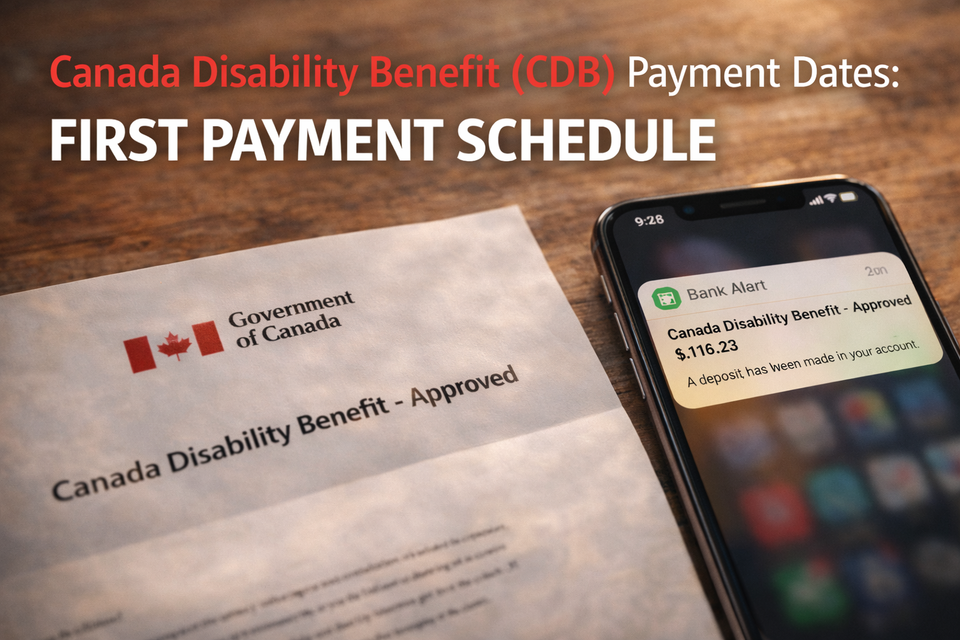
Canada Disability Benefit (CDB) Payment Dates 2026: First Payment Schedule
For years, advocates have fought for a federal benefit to support working-age Canadians with disabilities. In July 2025, that fight finally resulted in the launch of the Canada Disability Benefit (CDB).
Now that the program is active, the biggest question isn't "if" it's coming, but when it arrives each month.
Live CDB Tracker: Real-Time Countdown to Your Next 2026 Disability Payment
The next Canada Disability Benefit (CDB) payment date is Calculating.... Eligibility for the CDB requires a valid Disability Tax Credit (DTC) certificate. Most recipients receive these funds via direct deposit between 3:00 AM and 6:00 AM EST. Digital-first banks like Tangerine or Neo Financial may release funds the evening prior.
Future CDB Payments:
Unlike the Canada Pension Plan (CPP), which pays at the end of the month, or the Canada Child Benefit which pays on the 20th, the CDB follows its own unique schedule: The Third Thursday of every month.
This is the Official 2026 CDB Payment Schedule, verified against Employment and Social Development Canada (ESDC) regulations. We breakdown the exact dates, the confirmed amounts for 2026, and the critical "Clawback" list for every province.
Planning Your Budget?
For a complete list of every federal and provincial deposit day this year, bookmark our Master Payment Calendar 2026.
Official 2026 CDB Payment Schedule
Save this table. The CDB is strictly paid on the third Thursday of the month.
| Month | Official Payment Date | Status |
| January | Jan 15, 2026 | Thursday (Standard) |
| February | Feb 19, 2026 | Thursday (Standard) |
| March | Mar 19, 2026 | Thursday (Standard) |
| April | Apr 16, 2026 | Thursday (Standard) |
| May | May 21, 2026 | Thursday (Standard) |
| June | Jun 18, 2026 | Thursday (Standard) |
| July | Jul 16, 2026 | Thursday (New Benefit Year) |
| August | Aug 20, 2026 | Thursday (Standard) |
| September | Sep 17, 2026 | Thursday (Standard) |
| October | Oct 15, 2026 | Thursday (Standard) |
| November | Nov 19, 2026 | Thursday (Standard) |
| December | Dec 17, 2026 | Thursday (Standard) |
The "Third Thursday" Rule:
According to the Canada Disability Benefit Regulations, payments are issued on the third Thursday of each month. Unlike the GST/HST Credit which shifts for weekends, this date is stable because Thursdays are rarely statutory holidays.
Quick Answers: Common CDB Questions
What is the payment date for the Canada Disability Benefit 2026?
The Canada Disability Benefit (CDB) is paid monthly on the third Thursday of the month. For 2026, the first payment is January 15, 2026, followed by February 19, 2026.
Is the Canada Disability Benefit taxable?
No. The Canada Disability Benefit is tax-free. You do not need to report it as income on your tax return, and it does not count as income when calculating your eligibility for the GST/HST Credit or Canada Child Benefit.
Will ODSP or OW claw back the Canada Disability Benefit?
The Government of Ontario has confirmed that the federal CDB is fully exempt from provincial social assistance calculations. This means if you are on ODSP or Ontario Works, your benefits will not be reduced (clawed back) when you receive the federal disability payment.
How much is the Canada Disability Benefit in 2026?
For the benefit year starting July 2026, the maximum base benefit is **$200 per month** ($2,400 per year), adjusted for inflation. This amount is reduced if your adjusted family net income exceeds the threshold of $23,000 (for singles) or $32,500 (for couples).
How Much Will I Get? (The 2026 Math)
The CDB is designed to be a "top-up" for low-income Canadians, not a full income replacement.
The Maximum Amount
- July 2025 - June 2026: The maximum is $200.00 per month.
- July 2026 - June 2027: The amount will be indexed to inflation. If inflation is 2.5%, the payment will rise to approx. $205.00 per month.
The Income Test (Who gets the full $200?)
You get the full amount if your 2025 Adjusted Family Net Income is below these verified thresholds:
- Single Person: Income under $23,000.
- Couple: Income under $32,500.
The "Working Income" Exemption
To encourage people to work, the CDB ignores a specific amount of your employment income:
- Singles: The first $10,000 of work income is ignored.
- Couples: The first $14,000 of work income is ignored.
- Translation: A single person could earn $10,000 from a job + $23,000 from other sources (Total $33,000) and still get the full $200/month benefit.
The Golden Ticket: The DTC Requirement
This is the most controversial part of the new benefit.
To qualify for the CDB, you MUST have a valid Disability Tax Credit (DTC) certificate (Form T2201) approved by the CRA.
- No DTC = No CDB.
- Receiving provincial benefits like ODSP, AISH, or PWD is not enough. You must apply for the federal DTC separately.
How to Check if You Have the DTC:
- Log in to CRA My Account.
- Click on "Benefits and credits."
- Look for the "Disability Tax Credit" section.
- It must say "Eligible for 2026" (or Indeterminate).
Street Reality: The Application Backlog
Because millions of Canadians are rushing to apply for the DTC to get this new money, wait times for approval have skyrocketed.Official Wait Time: 8 weeks.Real Wait Time: Users are reporting delays of 12 to 16 weeks.Strategy: If you don't have the DTC yet, apply today. Do not wait.
The "Clawback" List: Is Your Province Safe?
One of the biggest fears is that provinces will see this extra $200 and cut your provincial welfare check by the same amount.
Here is the Official 2026 Clawback Status by province (as of January 2026):
✅ The "Safe" Provinces (No Clawback)
These provinces have passed laws or issued memos stating the CDB is fully exempt.
- Ontario (ODSP & Ontario Works)
- Note: This also means your Ontario Trillium Benefit will not be affected.
- British Columbia (PWD & Income Assistance)
- Nova Scotia
- Newfoundland & Labrador
- Saskatchewan (SAID)
- Manitoba
- Nunavut
⚠️ The "Danger" / Unconfirmed Zones
At the time of writing, these regions have conflicting or incomplete policies.
- Alberta (AISH): Alberta has sent mixed signals. While they generally exempt federal tax credits, there is no specific legislation protecting the CDB yet. Monitor your statements closely.
- Quebec: Quebec often handles benefits differently. While they likely will not claw it back, the interaction with the Solidarity Tax Credit is complex.
- New Brunswick: Policy is currently under review.
Street Reality: Deposit Times
Since the CDB is paid via the standard federal direct deposit system (same as the Canada Child Benefit and GST), the banking times are predictable.
- Tangerine / PC Financial: Expect the deposit around 10:30 PM ET on the Wednesday night before payment day.
- RBC / TD / Scotiabank: Funds will appear between 3:00 AM and 6:00 AM local time on Thursday morning.
- Note on Cheques: The government is pushing hard for Direct Deposit Only for this benefit to avoid postal delays. If you apply, ensure your banking info is updated on CRA My Account.
How to Apply for the CDB
Unlike the GST Credit (which is automatic), you MUST APPLY for the Canada Disability Benefit. It is not given to you automatically even if you have the DTC.
The Application Steps (2026):
- Ensure you have filed your 2025 Taxes. (You cannot get it if you haven't filed).
- Ensure you have an active DTC.
- Go to CRA My Account or Service Canada Account.
- Look for the "Apply for Canada Disability Benefit" button under the Benefits tab.
- The Process: It is a simplified "One-Click" application. You confirm your info, and the system checks your eligibility instantly.
Retroactive Payments:
If you are approved late, the government may issue a retroactive payment back to the month you became eligible (up to a limit).
- Example: If you apply in March 2026 but were eligible in January, your March payment should include the missing $400 from Jan/Feb.
Detailed Guide: Qualifying, Retroactive Pay & Denials
While knowing the CDB payment dates is important, the biggest hurdle for most Canadians is actually getting approved. Below is the "Street Reality" guide to navigating the medical requirements and maximizing your back pay in 2026.
The "Medical List": What Conditions Qualify in 2026?
One of the most common misconceptions is that there is a specific "List of Diseases" for the CDB. Users frequently search for "Does anxiety qualify for CDB?" or "Is diabetes on the CDB list?"
The Reality: The CDB does not diagnose you. It relies entirely on the Disability Tax Credit (DTC) criteria. If you have the DTC, you have the medical approval for the CDB.
Instead of a disease list, the government looks for a "Severe and Prolonged Impairment" in one of these specific categories. If your condition prevents you from doing these tasks 90% of the time, you likely qualify:
- Mental Functions: Severe issues with adaptive functioning, memory, judgment, or problem-solving (e.g., severe ADHD, Autism, Bipolar Disorder).
- Walking: Requiring a wheelchair or taking 3x longer than an average person to walk 100 metres.
- Life-Sustaining Therapy: Needing therapy at least 3 times per week for a total of 14 hours (e.g., Type 1 Diabetes requiring intensive insulin monitoring, Kidney Dialysis).
- Vision & Hearing: Legally blind or profoundly deaf.
- Cumulative Effect: You might not meet the strict criteria for one category, but if you have two conditions (e.g., mild mobility issues + mild memory issues) that combined stop you from daily living, you can qualify under the "Cumulative Effects" rule.
Pro Tip: If you are already receiving CPP Disability, do not assume you automatically qualify for the CDB. You must apply for the DTC separately.
CDB vs. CPP Disability: What is the Difference?
Many applicants confuse the new Canada Disability Benefit (CDB) with the old Canada Pension Plan Disability (CPP-D). They are two completely different systems, and yes—you can get both at the same time.
| Feature | Canada Disability Benefit (CDB) | CPP Disability (CPP-D) |
| Source | Tax-Funded (General Revenue) | Your Contributions (Work History) |
| Taxable? | No (100% Tax-Free) | Yes (Taxable Income) |
| Requirement | Valid DTC Certificate | Recent contributions to CPP |
| Work Rules | Can earn up to $10k (Single) without penalty | Earning >$6,800 triggers a review |
| Clawbacks | Exempt from most Provincial Welfare | Deducted dollar-for-dollar from Welfare |
The Strategy:
If you are currently on CPP-D and struggling, adding the $200/month CDB is the safest way to boost your income because it is tax-free and generally does not trigger clawbacks on other benefits like the Canada Child Benefit.
Retroactive Pay: How to Claim "Back Money"
If you didn't apply for the CDB immediately when it launched in July 2025, you haven't lost that money. The government has a Retroactive Payment Rule.
- The 24-Month Rule: You can receive a lump-sum payment for up to 24 months of past eligibility.
- The Constraint: You cannot claim money for months before the program started (July 2025).
Example Scenario (The "Big Cheque" Opportunity):
Imagine you wait until January 2026 to apply, but you had your DTC approved back in 2024.
- You apply in January 2026.
- You are approved in March 2026.
- The Payout: In March, you will receive your regular $200 payment PLUS a lump sum for the months you missed (July 2025 to February 2026).
- The Math: 8 months x $200 = **$1,600 Tax-Free Lump Sum.**
Note: This large deposit might look suspicious to your bank. We recommend keeping your "Notice of Determination" letter to prove to your landlord or bank that this large sum is a legal government benefit.
"Application Denied": What To Do Next
Receiving a denial letter is devastating, but it is often just a paperwork error. The most common reasons for rejection in 2026 are surprisingly simple to fix.
Reason 1: The "Expired DTC" Trap
Many people don't realize their Disability Tax Credit has an expiry date. If your DTC expired in 2025, your CDB application for 2026 will be automatically denied.
- The Fix: Check your CRA My Account. If your DTC is expired, you must submit a new Form T2201 signed by your doctor immediately.
Reason 2: The "Unfiled Taxes" Error
The CDB is income-tested. If you (or your spouse) forgot to file your 2025 Tax Return, the CRA has no way to verify your income.
- The Fix: File your taxes immediately. The system will automatically re-assess your eligibility once the return is processed.
Reason 3: The Income Cutoff
If your family income spiked last year (perhaps due to a one-time severance package or selling a house), you might have crossed the $23,000 (Single) or $32,500 (Couple) threshold.
- The Fix: Wait until July. When the new "Benefit Year" starts in July 2026, your eligibility will be re-calculated based on your new tax return. If your income dropped back down, you will qualify again.
How to Appeal:
If you believe the denial is a mistake, you have 90 days to request a "Reconsideration."
- Log into CRA My Account.
- Select "Submit Documents."
- Upload a letter titled "Request for Reconsideration - CDB" explaining why the decision was wrong.
Need More Income?
If the $200/month CDB isn't enough to cover your expenses, you may need to look for accessible, immediate work opportunities.
👉 Find Daily Pay Jobs at BetterPayJobs.ca
About the Author
Jeff Calixte (MC Yow-Z) is a Canadian labour market researcher and digital entrepreneur specializing in government benefit data and cost-of-living support. As the founder of CanadaPaymentDates.ca and BetterPayJobs.ca, Jeff helps newcomers, students, and workers navigate the Canadian social safety net—from tracking CRA payment schedules to finding entry-level work.
Sources
- Government of Canada: Canada Disability Benefit Regulations
- Canada Revenue Agency (CRA): Disability Tax Credit (DTC) Eligibility
- Disability Without Poverty: Provincial Clawback Map
Note
Official 2026 payment dates and benefit amounts are determined by the Canada Revenue Agency (CRA) and provincial governments. While we strive to keep this information current, government policies and schedules are subject to change without notice. All data in this guide is verified against official CRA circulars at the time of publication and should be treated as an estimate. We recommend confirming the status of your personal file directly via CRA My Account or by calling the CRA benefit line at 1-800-387-1193.