Canada Learning Bond (CLB): How to Get $2,000 Free for Your Child
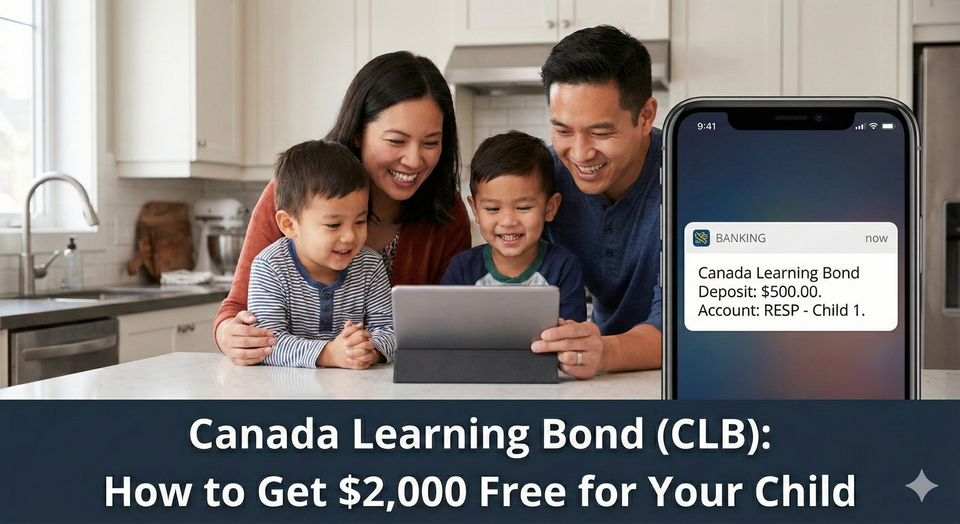
In the 2026 economic climate, saving for your child’s post-secondary education can feel like an impossible task. However, the Government of Canada has a "Hidden Gem" program that many eligible families completely miss out on. The Canada Learning Bond (CLB) is essentially a gift of up to $2,000 deposited directly into a Registered Education Savings Plan (RESP) for children from low-to-modest income families.
The biggest misconception about the CLB is that you need to put your own money into the account to get it. You do not. Unlike the Canada Education Savings Grant (CESG) which matches your contributions, the CLB is "No-Strings-Attached" money. You simply open the account, and the government does the rest.
This guide is a cornerstone of our Ultimate Savings Guide. We will walk you through the 2026 income thresholds, the "No-Fee" bank list, and the strategies to ensure your child gets every dollar they are entitled to.
1. How the Canada Learning Bond Works in 2026
The CLB is designed to grow as your child grows. It is not a one-time payment, but a series of deposits that accumulate over time.
- The Initial Deposit: Once an RESP is opened and the CLB is requested, the government deposits $500 immediately. They also add an extra $25 to help cover any potential administrative costs of opening the account.
- The Annual Top-Up: For every year your family remains eligible, the government adds another $100 to the account until the child turns 15.
- The Lifetime Maximum: A single child can receive up to $2,000 in total.
- Retroactive Payments: If your child is already 10 years old and you are just finding out about this now, don't worry. You can claim the money for all the years they were eligible in the past.
2. Who Qualifies? 2026 Income Thresholds
Eligibility for the CLB is based on the number of children in your family and your adjusted family net income.
| Number of Children | 2026 Adjusted Family Income Threshold |
| 1 to 3 Children | Up to $55,867 |
| 4 Children | Up to $63,036 |
| 5 Children | Up to $70,234 |
Note: For families with more than 5 children, the threshold continues to increase. Always check the official CRA Benefit portal for the most up-to-date figures based on your current tax filing.
3. How to Apply: The "No-Fee" Path
To get the CLB, you must have a Registered Education Savings Plan (RESP). Many banks try to sell you complex investment products, but for the CLB, you want a "No-Fee, No-Contribution" RESP.
Steps to Secure the $2,000:
- Get Your SINs: You need a Social Insurance Number for yourself and your child. If you don't have one, visit a Service Canada office.
- Choose a Provider: Not all RESP providers offer the CLB. Stick with the major banks (BMO, CIBC, RBC, Scotiabank, TD) or credit unions. Explicitly ask for a "No-Fee RESP for the Canada Learning Bond."
- The Application: The bank will handle the paperwork. Once the account is open, it typically takes 2 to 3 months for the first $525 to appear in the account.
"CLB Wealth Strategies"
1. The "CLB Retroactive Claim until Age 21" Rule
A common search is "Can I get the Canada Learning Bond for my 18-year-old?"
- The Street Angle: Most parents think the window closes at age 15. While the eligibility stops at 15, the claim period is much longer.
- The Hack: In 2026, a youth between the ages of 18 and 21 can open their own RESP and request the CLB for themselves for all the years they were eligible as a child.
If you are a student following our OSAP Payment Guide, check if your parents ever claimed your CLB. If they didn't, you can open an account today and get a "lump sum" of up to $2,000 to help pay for your current semester. This is the way to find free tuition money.
2. The SmartSAVER No-Wait Portal
Applying through a big bank branch can take hours of waiting and paperwork.
- The Hack: Use SmartSAVER (MySmartFUTURE). This is a non-profit portal that allows you to start the RESP process online with "CLB-Friendly" banks.
- The Benefit: They filter for "No-Fee" accounts specifically. It bypasses the "Sales Pitch" you might get at a physical branch where a teller might try to sign you up for a high-fee mutual fund.
"SmartSAVER RESP application online reviews 2026" — This is the fastest way to get the bond without the banking headache.
3. Combining CLB with the "Additional CESG"
Most people know about the 20% match on the Canada Education Savings Grant (CESG).
- The Street Angle: If you are eligible for the CLB, you are also eligible for the "Additional CESG."
- The Math: Instead of the standard 20% match, the government will give you a 40% match on the first $500 you contribute each year.
- The Strategy: If you can scrape together just **$10 a week** ($520 a year), the government will add $200 in grants plus your $100 CLB. That is a 300% return on your money before any investment growth.
4. The "Auto-Enrollment" 2028 Update (Why you should act NOW)
In 2026, the federal government is preparing for the 2028 Auto-Enrollment initiative, where RESPs will be opened automatically for low-income kids.
- The Hack: Don't wait for 2028. The auto-enrollment will only apply to children born in 2024 or later.
- The Warning: If your child was born between 2004 and 2023, you are in the "Manual Zone." If you don't open the account yourself, that $2,000 will simply sit in the government's vault until it expires when the child turns 21.
5. Using CLB for "Trades and Apprenticeships"
A high-traffic query is "Can I use the Canada Learning Bond for trade school?"
- The Answer: Yes. The CLB is not just for University or College. It can be used for Apprenticeships, Vocational Schools, and Trade Certifications.
- The Strategy: If your child wants to be an electrician or a plumber, this $2,000 can pay for their first set of tools and their Level 1 technical training.
5. Summary: Your CLB To-Do List
| Action | Why it Matters |
| Check 2025 Taxes | Eligibility is based on your most recent tax return. |
| Call 1-800-O-Canada | Verify if your child has a "Bond Waiting" status. |
| Avoid "Group RESPs" | Stick to "Individual" or "Family" plans to avoid high fees. |
| Link your SIN | The bond is tracked via the child's SIN number. |
Canada Learning Bond
How do I get the $2,000 Canada Learning Bond? To receive the Canada Learning Bond, you must open a Registered Education Savings Plan (RESP) and request the bond through your bank or provider. There is no personal contribution required. The government will deposit an initial $500, followed by $100 for every year your family remains below the income threshold (approx. $55,867 for 3 kids) until the child turns 15, up to a lifetime maximum of **$2,000**.
Frequently Asked Questions (FAQ)
Q: What happens to the money if my child doesn't go to school?
A: If the child does not pursue post-secondary education by age 35, the CLB money is returned to the government. However, any interest earned on that money may be kept by the subscriber (the parent) as long as they have RRSP room.
Q: Does receiving the CLB affect my Canada Child Benefit (CCB)?
A: No. The CLB is an education grant and does not count as income. It will not reduce your CCB, Ontario Works, or any other social assistance.
Q: Can I have more than one RESP?
A: Yes, but the $2,000 lifetime limit for the CLB is per child, not per account. If you have two RESPs, the bond will be deposited into the first one that successfully requests it.
About the Author
Jeff Calixte (MC Yow-Z) is a Canadian labour market researcher and digital entrepreneur specializing in government benefit data and cost-of-living support. As the founder of CanadaPaymentDates.ca and BetterPayJobs.ca, Jeff helps newcomers, students, and workers navigate the Canadian social safety net—from tracking CRA payment schedules to finding entry-level work.
Sources
- Employment and Social Development Canada: Canada Learning Bond - Overview and Eligibility
- Government of Canada: List of RESP Promoters who offer the CLB
Note
Official 2026 payment dates and benefit amounts are determined by the Canada Revenue Agency (CRA) and provincial governments. While we strive to keep this information current, government policies and schedules are subject to change without notice. All data in this guide is verified against official CRA circulars at the time of publication and should be treated as an estimate. We recommend confirming the status of your personal file directly via CRA My Account or by calling the CRA benefit line at 1-800-387-1193.