2026 Sales Tax Chart: GST, HST, and PST Rates by Province
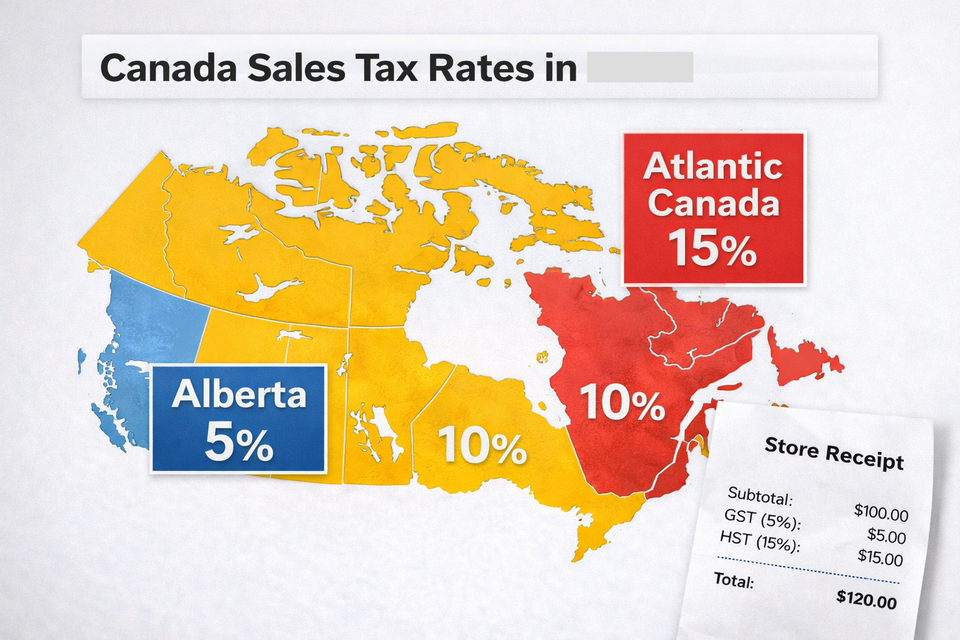
For newcomers and even long-time residents, Canada’s sales tax system is a math headache. Depending on which side of a provincial border you stand on, a $1,000 laptop can cost you **$1,050** (Alberta) or $1,150 (Nova Scotia).
In 2026, the gap between the "High Tax" provinces (Atlantic Canada) and the "Low Tax" havens (Alberta/Territories) remains the biggest driver of cross-border shopping. While the base price of goods is similar across the country, the tax difference allows smart shoppers to save hundreds of dollars a year simply by knowing where to buy.
This is the Official 2026 Sales Tax Master Guide. We break down the official rates for every jurisdiction, the confusing "Grocery Rule" (why your ice cream is tax-free in a tub but taxable in a cone), and the technical strategies—from First Nations exemptions to cross-border duty limits—that can legally lower your bill.
1. The Official 2026 Sales Tax Chart
Current as of January 2026. Use this table to calculate the true cost of any item.
| Province / Territory | Type of Tax | Total Rate | Breakdown |
| Alberta | GST Only | 5% | 5% GST |
| British Columbia | GST + PST | 12% | 5% GST + 7% PST |
| Manitoba | GST + PST | 12% | 5% GST + 7% PST |
| New Brunswick | HST | 15% | 15% Harmonized |
| Newfoundland & Labrador | HST | 15% | 15% Harmonized |
| Northwest Territories | GST Only | 5% | 5% GST |
| Nova Scotia | HST | 15% | 15% Harmonized |
| Nunavut | GST Only | 5% | 5% GST |
| Ontario | HST | 13% | 13% Harmonized |
| Prince Edward Island | HST | 15% | 15% Harmonized |
| Quebec | GST + QST | 14.975% | 5% GST + 9.975% QST |
| Saskatchewan | GST + PST | 11% | 5% GST + 6% PST |
| Yukon | GST Only | 5% | 5% GST |
Key Terms Explained:GST (Goods and Services Tax): The 5% federal tax charged everywhere in Canada. No one escapes this.PST (Provincial Sales Tax): The extra tax charged by the province. In BC, Manitoba, and Saskatchewan, this is calculated separately at the register. Crucially, PST is often not charged on essential items like books or children's clothes.HST (Harmonized Sales Tax): Used in Ontario and Atlantic Canada. The province and the federal government combine their taxes into one single rate. This simplifies the receipt but often means you pay tax on more items (since the provincial exemptions are harder to claim).
2. The "Grocery Rule": Why is My Snack Taxed?
Have you ever noticed that buying 5 donuts is taxable, but buying 6 is tax-free? This is not a mistake by the cashier; it is the CRA Basic Grocery Definition, and understanding it can save you money at the checkout.
The "Basic" vs. "Snack" Distinction
The CRA divides all food into two categories:
- Basic Groceries (0% Tax): Meat, vegetables, dairy, eggs, bread, and canned goods. You pay the sticker price.
- Taxable Snacks (Full Tax): Carbonated drinks, candies, potato chips, and prepared hot meals.
The "Single Serving" Trap
The tax status of many items depends entirely on the quantity you buy.
- The Rule: A single serving is a "snack" (Taxable). A bulk pack is "groceries" (Tax-Free).
- The Donut Strategy:
- Buy 1 to 5 donuts: The CRA considers this immediate consumption. You pay 13-15% tax.
- Buy 6 or more: The CRA considers this a "family grocery purchase." The tax drops to 0%.
- The Hack: Always buy bakery items (muffins, cookies, tarts) in packs of 6. You save the tax instantly. If you are struggling with food costs this year, you should check if the Grocery Rebate 2026 is coming back to help offset these expenses.
- The Ice Cream Paradox:
- A 500ml tub of ice cream from the freezer aisle is tax-free (Grocery).
- A single scoop served in a cone at Dairy Queen is taxable (Catering Service).
- The "Salad Kit" Test:
- A bag of lettuce mix is tax-free.
- A salad kit that includes a fork and a dressing packet is considered "prepared food" and is fully taxable.
3. Provincial Exemptions & "Point-of-Sale" Rebates
Even in high-tax provinces, certain items are legally tax-free if you know the rules.
Ontario: The 8% Children's Rebate
In Ontario, the 13% HST is composed of 5% Federal and 8% Provincial tax. For specific items, the province waives its 8% share.
- Children's Clothing: Clothing designed for children (up to Girls' size 16 and Boys' size 20) is only taxed at 5% (GST only).
- The Hack: If you are a small adult who fits into "Youth XL" sizes, you can buy high-end brands (like Nike or Adidas) in the youth section. You save the 8% tax and the youth prices are often lower.
- Books: Physical books in Ontario are also taxed at only 5%. (Digital audiobooks, however, are often taxed at the full 13%).
- Prepared Food under $4: If you buy a prepared meal (like a slice of pizza) for under $4.00, you are only charged 5% tax. If it costs $4.01, you are charged 13%.
British Columbia: The "Soda Tax" & Vapor Rules
BC has a unique PST system that specifically targets "unhealthy" items.
- Soda Tax: BC charges PST on soda and sugary drinks, even though they are technically food.
- Vapor Products: The PST on vape juice and devices in BC is hiked to 20% (instead of the standard 7%) to discourage use.
- Safety Gear: Work-related safety equipment (steel-toed boots, hard hats) is exempt from the 7% PST in BC.
Nova Scotia & Atlantic Canada
These provinces have the highest consumption taxes in North America (15%).
- Home Heating Rebate: Nova Scotia provides a rebate on the provincial portion of the HST for home heating fuel and electricity. This is often applied automatically by the utility provider. If you live in this region, make sure you are also registered for the New Brunswick Harmonized Sales Tax Credit (HSTC) or the PEI Sales Tax Credit to get some of that money back quarterly.
4. Street Strategies: Legally Paying Less Tax
Here is the technical breakdown of how smart shoppers minimize their tax bill in 2026.
Strategy A: The "Place of Supply" Rule (Digital Nomads)
Sales tax in Canada is charged based on where the item is delivered, not where the seller is located.
- The Rule: If you order a laptop online, the tax rate is determined by the shipping address.
- The Strategy: If you have a trusted family member in Alberta (5% tax) or a Territory, shipping expensive items to their address saves you the provincial tax difference.
- Example: Buying a $3,000 MacBook Pro.
- Ship to Ontario (13%): Tax is $390. Total: $3,390.
- Ship to Alberta (5%): Tax is $150. Total: $3,150.
- Savings: $240.
- The Catch: You must physically pick it up. If they re-ship it to you, technically the tax applies to your province of residence. However, for digital nomads or those moving between provinces, establishing a "Place of Supply" in a low-tax province is a massive money saver. This is a key strategy often discussed in our Newcomer’s Guide to Money in Canada.
Strategy B: The First Nations "Amazon Hack"
If you are a Status Indian, you are exempt from paying GST/HST on goods delivered to a reserve.
- The Old Way: You had to drive to a store on a reserve to get the exemption.
- The 2026 Way: Major retailers like Amazon Canada and Best Buy now have digital tax exemption programs (ATEP).
- How it Works: You upload a photo of your Status Card to your Amazon profile. Once approved, any order you ship to an address on a First Nations reserve will automatically have the GST/HST removed at checkout.
- The Benefit: This applies to almost everything—electronics, clothes, furniture. For high-volume buyers, this saves 13-15% on every purchase.
Strategy C: Cross-Border Shopping (The 24h/48h Rule)
Living near the US border? The CBSA (Canada Border Services Agency) has strict limits on what you can bring back tax-free. Knowing these limits prevents you from getting hit with double tax (US Sales Tax + Canadian Duty).
- Trip under 24 hours: $0 Exemption. You pay duty and taxes on everything you buy.
- Trip of 24 to 48 hours: $200 Exemption. You can bring back CAD $200 worth of goods tax-free. If you spend $250, you pay tax on the entire $250, not just the difference.
- Trip over 48 hours: $800 Exemption. You can bring back CAD $800 worth of goods tax-free.
- The Alcohol Rule: You can only bring back alcohol (1.14L of liquor or 24 beers) tax-free if you have been away for 48+ hours. If you grab a 6-pack on a day trip, you will pay massive duties (often 50% of the value) at the border.
5. Special Purchase Rules: Cars and Digital Goods
The "Red Book" Trap (Used Cars)
When you buy a used car privately (e.g., from a neighbor), you don't pay tax to the seller. However, the government still wants its cut.
- The Rule: When you go to register the car and get your plates, the province will charge you sales tax.
- The Trap: They do not charge tax on what you paid. They charge tax on the Wholesale Value (Red Book Value) of the car.
- Example: You buy an old Honda Civic for $2,000 because it has scratches. The government says the "Book Value" is $5,000. They will charge you 13% tax on $5,000 ($650), not on the $2,000 you actually paid.
- The Fix: If the car is damaged/low value, you must get a Safety Standards Certificate and a formal Appraisal from a mechanic to prove it is worth less than the book value. For a complete walkthrough of this process, read our full guide on Buying a Car in Canada (2026): How to Avoid "Curb Siders".
The "Netflix Tax" (Digital Services)
In 2026, all foreign digital services are required to collect GST/HST.
- What it hits: Netflix, Spotify, Airbnb service fees, and digital software downloads.
- The Rate: These companies charge tax based on your billing address. If you move from Nova Scotia to Alberta, make sure to update your billing address on these platforms immediately to drop your tax rate from 15% to 5%. If you are paying for news subscriptions, check if you can claim the Digital News Subscription Tax Credit to get some of that money back.
Frequently Asked Questions (FAQ)
Q: Is there tax on rent?
A: No. Long-term residential rent (leases over 1 month) is tax-exempt in Canada. However, short-term rentals (like AirBnB) are fully taxable. If your landlord tries to add "HST" to your monthly apartment rent, this is illegal.
Q: Do I charge GST if I am a Gig Worker (Uber/Freelance)?
A: Only if you earn over $30,000 in a year. This is the "Small Supplier" threshold.
- Under $30k: You do not need to register for a GST number or charge tax.
- Over $30k: You must register, charge the tax to your clients, and remit it to the CRA. Uber drivers are the exception—they must register for GST immediately, regardless of income. Check our 2026 Uber and SkipTheDishes Tax Guide for the specific registration steps.
Q: Will the "Grocery Rebate" offset these taxes?
A: The GST/HST credit is designed to offset the GST you pay throughout the year. If you are low-income, the government effectively refunds this tax to you quarterly. Check the GST/HST Credit Payment Dates 2026 to see when your next payment arrives. Also, verify you aren't missing any other Hidden Tax Credits Canada 2026 that could increase your refund.
About the Author
Jeff Calixte (MC Yow-Z) is a Canadian labour market researcher and digital entrepreneur specializing in government benefit data and cost-of-living support. As the founder of CanadaPaymentDates.ca and BetterPayJobs.ca, Jeff helps newcomers, students, and workers navigate the Canadian social safety net—from tracking CRA payment schedules to identifying entry-level employment opportunities.
Sources
- Canada Revenue Agency: GST/HST Rates by Province
- Retail Council of Canada: Sales Tax Exemptions 2026
- CRA: Basic Groceries and Zero-Rated Supplies
- Amazon Canada: Amazon Tax Exemption Program (ATEP)
Note
Official 2026 tax rates and exemptions are determined by the Canada Revenue Agency (CRA) and provincial finance ministries. While we strive to keep this information current, government policies are subject to change without notice. All data in this guide is verified against official CRA circulars at the time of publication. We recommend confirming the status of your personal file directly via CRA My Account or by calling the CRA benefit line at 1-800-387-1193.