The "Canadian Experience" Job Trap (2026): How to Fix Your Resume

For decades, newcomers to Canada have faced an invisible wall: the "Canadian Experience" trap. You have the degree, you have ten years of experience in London, Mumbai, or Dubai, but the recruiter says, "We love your background, but we need someone with Canadian experience."
In 2026, this phrase has become a flashpoint for legal and economic debate. While many employers use it as a shorthand for "cultural fit" or "knowledge of local regulations," the Ontario government has officially stepped in to dismantle this barrier. However, even with new laws, the bias remains in the resume screening process.
To get hired in 2026, you cannot just wait for the law to protect you. You must fix your resume to bridge the gap between your international success and the Canadian hiring manager’s expectations. This guide, powered by data from BetterPayJobs.ca, will show you exactly how to retool your profile.
The Verdict for 2026: Never list your Work Permit or PR status at the top of your resume.
Why? Because it immediately flags you as "new," which triggers the unconscious bias of the "Canadian Experience" trap. Canadian employers are legally barred from asking about your country of origin, but they can ask if you are "legally entitled to work in Canada."
The Fix: Simply include a "Professional Location" and "Work Authorization" line at the very bottom if necessary, but ideally, let your Canadian address and phone number do the talking. For verified employers who are actively looking for international talent without these biases, you should browse the listings on BetterPayJobs.ca, where "Canadian Experience" is never a mandatory filter.
More Financial & Career Resources
- Pillar: Master Benefit Payment Calendar 2026
- Ontario Trillium Benefit (OTB) Payment Dates
- GST/HST Credit Payment Schedule 2026
- No Credit Check Cell Phone Plans (2026)
- Avoid "Curb Sider" Car Buying Scams
Part 1: The 2026 Legal Landscape: Ontario's Bill 60
Starting January 1, 2026, Ontario implemented some of the strictest hiring laws in North America. Under the Working for Workers Five Act, employers with 25 or more employees are now prohibited from requiring Canadian work experience in publicly advertised job postings.
What this means for your search:
- Illegal Postings: If you see a job ad in Toronto or Ottawa that says "Must have 2 years of Canadian experience," that employer is in violation of the ESA (Employment Standards Act).
- AI Transparency: Employers must now disclose if they use AI to screen resumes. This is huge for newcomers because many AI filters were previously programmed to "weight" Canadian company names higher than international ones.
- Salary Disclosure: All postings must include a salary range. You can check if these ranges are competitive by comparing them to the market data at BetterPayJobs.ca.
Despite these laws, the "Internal Selection" bias still exists. Managers might not write that they want Canadian experience, but they still look for it. Your job is to make your international experience look as "local" as possible.
Part 2: Step-by-Step Resume Retooling
1. Retooling Your Job Titles
The biggest reason resumes get rejected is that job titles don't translate across borders. A "General Manager" in some countries might be equivalent to an "Operations Supervisor" in Canada.
The Fix: Use "Canadian Equivalents"
If your title back home was "Vice President of Sales" but you managed a team of 3 people, a Canadian recruiter will find that confusing. Retitle your section to reflect the functional Canadian role:
- Foreign Title: Assistant Manager, Business Development
- Canadian Retool: Account Executive / Business Development Manager
Always include the original title in brackets if you are worried about background checks, but lead with the term that a Canadian recruiter at BetterPayJobs.ca would search for in their database.
2. The "Achievement-First" Bullet Points
Canadian recruiters spend an average of 6 seconds looking at your resume. If your bullets list "responsibilities" (e.g., "Responsible for managing a budget"), you will be ignored. They want to see Impact.
The Formula: Action Verb + Task + Quantifiable Result.
- Weak: Managed a team of 10 people in the retail sector.
- Strong: Led a cross-functional team of 10 to increase quarterly sales by 15% ($200k CAD equivalent) through a new CRM implementation.
Notice the use of "$ CAD equivalent". In 2026, with the high cost of living, showing that you understand the value of the Canadian dollar—even when referencing work in Euros or Rupees—is a subtle way to show "Canadian Business Intelligence."
3. Localization of Terms and Tools
Every industry has its own "Canadian vocabulary." If you are an accountant, you use GAAP or IFRS. If you are a project manager, you use Agile or Waterfall.
- Don't say: "Worked with the company's internal tax system."
- Do say: "Ensured compliance with corporate tax standards (equivalent to Canadian CRA regulations)."
Part 3: Formatting for 2026 ATS Systems
Modern Applicant Tracking Systems (ATS) in 2026 are highly sophisticated. They are looking for keywords that match the job description.
| Do Not Use | Use Instead |
| Photos or Headshots | Clean, text-based header |
| Age, Gender, or Marital Status | LinkedIn URL & Portfolio Link |
| Tables or Graphics | Standard Bullet Points |
| "References Available Upon Request" | A "Key Skills" Section with Keywords |
Pro Tip: If you are applying for high-paying roles on BetterPayJobs.ca, ensure your resume is in a Reverse Chronological format. This is the gold standard for Canadian hiring managers in 2026.
Part 4: Bridging the Gap: The "Survival Job" Strategy
Many newcomers take "survival jobs" in retail, security, or gig work while they look for professional work. The trap here is leaving these off your resume.
The 2026 Pivot: If you are working as a security guard while waiting for a CPA role, do not hide it. List it under "Canadian Professional Development" or "Community Integration." It shows you are reliable, understand the Canadian work culture, and have a "local" reference. If you are still looking for these stepping-stone roles, check out the entry-level listings on BetterPayJobs.ca.
The Power of Volunteering
In Canada, volunteering is considered professional work. If you volunteer for 10 hours a month at a non-profit in a role related to your career (e.g., doing social media for a local charity), that counts as Canadian Experience.
- Resume Entry: Social Media Coordinator (Volunteer) — Toronto Community Center (2025–Present).
Part 5: The Hidden Job Market & Networking
In Canada, 80% of jobs are never posted publicly. They are filled through referrals. This is why the "Canadian Experience" trap feels so heavy—you don't have the network yet.
- LinkedIn Optimization: Set your location to your Canadian city immediately.
- Informational Interviews: Reach out to people in your field and ask for 15 minutes to learn about the "Canadian industry landscape." Do not ask for a job; ask for advice.
- BetterPayJobs.ca Direct Connections: Use platforms that offer direct employer interactions to bypass the "Black Hole" of major job boards.
The Secret to Bypassing ATS
How to beat the Canadian ATS in 2026: Mirror the exact "Hard Skills" listed in the job posting within the first third of your resume. If the posting asks for "Project Lifecycle Management," do not write "End-to-end project oversight." Use the exact wording. Additionally, ensure your contact info includes a local Canadian phone number and city, as many filters automatically reject international area codes.
Frequently Asked Questions (FAQ)
Q: Is it lying to change my job title to a Canadian equivalent?
A: No, as long as the function of the job is the same. It is called "localization." If you were a "Bank Officer" but did the work of a "Financial Advisor," using the latter term helps the recruiter understand your level.
Q: Do I need to get my degrees evaluated?
A: Yes. For 2026, most professional roles require a WES (World Education Services) or ICAS evaluation. List this on your resume as: "Bachelor of Commerce (WES Evaluated as Equivalent to a Canadian 4-Year Degree)."
Q: Should I use a Canadian phone number if I'm still abroad?
A: Yes. Use a VoIP service like Fongo or OpenPhone to get a Canadian area code (e.g., 416 or 604). Recruiters are significantly less likely to call an international number.
Q: Where can I find companies that don't care about "Canadian Experience"?
A: BetterPayJobs.ca specifically vets employers. Look for companies with "Diversity and Inclusion" badges or those that post transparent salary ranges, as these are indicators of a progressive hiring culture.
Q: Can I list my driver's license?
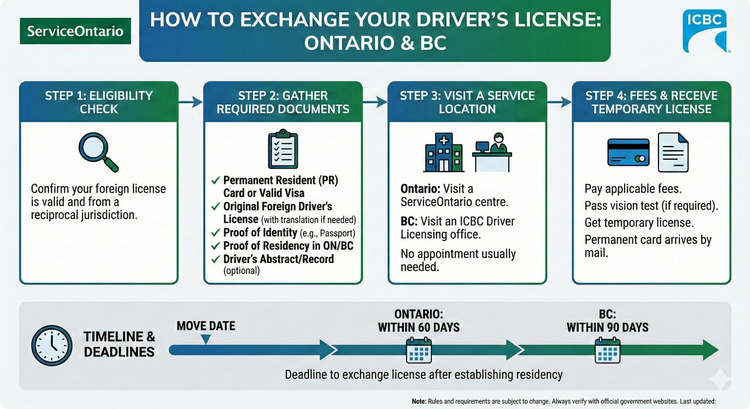
A: A: Yes! In Canada, a valid driver's license is often required even for office jobs. If you haven't switched yours yet, see our guide on How to Exchange Your Driver’s License (Ontario/BC).
About the Author
Jeff Calixte (MC Yow-Z) is a Canadian labour market researcher and digital entrepreneur specializing in government benefit data and cost-of-living support. As the founder of CanadaPaymentDates.ca and BetterPayJobs.ca, Jeff helps newcomers, students, and workers navigate the Canadian social safety net—from tracking CRA payment schedules to finding entry-level work.
Sources
- Ontario Newsroom: Regulations and Statutes in Force as of January 1, 2026
- BetterPayJobs.ca: Canadian Hiring Trends and Salary Benchmarks 2026
- OHRC: Policy on Removing the “Canadian experience” Barrier
- WES Canada: Credential Evaluation for Newcomers
- Indeed Hiring Lab: 2026 Canadian Jobs & Hiring Trends Report
Note
Official 2026 payment dates and benefit amounts are determined by the Canada Revenue Agency (CRA) and provincial governments. While we strive to keep this information current, government policies and schedules are subject to change without notice. All data in this guide is verified against official CRA circulars at the time of publication and should be treated as an estimate. We recommend confirming the status of your personal file directly via CRA My Account or by calling the CRA benefit line at 1-800-387-1193.