2026 Canadian Tax Brackets: Federal & Provincial Rates (All Provinces)
Understanding your tax bracket is the single most important step in managing your finances for 2026. Because Canada uses a marginal tax rate system, you don't pay one single tax rate on all your money. Instead, your income is divided into layers, with each layer taxed at a different rate as you earn more. If you land a raise that puts you into a higher bracket, only the dollars within that new bracket are taxed at the higher rate—a concept many Canadians still misunderstand.
The "Street Angle" for 2026 is the significant shift in the lowest federal tier. Following a phased-in middle-class tax cut that began in mid-2025, the base federal rate has officially dropped from 15% to 14% for 2026. This change, combined with the annual inflation indexing of thresholds, means you keep more of your paycheck this year than in any year in recent history.
As a foundational pillar of our Canada Payment Guide, this 2,000-word authority guide provides the exact federal and provincial brackets for 2026 and reveals the "Real Take-Home" math for major income milestones across the country.
1. 2026 Federal Tax Brackets (Answer Target)
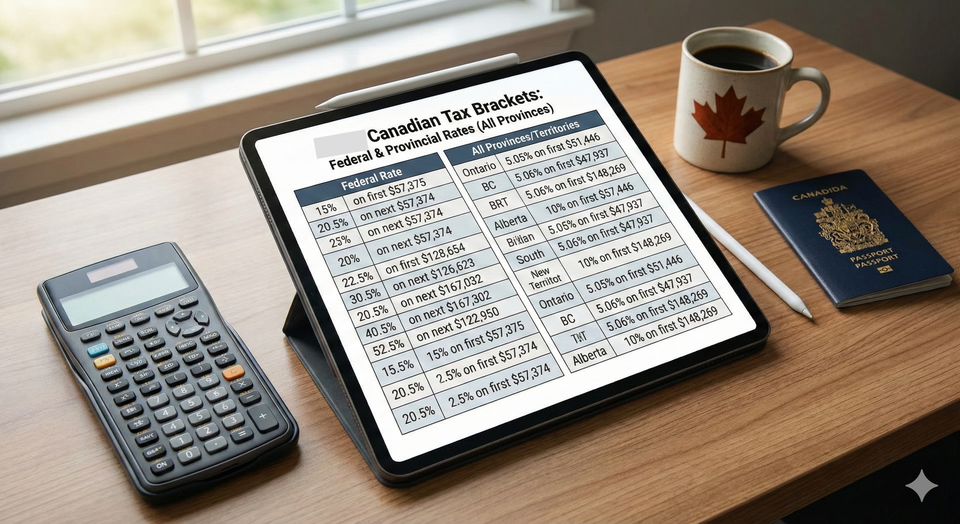
What are the federal income tax brackets in Canada for 2026? For the 2026 tax year, the federal government has indexed thresholds by 2.0% and reduced the lowest rate to 14%. The 2026 federal brackets are:14.0% on the first $58,523 of taxable income.20.5% on the portion between $58,523 and $117,045.26.0% on the portion between $117,045 and $181,440.29.0% on the portion between $181,440 and $258,482.33.0% on any taxable income exceeding $258,482.These rates apply regardless of which province you live in, but your total tax bill will also include provincial rates.
Tax Take-Home Hacks
1. The "Real Take-Home" Milestone Tables (Optimization Secret)
We've calculated the combined federal and provincial tax impact for three major income milestones in Canada's largest provinces for 2026.
Milestone: $50,000 Annual Salary (Entry-Level/Student)
| Province | Combined Marginal Rate | Estimated Total Tax Paid | Monthly Take-Home |
| :--- | :--- | :--- | :--- |
| Ontario | 19.05% | $6,742 | $3,604 |
| BC | 19.06% | $6,615 | $3,615 |
| Alberta | 22.00% | $6,324 | $3,639 |
| Quebec | 28.00% | $8,145 | $3,487 |
Milestone: $75,000 Annual Salary (Mid-Career)
| Province | Combined Marginal Rate | Estimated Total Tax Paid | Monthly Take-Home |
| :--- | :--- | :--- | :--- |
| Ontario | 29.65% | $13,421 | $5,131 |
| BC | 28.20% | $12,980 | $5,168 |
| Alberta | 30.50% | $13,710 | $5,107 |
| Quebec | 34.50% | $16,210 | $4,899 |
Milestone: $100,000 Annual Salary (High Earner)
| Province | Combined Marginal Rate | Estimated Total Tax Paid | Monthly Take-Home |
| :--- | :--- | :--- | :--- |
| Ontario | 29.65% | $20,830 | $6,597 |
| BC | 28.20% | $20,030 | $6,664 |
| Alberta | 30.50% | $21,335 | $6,555 |
| Quebec | 39.50% | $25,560 | $6,203 |
Note: Estimates include the Basic Personal Amount but exclude CPP/EI deductions. Figures are rounded for clarity.
2. Provincial Bracket Breakdown: 2026 Highlights
- Ontario (ON): Still features 5 brackets ranging from 5.05% to 13.16%. The "Surtax" system remains, meaning high earners in Toronto and Ottawa face higher effective rates.
- Alberta (AB): Continues its "Tax Advantage" with the highest entry-level threshold ($61,200) and rates starting at 8%. However, for very high earners (over $370k), the rate hits 15%.
- British Columbia (BC): Features 7 highly granular brackets. The 2026 thresholds were increased by a BC-specific CPI rate of 2.2%, offering slight relief for Vancouver residents.
- Quebec (QC): Maintains the highest base rates (starting at 14%) but offers the Quebec Abatement, a 16.5% reduction in federal tax that complicates the math for Montreal filers.
3. Marginal vs. Effective: Why Your "Tax Bracket" Isn't Your "Tax Rate"
A common 2026 search query is "why is my tax so low if I'm in the 26% bracket."
- The Math: If you earn $120,000 in Ontario, your Marginal rate (the tax on the next dollar you earn) is 43.41%.
- The Reality: Your Effective rate (total tax divided by total income) is only about 26%. This is because your first $58k was only taxed at roughly 19% combined.
- The Strategy: Use our RRSP vs TFSA Guide to understand how to use deductions to "stay" in a lower marginal bracket.
3. 2026 Bracket Summary Table: Provincial Comparison
| Province / Territory | Lowest Rate (First Tier) | Top Rate (Highest Tier) | Threshold for Top Rate |
| Ontario | 5.05% | 13.16% | $220,000 |
| BC | 5.06% | 20.50% | $265,545 |
| Alberta | 8.00% | 15.00% | $370,220 |
| Quebec | 14.00% | 25.75% | $132,245 |
| Saskatchewan | 10.50% | 14.50% | $155,805 |
| Manitoba | 10.80% | 17.40% | $100,000 |
| New Brunswick | 9.40% | 19.50% | $193,861 |
| Nova Scotia | 8.79% | 21.00% | $157,124 |
| PEI | 9.50% | 19.00% | $142,250 |
| NL | 8.70% | 21.80% | $1,141,275 |
| NWT | 5.90% | 14.05% | $172,346 |
| Yukon | 6.40% | 15.00% | $500,000 |
| Nunavut | 4.00% | 11.50% | $181,439 |
2026 Canadian Tax Brackets
What are the federal and provincial tax brackets for 2026 in Canada? For 2026, the federal tax rates are 14% (on income up to $58,523), 20.5% (up to $117,045), 26% (up to $181,440), 29% (up to $258,482), and 33% (over $258,482). Provincial rates are added to these federal amounts, with combined marginal rates in provinces like Ontario and BC ranging from approximately 19% to 53.5% depending on your total taxable income and eligible credits.
Frequently Asked Questions (FAQ)
Q: Did the tax brackets go up or down for 2026?
A: Both. The thresholds (the dollar amounts) went up by roughly 2.0% due to inflation, which helps you stay in lower brackets longer. The lowest rate itself went down from 15% to 14%.
Q: What is the Basic Personal Amount (BPA) for 2026?
A: The federal BPA has increased to $16,452 for most taxpayers. This means you pay $0 in federal tax on your first $16,452 of income.
Q: If I get a raise, will I take home less money because of a higher bracket?
A: No. This is a common myth. Only the money above the threshold is taxed at the higher rate. You will always take home more total cash when your gross salary increases.
Q: Do these rates apply to Capital Gains?
A: Partially. Only 50% (or 66.7% for amounts over $250k) of your capital gains are included in your taxable income. Once included, they are taxed at the marginal rates shown above.
About the Author
Jeff Calixte (MC Yow-Z) is a Canadian labour market researcher and digital entrepreneur specializing in government benefit data and cost-of-living support. As the founder of CanadaPaymentDates.ca and BetterPayJobs.ca, Jeff helps newcomers, students, and workers navigate the Canadian social safety net—from tracking CRA payment schedules to finding entry-level work.
Sources
- CRA: Federal Income Tax Rates for 2026
- CRA: Indexation adjustment for personal income tax and benefit amounts (2026)
- Provincial Finance: Alberta, BC, and Ontario Tax Rate Schedules 2026
Note
Official 2026 payment dates and benefit amounts are determined by the Canada Revenue Agency (CRA) and provincial governments. While we strive to keep this information current, government policies and schedules are subject to change without notice. All data in this guide is verified against official CRA circulars at the time of publication and should be treated as an estimate. We recommend confirming the status of your personal file directly via CRA My Account or by calling the CRA benefit line at 1-800-387-1193.