
Capital Loss Carryover 2026: How to Offset Your Stock Losses
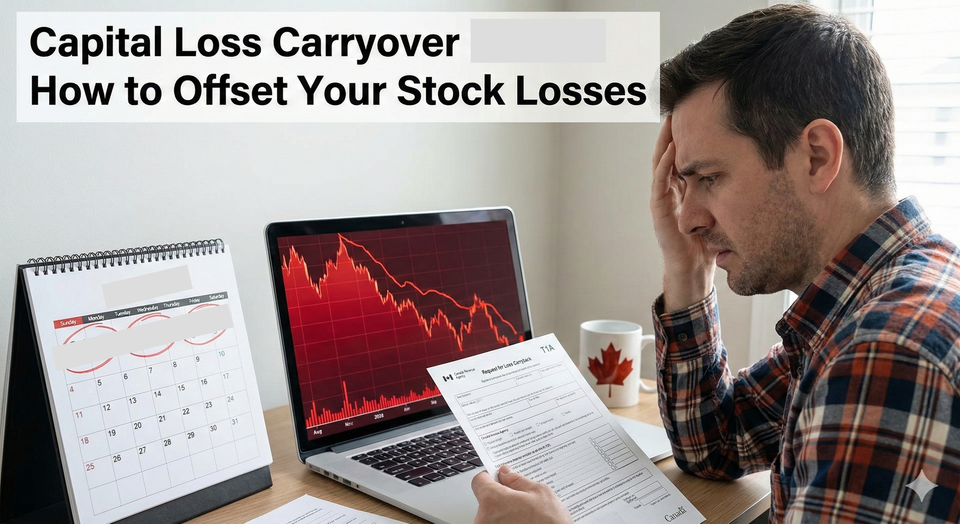
No one likes losing money in the stock market. But in Canada, a loss is not just a loss—it is a powerful tax asset.
If you sold stocks, crypto, or real estate (other than your home) for less than you paid, you have generated a Capital Loss. Most Canadians simply "bank" these losses to use in the future.
But what if you paid a huge tax bill on capital gains last year? Or the year before?
This is where the "3-Year Back Rule" comes in. Instead of waiting for future profits, you can use your 2026 losses to essentially "travel back in time" and get a refund on taxes you already paid in 2023, 2024, or 2025.
This is the Official 2026 Capital Loss Carryover Guide. We explain exactly how to fill out Form T1A, the strict "Superficial Loss" rule that can ruin your claim, and the math behind getting a retroactive refund.
1. The "3-Year Back" Rule: Time Travel for Your Taxes
Why wait for a refund when you can get it now?
When you file your 2026 taxes (in Spring 2027), you have three choices for your Net Capital Losses:
- Current Year: Offset any capital gains you made in 2026 (Automatic).
- Carry Forward: Save the loss to offset gains in 2027, 2028, or essentially forever (Indefinitely).
- Carry Back: Apply the loss to 2023, 2024, or 2025 to recover taxes paid in those years.
The "Refund Math" (Example)
- 2024 Context: You had a great year. You made $10,000 in capital gains and paid roughly **$1,500** in tax on it.
- 2026 Reality: The market crashed. You sold stocks at a $10,000 loss.
- The Strategy: You file Form T1A with your 2026 return. You ask the CRA to apply your 2026 loss to your 2024 gains.
- The Result: The CRA recalculates your 2024 income as if that $10,000 gain never happened. They send you a cheque for the **$1,500** tax you paid back then.
Street Tip: Always carry back to the oldest year first (2023), because that year is about to "expire" from the 3-year window. Once 2026 ends, the chance to reclaim 2023 taxes is gone forever.
2. How to File: Form T1A (Request for Loss Carryback)
You do not need to amend your old tax returns.
Many people think they have to "Refile" their 2023 taxes to do this. You do not.
You simply file one extra form with your current 2026 tax return.
Step-by-Step:
- Download Form T1A: It is called "Request for Loss Carryback."
- Section 1 (2026 Loss): Enter the Net Capital Loss amount from your 2026 Notice of Assessment.
- Section 2 (Carryback Amount): Choose which year you want to apply it to.
- Line 66250: Amount for 2023.
- Line 66260: Amount for 2024.
- Line 66270: Amount for 2025.
- Submit: Send this form electronically via Netfile or mail it with your 2026 T1 General.
Note: The refund for the previous years will come separately from your 2026 refund. It usually takes the CRA an extra 4-8 weeks to process a T1A request.
3. The "Superficial Loss" Trap (The 30-Day Rule)
Don't try to outsmart the system.
The CRA has a strict rule to prevent "fake" losses. It is called the Superficial Loss Rule.
If you sell a stock at a loss and buy it back immediately just to trigger the tax deduction, your loss is denied.
The Rule: Your capital loss is zero if:
- You (or your spouse/partner) buy the same or identical property (e.g., selling Apple stock and buying Apple stock).
- This purchase happens within 30 days before OR 30 days after the sale.
- You still hold that stock 30 days after the sale.
How to Avoid It:
- Wait 31 Days: Sell the stock, wait 31 days, then buy it back.
- Buy a Substitute: Sell "ETF A" (e.g., S&P 500) and buy "ETF B" (e.g., Total World Stock). They are similar but not "identical."
- Check Your Spouse: Ensure your spouse doesn't buy the same stock in their account during the 30-day window.
4. Capital Losses vs. Income (The Restriction)
You cannot use this to lower your salary tax.
This is the most common misunderstanding.
- Capital Losses can ONLY offset Capital Gains.
- They cannot be used to reduce tax on your employment income, interest income, or dividends.
The Exception (Death):
In the year of death (and the year before), Special Rules apply. If you pass away, your executor can use your Net Capital Losses to offset any type of income on your Final Return.
5. Crypto & Real Estate: Do They Count?
- Crypto: Yes. If you sold Bitcoin or Ethereum at a loss, it is a Capital Loss (unless you are a professional day trader, in which case it is a Business Loss).
- Real Estate: Yes, BUT only for investment properties (rental condos, cottages).
- Your Home: No. You cannot claim a capital loss on your Principal Residence. If you sell your home for less than you bought it, that loss is personal and tax-free (meaning no deduction).
Frequently Asked Questions (FAQ)
Q: Can I carry back losses to 2022?
A: No. In 2026, the 3-year window covers 2025, 2024, and 2023. The 2022 tax year is now out of reach for carrybacks.
Q: Does carrying back a loss affect my GST/CCB payments from those years?
A: No. Carrying back a loss reduces your Taxable Income for that year (generating a tax refund), but it does not change your Net Income. Since benefits like the Canada Child Benefit (CCB) are based on Net Income, your past benefit payments will not change.
Q: Do I need a lawyer to file Form T1A?
A: No. Most tax software (Wealthsimple Tax, TurboTax) will ask you: "Do you want to carry back losses?" If you say yes, the software generates and files Form T1A for you automatically.
About the Author
Jeff Calixte (MC Yow-Z) is a Canadian labour market researcher and digital entrepreneur specializing in government benefit data and cost-of-living support. As the founder of CanadaPaymentDates.ca and BetterPayJobs.ca, Jeff helps newcomers, students, and workers navigate the Canadian social safety net—from tracking CRA payment schedules to identifying entry-level employment opportunities.
Sources
- Canada Revenue Agency: Capital Losses and Deductions
- CRA: Line 25300 – Net capital losses of other years
- TurboTax Canada: Carrying Capital Losses Backward or Forward
Note
Official 2026 tax forms and carryover rules are determined by the Canada Revenue Agency (CRA). While we strive to keep this information current, government policies are subject to change without notice. All data in this guide is verified against official CRA circulars at the time of publication. We recommend confirming the status of your personal file directly via CRA My Account or by calling the CRA benefit line at 1-800-959-8281.