CDB Clawback List: Will My ODSP/AISH Be Reduced by the Canada Disability Benefit?
For the 600,000 Canadians expecting the new Canada Disability Benefit (CDB), there is one burning question that matters more than the payment date:
"Will the government give me $200 with one hand, and take it away with the other?"
This is called a "Clawback."
Historically, when the federal government gives more money (like CPP-Disability), provincial welfare programs (like ODSP or AISH) reduce your monthly cheque dollar-for-dollar. If that happens, you are no better off.
This is the Official 2026 CDB Clawback List, verified against provincial memos and legislative announcements as of January 2026. We break down the "Safe Zones" (Exempt), the "Danger Zones" (Clawbacks), and the specific rules for complex cases like housing subsidies.
Need the Payment Dates?
If you already know you are safe, check the Official 2026 CDB Payment Schedule to see when the money lands.
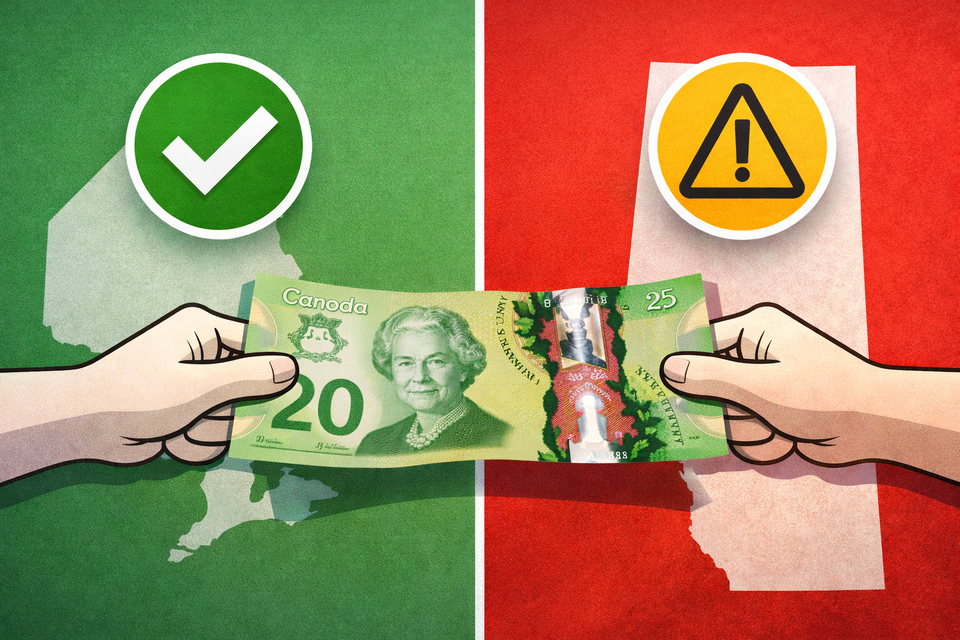
The National Snapshot (2026 Map)
Save this list. It determines if you actually get to keep the money.
| Province / Territory | Status | Program Name |
| Ontario | ✅ EXEMPT | ODSP & Ontario Works |
| British Columbia | ✅ EXEMPT | PWD & Income Assistance |
| Saskatchewan | ✅ EXEMPT | SAID & SIS |
| Manitoba | ✅ EXEMPT | MSPD & EIA |
| Nova Scotia | ✅ EXEMPT | DSP & Income Assistance |
| New Brunswick | ✅ EXEMPT | Social Assistance |
| Newfoundland | ✅ EXEMPT | Income Support |
| Prince Edward Island | ✅ EXEMPT | AccessAbility Support |
| Quebec | ✅ EXEMPT | Social Solidarity |
| Yukon / NWT / Nunavut | ✅ EXEMPT | Income Assistance |
| Alberta | ⚠️ CLAWBACK | AISH & Income Support |
Quick Answers: Common Clawback Questions
Will ODSP claw back the Canada Disability Benefit?
No. The Government of Ontario has officially confirmed that the Canada Disability Benefit (CDB) is fully exempt as income for the Ontario Disability Support Program (ODSP) and Ontario Works (OW). Your provincial benefits will not be reduced when you receive the federal payment.
Is the Canada Disability Benefit exempt from AISH?
Currently, No. As of January 2026, the Government of Alberta has stated that the Canada Disability Benefit is considered "unearned income" and may be deducted dollar-for-dollar from AISH (Assured Income for the Severely Handicapped) payments. However, a new program called "ADAP" launching in July 2026 may change these rules.
Does the Canada Disability Benefit affect my rent-geared-to-income?
In most provinces (including Ontario and BC), the Canada Disability Benefit is excluded from Rent-Geared-to-Income (RGI) calculations. This means your subsidized housing rent should not increase. However, you must still declare the income to your housing provider and show proof that it is exempt.
- Can I Get EI if I Quit? (Just Cause Checklist)
- TFSA vs. RRSP for Low Income (The GIS Trap)
- Shared Custody CCB Rules (50/50 Split Guide)
- Warm Neighbor Programs (Heating Bill Help)
Zone 1: The "Safe" Provinces (Exempt)
If you live here, you keep 100% of the money. You get your full provincial cheque PLUS the $200 federal cheque.
Ontario (ODSP & OW)
Ontario was one of the first to confirm safety.
- The Rule: The CDB is listed as "Exempt Income" in the ODSP directives.
- The Math:
- ODSP Cheque: $1,308 (Single)
- CDB Cheque: $200
- Total: $1,508 (You keep it all).
- Trillium Benefit: The CDB also does not lower your Ontario Trillium Benefit.
British Columbia (PWD)
BC has legally exempted the benefit.
- The Rule: The Ministry of Social Development and Poverty Reduction has amended the Employment and Assistance Regulation to exclude the CDB.
- Hardship Assistance: Even if you are on temporary "Hardship Assistance," the CDB is safe.
Saskatchewan (SAID)
Saskatchewan confirmed the exemption to protect SAID recipients.
- The Rule: The CDB is excluded from the "excess income" calculation.
- Warning: While SAID is safe, be careful with the Rental Housing Supplement. Always report the income, even if it is exempt, to avoid audit issues.
Manitoba, Nova Scotia & Atlantic Canada
All four Atlantic provinces and Manitoba have joined the "No Clawback" coalition.
- Newfoundland Bonus: Not only is it exempt, but Newfoundland has launched its own separate disability top-up that stacks on top of the federal one.
Zone 2: The "Danger" Zone (Alberta)
Alberta is currently the only province taking a hard line. This situation is evolving rapidly.
Alberta (AISH & Income Support)
The Alberta government views the CDB as a direct replacement for provincial support, not a top-up.
- The Current Rule: AISH deducts "unearned income" dollar-for-dollar.
- The Impact:
- AISH Cheque: $1,863
- CDB Cheque: $200
- Clawback: AISH reduces your cheque by $200.
- Total: $1,863 (You are no better off).
- The "Mandatory" Trap: Alberta legislation requires AISH recipients to "pursue all other financial resources." This means you MUST apply for the CDB if you are eligible. If you refuse to apply (to avoid the paperwork), AISH can cut you off completely.
Street Reality: The "ADAP" Change (July 2026)
Alberta is launching a new system in July 2026 called the Alberta Disability Assistance Program (ADAP).Rumors suggest ADAP might allow partial exemptions for federal benefits, but this is unconfirmed.Advice: Do not spend the CDB money immediately if you are on AISH. Set it aside in a savings account until you receive your AISH statement confirming if they deducted it.
Zone 3: The "Hidden" Clawbacks (Insurance & LTD)
Even if your province is safe, private companies might not be.
Long-Term Disability (LTD) Insurance
If you receive private disability payments from an insurance company (like Sun Life, Manulife, or Great-West Life) through a work policy:
- The Danger: Most private insurance contracts have an "All Source Offset" clause.
- The Meaning: If you get money from any government source (CPP or CDB), the insurance company reduces their payment to you by the same amount.
- The Result: The insurance company saves money; you get nothing extra.
- Action: Check your policy handbook for the definition of "Other Income."
Veterans Affairs (VAC)
If you receive the Income Replacement Benefit (IRB) from Veterans Affairs:
- Status: Likely Clawback.
- VAC usually offsets other federal benefits. However, advocacy groups are currently fighting to have the CDB exempted for veterans.
Does It Affect Other Federal Benefits?
Good news: Federal benefits generally play nice with each other.
- Guaranteed Income Supplement (GIS):
- Status: Safe.
- The CDB is not taxable income, so it does not increase your "Net Income" line on your taxes. Since GIS is based on Net Income, your GIS cheque will not shrink.
- Canada Child Benefit (CCB):
- Status: Safe.
- The CDB does not affect your CCB calculation.
- GST/HST Credit:
- Status: Safe.
- You will still get your full quarterly GST Credit.
Street Reality: Rent-Geared-to-Income (RGI)
If you live in subsidized housing (TCHC, BC Housing, etc.), your rent is usually 30% of your income.
The Question: Does the $200 CDB count as income?
The Answer: In most "Safe" provinces (ON, BC, MB), the answer is NO.
- The Ministry of Housing usually follows the social assistance rules. If ODSP says it isn't income, Housing says it isn't income.
The Warning:
You typically have to report changes in income to your landlord within 30 days.
- Do this: Send a letter saying: "I have begun receiving the Canada Disability Benefit of $200/month. This is an exempt federal benefit under the Social Assistance Act."
- Do NOT: Hide it. If you hide it and they find out later, they could try to evict you for "failure to disclose," even if the money was exempt.
Detailed Guide: Asset Limits, Housing & Spousal Rules
Even if your province (like Ontario or BC) promises not to claw back your monthly cheque, there are three hidden traps that can still disqualify you. Here is the "Street Reality" on how to protect your benefits from asset limits, housing managers, and spousal income rules.
The "Asset Limit" Trap: Can You Save the Money?
This is the most dangerous trap for people on ODSP (Ontario) or Income Assistance (BC).
- The Rule: While the CDB income is exempt, the money you save counts as an "Asset."
- The Danger: If you save your $200/month CDB payments for a few years, your bank account might grow too large. If you cross the "Asset Limit," your provincial benefits will be cut off completely.
2026 Asset Limits (Verify Your Province):
- Ontario (ODSP): Limit is $40,000 (Single) or $50,000 (Couple).
- Alberta (AISH): Limit is $100,000 (plus home/vehicle).
- BC (PWD): Limit is $100,000 (Single).
- Nova Scotia / Atlantic: Limits can be as low as $1,000 to $2,000. Be extremely careful here.
The Solution: Move Money to an RDSP
If you are approaching your asset limit, do not keep the CDB money in your chequing account.
- Strategy: Open a Registered Disability Savings Plan (RDSP).
- Why: In almost every province (including Ontario, BC, and Alberta), money inside an RDSP is 100% Exempt. It does not count towards your asset limit. You can save up to $200,000 in there without losing a cent of your provincial benefits.
Subsidized Housing: The "Declaration" Letter
If you live in Rent-Geared-to-Income (RGI) housing (like TCHC in Toronto or BC Housing), you know the rule: Rent is 30% of your income.
Does the CDB raise your rent?
- In "Safe" Provinces (ON, BC, MB): No. Housing providers generally follow provincial social assistance rules. Since ODSP says it is exempt, housing providers treat it as exempt.
- The Trap: You MUST still report it. If you hide the income, they can evict you for "Misrepresentation," even if the money was exempt.
Copy/Paste this Letter for your Annual Review:
"To Property Management:
I am writing to update my income file. As of [Date], I have begun receiving the federal Canada Disability Benefit (CDB) of $200.00/month.
Please note that under current provincial regulations, this benefit is classified as 'Exempt Income' for the purposes of social assistance and RGI calculations. It should not result in a rent increase. I have attached my Notice of Determination as proof.
Sincerely, [Your Name]"
The "Spouse" Problem: Will My Partner's Job Ruin It?
The Canada Disability Benefit is calculated based on Family Net Income, not just your income. This is a major frustration for many applicants.
The 2026 "Cutoff" Numbers:
If your spouse works, their income could reduce your benefit to $0.
- The Threshold: If you are a couple, the CDB starts to shrink once your combined family income crosses approx. $32,500.
- The Phase-Out: If your combined family income is over approx. $45,000 - $58,000 (depending on working income), you will likely receive $0 from the CDB.
Street Reality: This is stricter than ODSP/AISH limits.
Many people qualify for provincial disability (because their spouse earns $50k), but they will fail to get the federal CDB because the federal cutoff is much lower.
Note: You do not lose your provincial benefits if you are denied the federal one. They are separate applications.
The "Medical Review" Fear
Many people are afraid to apply for the CDB because they think it will cause the government to "re-open" their medical file and cut them off.
The Truth:
- Federal (CRA): Applying for the CDB does require a valid Disability Tax Credit (DTC). If your DTC is expired, you will need a new medical form from your doctor.
- Provincial (ODSP/AISH): Applying for the federal benefit does not trigger a provincial medical review. The two computer systems do not "talk" to each other in that way. Your caseworker will not suddenly question your disability just because you applied for federal money.
Bottom Line:
If you already have a valid, non-expired DTC (T2201) on file with the CRA, the CDB application is purely financial. No doctor is involved.
Is It Retroactive? (The "Big Cheque" Warning)
If you are approved late, you might get a retroactive lump sum (e.g., $1,000 for 5 months of back pay).
- Spending Rule: In provinces with low asset limits (like Nova Scotia or New Brunswick), receiving a $1,000 lump sum can push you over your limit for that specific month.
- Strategy: Spend the lump sum on "necessary" items (rent arrears, dental work, kids' clothes) or move it to an RDSP within 30 days to keep your assets low.
Need to check your status?
See the Official CDB Payment Schedule to know when the next deposit cycle begins.
What If I Am Denied? (The Appeal Process)
If your province (Alberta) or your insurance company claws back your money, you have rights.
- Request an Internal Review: Write to your caseworker immediately. Ask for the specific regulation number they are using to justify the deduction.
- Contact Your MPP/MLA: Provincial politicians are very sensitive to this issue right now. If AISH is clawing back your money, call your MLA's office. They can sometimes flag your file as "Hardship."
- Keep the Money: If you receive an "Overpayment" letter saying you owe money back because of the CDB, do not pay it immediately. File an appeal. Often, these letters are automated errors that get overturned by a human.
Need More Income?
If the $200 CDB is being clawed back or simply isn't enough, you may need to look for permissible work opportunities (ODSP allows you to earn $1,000/month without penalty).
👉 Find Daily Pay Jobs at BetterPayJobs.ca
About the Author
Jeff Calixte (MC Yow-Z) is a Canadian labour market researcher and digital entrepreneur specializing in government benefit data and cost-of-living support. As the founder of CanadaPaymentDates.ca and BetterPayJobs.ca, Jeff helps newcomers, students, and workers navigate the Canadian social safety net—from tracking CRA payment schedules to finding entry-level work.
Sources
- Government of Ontario: ODSP Income Exemptions Directive
- Government of British Columbia: Disability Assistance Rate Table
- Disability Without Poverty: Provincial Clawback Watchlist
Note
Social assistance payment dates and benefit rates are determined by your provincial Ministry of Social Services (e.g., MCCSS in Ontario, Seniors and Housing in Alberta). These benefits are not managed by the CRA. All dates in this guide are verified against official provincial schedules. We recommend confirming the status of your file directly with your caseworker or via your provincial online portal (e.g., MyBenefits, My Alberta Supports).