
Consumer Proposal vs. Bankruptcy: Which One Lets You Keep Your Car?
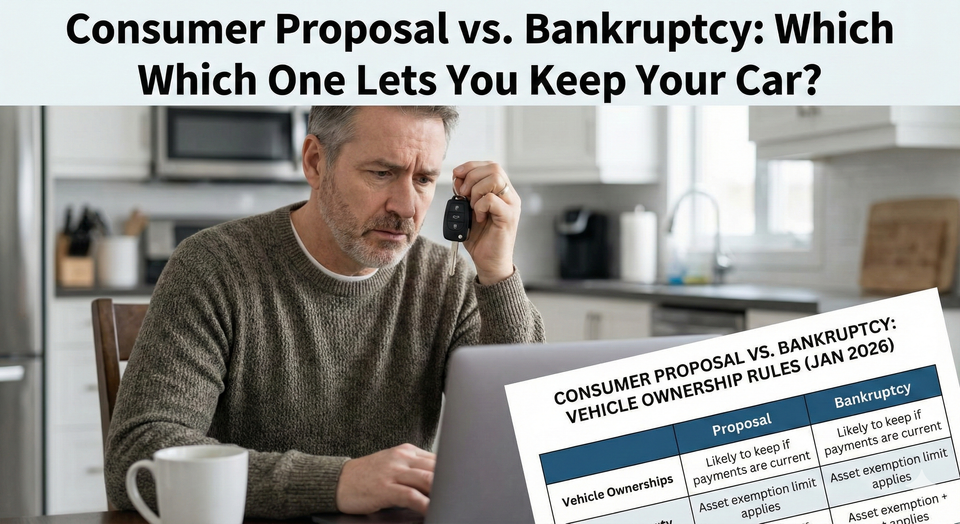
For many Canadians, a vehicle is not a luxury—it is a lifeline. Whether you’re commuting to a job in the GTA, driving kids to school in Calgary, or navigating winter in rural Nova Scotia, losing your car is often the biggest fear when considering debt relief. As we enter 2026, the question "Consumer Proposal vs. Bankruptcy" has become a high-stakes decision for thousands of households.
The short answer is that yes, you can usually keep your car in both scenarios, but the rules are very different. While a consumer proposal allows you to keep almost any asset as long as you pay your creditors a fair settlement, bankruptcy involves rigid provincial "Exemption Limits." If your car is worth too much, a bankruptcy trustee might be legally required to seize it.
As part of our Debt & Credit Series, this guide breaks down the 2026 provincial car exemptions, explains the "Equity Math," and reveals the strategies to protect your vehicle even if it's worth more than the legal limit.
1. The Core Difference: Assets vs. Payments
To understand which path is better for your car, you must understand how each process treats "Stuff."
The Consumer Proposal (The "Asset Shield")
In a consumer proposal, you make a deal to pay back a portion of your debt over five years.
- The Rule: You keep all your assets. The value of your car is used to determine how much you should offer your creditors, but the car itself is never seized.
- The Condition: If you have a car loan (secured debt), you must continue making those payments. A consumer proposal only settles unsecured debt like credit cards and tax bills.
Bankruptcy (The "Equity Test")
In bankruptcy, you "surrender" your non-exempt assets in exchange for the total elimination of your debt.
- The Rule: Each province has an "Exemption Limit." If your car's equity is below this limit, you keep it.
- The Risk: If you own a $20,000 car with no loan in Ontario (where the limit is $7,117), you may have to pay the $12,883 difference to the trustee or lose the car.
2. 2026 Provincial Car Exemption Table
If you file for bankruptcy in 2026, these are the maximum "Equity" amounts you are allowed to keep in one motor vehicle.
| Province / Territory | 2026 Exemption Limit | Key Condition |
| Ontario | $7,117 | Includes cars, trucks, and motorcycles. |
| British Columbia | $5,000 | Drops to $2,000 if behind on child support. |
| Alberta | $5,000 | Must be your primary vehicle. |
| Nova Scotia | $6,500 | For one vehicle only. |
| New Brunswick | $6,500 | If needed for employment. |
| Quebec | No Fixed Cap | Must be required for work or health. |
| NWT / Yukon | $6,000 | For one vehicle used for work. |
The Equity Formula:
$$Equity = Fair Market Value - Balance Owing on Loan$$
If your equity is $0 (or "underwater"), your car is 100% safe in both a consumer proposal and bankruptcy because the trustee has no interest in a car that has no resale value for creditors.
Vehicle Protection Hacks
This deep dive identifies the specific "Street Angles" that Licensed Insolvency Trustees (LITs) use to help clients stay on the road.
1. The Buy-Back Hack (Bankruptcy Only)
How to buy back car from bankruptcy trustee.
- The Street Angle: You have a $10,000 car in BC, where the limit is $5,000. You owe the trustee $5,000 to keep it.
- The Hack: You don't have to pay the $5,000 upfront.
- The Strategy: Most trustees will allow you to "buy back" the equity over the 9 to 21 months of your bankruptcy.
- The Move: If your bankruptcy lasts 9 months, you pay an extra $555 per month to the trustee. If that’s too high, you should switch to a Consumer Proposal, where you can spread that $5,000 payment over 60 months ($83/month).
2. The Right of Offset Bank Account Hack
Many people search for "can the bank take my car if I file for debt relief."
- The Trap: If your car loan is with RBC, and you also have an RBC credit card that you are including in your proposal, the bank might try to "offset" your payments.
- The Hack: Move your daily banking to a different institution before you file.
- The Strategy: Keeping your car loan at Bank A and your daily spending at Bank B prevents the bank from freezing your "Car Payment Money" to cover your "Credit Card Debt."
3. The Voluntary Surrender Reset
A common search in 2026 is "voluntary repossession vs consumer proposal."
- The Street Angle: You have a car loan with a 24% interest rate and $10,000 in "Negative Equity" (you owe more than it's worth).
- The Hack: Surrender the car before you file the proposal.
- The Move: When the lender sells the car at auction and sends you a bill for the "Shortfall" (the difference), that shortfall is unsecured debt.
- The Payoff: You can include that $10,000 shortfall in your proposal, paying it off at 20 cents on the dollar, and then go buy a cheaper, more reliable used car with cash or a lower-interest loan.
4. Financing a Car During a Proposal
Users often ask: "Can I get a car loan while in a consumer proposal?"
- The Reality: Yes.
- The 2026 Hack: Specialized lenders (like Peel Chrysler or Loans Canada) focus on "In-Proposal" financing.
- The Strategy: Because your other debts are frozen, these lenders see you as having more cash flow than you did before.
- The Move: If your current car dies during your proposal, you can get a new loan, but expect interest rates between 15% and 25%. Use this for 12 months, make every payment on time, and then refinance at a lower rate once your credit score begins to climb.
5. The "Tools of the Trade" Double-Up
A rising search in 2026 is "can I have two cars in bankruptcy."
- The Hack: Normally, you only get one vehicle exemption.
- The Exception: If you are a tradesperson, delivery driver, or salesperson, a second vehicle (like a work van) might qualify under the "Tools of the Trade" exemption.
- The Limit: In Ontario, this is an additional $14,405. Stacking the $7,117 car exemption and the $14,405 tool exemption allows you to protect over **$21,000** in vehicle equity.
4. Summary: Which Should You Choose?
| Feature | Consumer Proposal | Bankruptcy |
| Keep Car? | Always (if you pay the loan). | Maybe (depends on equity). |
| Multiple Cars? | Yes. | No (unless for work). |
| Impact on Loan? | No change to terms. | No change to terms. |
| Surrender Option? | Yes, shortfall is included. | Yes, shortfall is discharged. |
| Best for... | New cars with equity. | Old cars with low value. |
Keep Car Consumer Proposal
Can I keep my car if I file a consumer proposal in Canada? Yes. In a consumer proposal, you maintain ownership of all your assets, including your car, regardless of its value. You must continue making your regular car loan or lease payments to the secured lender to avoid repossession. If you choose bankruptcy instead, you can only keep your car if the equity is below provincial limits, such as $7,117 in Ontario or $5,000 in Alberta and BC.
Frequently Asked Questions (FAQ)
Q: Can I lower my car payments in a consumer proposal?
A: No. The proposal only affects unsecured debt. To lower car payments, you must negotiate directly with the lender or surrender the vehicle and include the shortfall in the proposal.
Q: Does a consumer proposal hurt my credit score?
A: Yes. It results in an R7 rating for the duration of the proposal plus 3 years (or 6 years total). However, it is less damaging than a bankruptcy (R9).
Q: What if my car is leased?
A: Leasing is the same as financing: keep making the monthly payments and you keep the car. If you can't afford the lease, you can "Break" the lease as part of the filing.
Q: My car is worth $15,000 and I have no loan. Is it safe?
A: In a Consumer Proposal, yes. In a Bankruptcy, no—the trustee will want the "Non-Exempt" portion (approx. $8,000 in Ontario) to pay your creditors.
About the Author
Jeff Calixte (MC Yow-Z) is a Canadian labour market researcher and digital entrepreneur specializing in government benefit data and cost-of-living support. As the founder of CanadaPaymentDates.ca and BetterPayJobs.ca, Jeff helps newcomers, students, and workers navigate the Canadian social safety net—from tracking CRA payment schedules to finding entry-level work.
Sources
- Office of the Superintendent of Bankruptcy (OSB): Consumer Proposals vs Bankruptcy - Official Guide
- Ontario.ca: Execution Act - Exemptions for Motor Vehicles 2026
- Hoyes Michalos: What Happens to My Car in a Consumer Proposal?
Note
Credit score algorithms (Equifax/TransUnion) and lending criteria are determined by private financial institutions and are subject to change without notice. This guide is for informational purposes only and does not constitute professional financial advice. If you are facing insolvency or legal action regarding debt, we recommend consulting with a Licensed Insolvency Trustee (LIT) or a non-profit credit counsellor.