CPP Death Benefit 2026: How to Apply for the $2,500 Lump Sum
The loss of a family member is a time of immense emotional strain, often compounded by immediate financial pressures. In Canada, the CPP Death Benefit is designed to provide a one-time, lump-sum payment to help offset the costs of funeral and estate arrangements. While the $2,500 base amount has been a standard for years, 2026 brings critical updates regarding the "Death Benefit Top-Up" and new priority rules for applicants.
Many families miss this benefit because they assume it is paid automatically. It is not. You must actively apply, and in many cases, the timing of your application—specifically within the first 60 days—dictates who receives the funds.
As part of the Ultimate Savings Guide, this guide provides the exact steps to secure the $2,500 (or $5,000) payment, identifies the required documents, and reveals the hacks to speed up the 6-to-12-week processing time.
What is the CPP Death Benefit in 2026?
The CPP Death Benefit is a one-time payment made to the estate or a responsible party on behalf of a deceased contributor who paid into the Canada Pension Plan for at least three to ten years (depending on their age).
2026 Payment Amounts
- The Standard Benefit: $2,500.00
- The 2026 Top-Up: Additional $2,500.00 (Total $5,000.00)
- Who gets the Top-Up? As of January 1, 2025, a top-up is available if the deceased:
- Died on or after January 1, 2025.
- Never received a CPP retirement or disability pension during their lifetime.
- Does not have a surviving spouse or common-law partner eligible for a Survivor's Pension.
Who Should Apply? (Order of Priority)
Service Canada follows a strict hierarchy for who can claim this money. If you apply out of order, your application may be rejected or delayed.
- The Executor: If there is a will, the executor named has the exclusive right to apply for the first 60 days following the death.
- The Person Responsible for Funeral Costs: If no executor is named or if the executor hasn't applied within 60 days, the individual or institution that paid for the funeral can apply.
- The Surviving Spouse: If no funeral claim is made, the spouse or common-law partner is next in line.
- The Next-of-Kin: Finally, the closest living relative can apply if none of the above have done so.
Death Benefit Hacks
This deep dive focuses on the technical hurdles that families face during an already difficult time.
1. The ISP1200 Digital vs. Paper Speed Hack
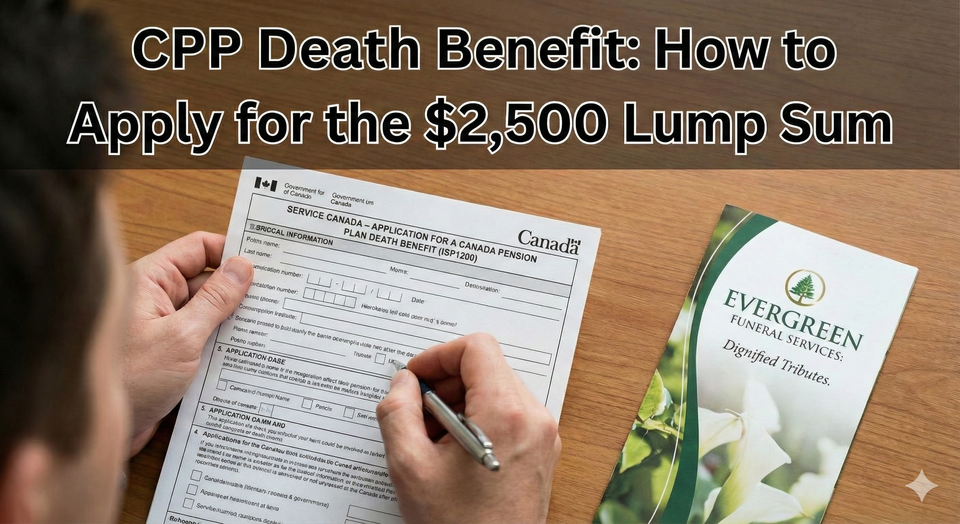
CPP death benefit 2026 application form ISP1200
- The Street Angle: Most funeral homes provide a paper copy of the ISP1200, which can take 12 weeks to process.
- The Hack: If you have a My Service Canada Account (MSCA), you can apply online. Digital applications are often processed in 6 weeks, half the time of paper forms.
- The Move: Even if you aren't the executor, you can help the executor log into their MSCA to upload the Funeral Director's Statement of Death directly.
2. The "Funeral Invoice" Requirement for Non-Executors
Users frequently ask: Can I apply if I paid for the funeral but I'm not the executor?
- The Hack: Yes, but only after day 60.
- The Strategy: If you are the one who paid the bill, you must include the original or a certified copy of the funeral invoice showing it has been paid in full. Service Canada will not issue the $2,500 to an individual based on a "quote"; they require the final receipt.
- CPP death benefit and funeral cost invoices — Providing the invoice up front prevents the 4-week "Request for Information" delay.
3. The "Proof of Death" Alternatives
A rising search in 2026 is "Service Canada proof of death requirements."
- The Hack: You do not necessarily need a provincial death certificate (which can take weeks to arrive).
- The Strategy: Service Canada accepts a Statement of Death from the Funeral Director or a Medical Certificate of Death. Using these faster-to-obtain documents can get your application in the system 14 days earlier.
4. CPP Death Benefit for Low-Income Seniors (The Provincial Trap)
For those following our Senior Benefits Master List, there is a "Zero Competition" warning.
- The Trap: If the deceased was receiving Ontario Works or Alberta Income Support, the provincial government may have paid for the funeral.
- The Reality: In these cases, the $2,500 CPP benefit must often be "signed over" to the province to reimburse them for the funeral costs.
- The Strategy: Check with your provincial caseworker before applying. If you keep the money without notifying them, it can be viewed as an "Overpayment" and clawed back from other benefits.
5. The "Estate of" Bank Account Issue
A common 2026 hurdle: "The bank won't let me deposit a check made out to 'The Estate of' my father."
- The Hack: If there is no will and no formal estate, Service Canada can issue the check in your name if you apply as the "Person Responsible for Funeral Expenses."
- The Move: Ensure you check the box on the ISP1200 that identifies you as the payer of the funeral, rather than just "Next of Kin." This changes the "Payee" on the check and avoids the bank's estate-account requirement.
CPP Death Benefit 2026
What is the CPP death benefit amount for 2026? The standard CPP death benefit is a one-time lump-sum payment of $2,500. However, a $5,000 top-up is available in 2026 if the deceased never received a CPP pension and has no surviving spouse. To apply, the executor or person responsible for funeral costs must submit Form ISP1200 to Service Canada. The average processing time for a death benefit payment is 6 to 12 weeks.
Frequently Asked Questions (FAQ)
Q: Is the CPP Death Benefit taxable?
A: Yes. The person or estate that receives the $2,500 must report it as income on their tax return. If it is paid to the estate, it is reported on the T3 Trust Income Tax and Information Return.
Q: Can I apply for the death benefit if I live outside of Canada?
A: Yes. If the deceased was a CPP contributor, their estate or next-of-kin can apply regardless of where they are currently living.
Q: What if the deceased lived in Quebec?
A: If the deceased only contributed to the Quebec Pension Plan (QPP), you must apply through Retraite Québec instead of Service Canada. The benefit amount and rules for the QPP are similar but handled by the provincial body.
About the Author
Jeff Calixte (MC Yow-Z) is a Canadian labour market researcher and digital entrepreneur specializing in government benefit data and cost-of-living support. As the founder of CanadaPaymentDates.ca and BetterPayJobs.ca, Jeff helps newcomers, students, and workers navigate the Canadian social safety net—from tracking CRA payment schedules to finding entry-level work.
Sources
- Canada.ca: CPP Death Benefit - Overview and Eligibility
- Employment and Social Development Canada: ISP1200 - Application for a Canada Pension Plan Death Benefit
- Canada Revenue Agency (CRA): Death Benefits - Tax Implications
Note
CPP and OAS payment schedules and eligibility are determined by Employment and Social Development Canada (ESDC). While the CRA administers the tax recovery (clawback), the benefits themselves are managed by Service Canada. We recommend confirming your payment status via My Service Canada Account (MSCA) or by calling the pension line at 1-800-277-9914.