CRA Moving Expenses Deduction 2026: How to Claim Your Relocation Costs
Moving is expensive. Between the U-Haul rental, the first and last month's rent, the gas, and the pizza for your friends, a standard relocation can easily cost $2,000 to $10,000.
Most Canadians treat this as a sunk cost. They complain about it, pay it, and move on.
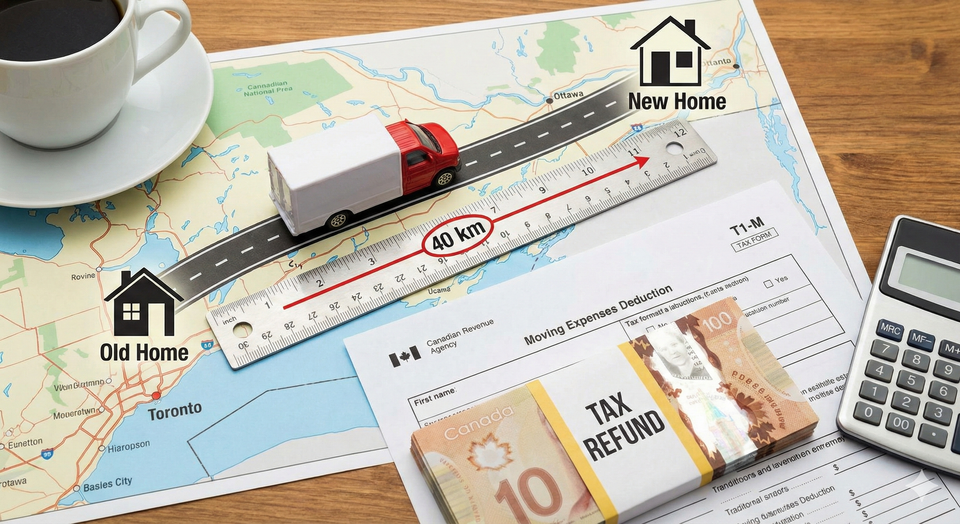
But in 2026, if you moved for the "right reasons" (work or school) and the "right distance" (40km), the Canada Revenue Agency (CRA) is willing to foot a massive chunk of the bill. The Moving Expenses Deduction (Line 21900) is one of the few tax breaks that is uncapped—meaning if you spent $15,000 legitimately, you can deduct $15,000 from your income.
This is the Official 2026 Guide to Moving Expenses. We break down the golden "40km Rule," the specific claims for students moving back home for summer jobs, and the "Simplified Method" that lets you claim cash for meals and gas without saving a single receipt.
RELATED
- [Link to: 2026 Canadian Tax Brackets: Federal & Provincial Rates (All Provinces)]
- [Link to: CRA My Account Locked? How to Reset Your 2026 CRA Login Fast]
- [Link to: OSAP Payment Dates 2026 (Ontario Student Loans): When Do You Get It?]
- [Link to: Student Aid BC Payment Dates: When Does the Money Deposit?]
- [Link to: Employment Insurance (EI) Canada 2026: New Rates & Application Guide]
- [Link to: Buying a Car in Canada (2026): How to Avoid "Curb Siders"]
1. The "40km Rule": The Golden Key
This is the single most important definition in the entire guide.
You cannot claim moving expenses just because you moved. You can only claim them if your move brings you at least 40 kilometers closer to your new place of work or school.
The Distance Formula
The CRA does not care if you moved 1,000km away. They care about the relative distance to your new job.
- The Test: Is your New Home at least 40km closer to your New Job than your Old Home was?
- Measurement: This is measured using the "Shortest Normal Route" (Google Maps driving distance), not a straight line "as the crow flies."
The "Student Trap" Example
- Scenario: You live in Oakville. You get a summer job in Downtown Toronto.
- Old Commute: Oakville to Toronto = 45km.
- The Move: You move to a condo in Toronto (2km from work) to avoid the commute.
- The Math:
- Distance from Old Home to New Work: 45km.
- Distance from New Home to New Work: 2km.
- Difference: 43km.
- Verdict: YES. You qualify. You moved 43km closer. You can deduct the cost of the move against your summer job income.
The "Commuter Trap" Example
- Scenario: You live in Barrie. You get a job in Toronto (100km away). You move to Newmarket (50km away) to shorten the drive.
- The Math:
- Distance from Old Home to New Work: 100km.
- Distance from New Home to New Work: 50km.
- Difference: 50km.
- Verdict: YES. Even though you are still 50km away from work, you are 50km closer than you were before. You qualify.
2. Who Is Eligible? (Workers vs. Students)
The rules are slightly different depending on why you are moving.
1. Employees and Self-Employed Workers
If you move to start a new job, or if you are transferred by your current employer, you can claim moving expenses.
- The Catch: You can only deduct the expenses from the income earned at the new location.
- Example: You move in December and earn only $1,000 at the new job in 2026. Your moving expenses were $5,000. You can deduct $1,000 this year, and carry forward the remaining $4,000 to deduct against next year's income.
2. Full-Time Students
If you move to study full-time at a university, college, or other post-secondary institution.
- The Catch: You can only deduct expenses from scholarship, fellowship, bursary, or research grant income. Since most scholarship income is tax-free (see our 2026 Canadian Tax Brackets guide), many students find they have no "taxable income" to deduct against.
- The Carry Forward: Like workers, you can carry these expenses forward to future years if you receive a taxable research grant later.
3. Students Moving for Summer Jobs (The Loophole)
This is the hidden gem. If you are a student moving for employment (e.g., a summer co-op, an internship), you are treated as a Worker, not a Student.
- The Benefit: You can deduct your moving costs against your employment income (the wages from the summer job).
- Double Move: You can claim the move to the job in May, and the move back to school in September (if you have a part-time job or grant income at school).
3. What Can You Claim? (The "Yes" List)
If you paid it, you can probably claim it.
1. Transportation & Travel
- Gas, oil, and windshield washer fluid.
- Meals for you and your family during the journey.
- Hotel/Motel costs along the way.
2. Storage & Hauling
- Movers (U-Haul, professional moving companies).
- Packing materials (boxes, tape).
- Storage fees (for up to 12 months).
3. Buying & Selling Costs (The Big Money)
If you sold your old home and bought a new one, this is where the deduction becomes massive.
- Selling: Real estate agent commissions (often 5% of the home value), legal fees, and penalty for breaking a mortgage.
- Buying: Legal fees and Land Transfer Tax. (Note: You can only claim buying costs if you sold a home and bought a new one).
4. Lease Cancellation
- If you rented your old home, you can claim the cost of breaking your lease (penalty fees).
- You cannot claim the "rent" for the new place, but you can claim the penalty for leaving the old one.
5. Incidental Expenses ($650 No-Receipt)
- Fees to change your address on documents (Driver’s License).
- Utility hook-up and disconnection fees.
- The Limit: You can claim up to $650 of incidental costs without submitting detailed receipts.
4. The "Simplified Method": No Receipts Required
Stop hoarding coffee receipts. Use the flat rates.
The CRA offers two ways to calculate your travel expenses: the Detailed Method (receipts for everything) and the Simplified Method (flat rates). In 2026, the Simplified Method is almost always better for gas and meals.
Meal Rate (2026 Estimate)
- Flat Rate: $23 per meal, per person, up to a maximum of $69/day per person.
- The Math: If a family of 4 drives for 2 days to move, you can claim:
- 4 People x $69/day x 2 days = **$552**.
- Proof Needed: None. You just need to prove the travel happened (e.g., a gas receipt at the destination).
Vehicle Rate (Cents per km)
Instead of tracking every litre of gas, you claim a flat rate per kilometer driven.
- The Rate: Varies by province (usually 55¢ to 68¢ per km).
- The Math: If you drove 1,000km from Ontario to Nova Scotia.
- 1,000km x $0.62 (approx Ontario rate) = **$620**.
- The Benefit: This usually adds up to more than the actual gas cost, especially if you drive a fuel-efficient car.
Note: If you bought a vehicle specifically for the move, check our Buying a Car in Canada (2026) guide, but remember: you cannot deduct the cost of the car, only the usage (gas/mileage) for the move.
5. Ineligible Expenses (The "No" List)
Don't try to claim these, or you will be audited.
- Renovations: Fixing up your old home to sell it.
- Mail Forwarding: Canada Post fees are personal costs.
- House Hunting Trips: Travel costs to look for a new home before you move.
- Job Hunting Costs: Travel costs to attend interviews.
- Value of Your Labour: You cannot pay yourself $50/hour to pack boxes.
- Loss on Sale: If you sold your house for less than you paid, you cannot claim the capital loss as a moving expense.
6. How to File (Form T1-M)
You do not need to mail receipts when you file. You simply fill out Form T1-M (Moving Expenses Deduction) and enter the total on Line 21900 of your return.
The "Audit Proofing" Strategy:
Moving expenses are a high-audit category because the amounts are large.
- Keep Documentation: Even if you use the Simplified Method, keep the Google Maps printout showing the "Old Home to New Work" vs. "New Home to New Work" distance.
- Employer Letter: If your employer reimbursed you for the move, you cannot claim the expenses (unless you include the reimbursement in your income). Keep a letter or pay stub showing what (if anything) was reimbursed.
- Digital Backups: Upload your lease agreements and U-Haul invoices to CRA My Account (via "Submit Documents") only if they ask for them later.
Frequently Asked Questions (FAQ)
Q: Can I claim moving expenses if I moved out of Canada?
A: Yes, but only if you remain a factual resident of Canada (meaning you still file Canadian taxes). You can deduct the move against the income earned at the new location (which would be foreign income reported on your Canadian return). If you sever ties and become a non-resident, you generally cannot claim the move.
Q: I moved in 2025 but didn't claim it. Is it too late?
A: No. You can request an adjustment to your 2025 return to add the expenses. Or, if you didn't have enough income in the new location in 2025, you can carry forward the expenses and claim them on your 2026 return.
Q: Does "OSAP" or student loan money count as income for the deduction?
A: No. Student loans (like OSAP or Student Aid BC) are loans, not income. You cannot deduct moving expenses against loan disbursements. You must have taxable income (scholarships, grants, or employment earnings).
Q: What if I am on Employment Insurance (EI)?
A: If you move to find work while on EI, the move itself is deductible against the future employment income you earn at the new job. It is not deductible against your EI payments. However, you should update your address immediately to ensure your Employment Insurance (EI) payments are not interrupted by the move.
About the Author
Jeff Calixte (MC Yow-Z) is a Canadian labour market researcher and digital entrepreneur specializing in government benefit data and cost-of-living support. As the founder of CanadaPaymentDates.ca and BetterPayJobs.ca, Jeff helps newcomers, students, and workers navigate the Canadian social safety net—from tracking CRA payment schedules to identifying entry-level employment opportunities.
Sources
- Canada Revenue Agency: Line 21900 – Moving expenses
- CRA: Income Tax Folio S1-F3-C4, Moving Expenses
- TurboTax Canada: Moving Expenses Deduction Guide
Note
Official 2026 tax deductions, mileage rates, and eligibility rules are determined by the Canada Revenue Agency (CRA). While we strive to keep this information current, government policies are subject to change without notice. All data in this guide is verified against official CRA circulars at the time of publication. We recommend confirming the status of your personal file directly via CRA My Account or by calling the CRA benefit line at 1-800-387-1193.