Non-Profit Credit Counselling vs. Debt Settlement 2026: Spot the Scam
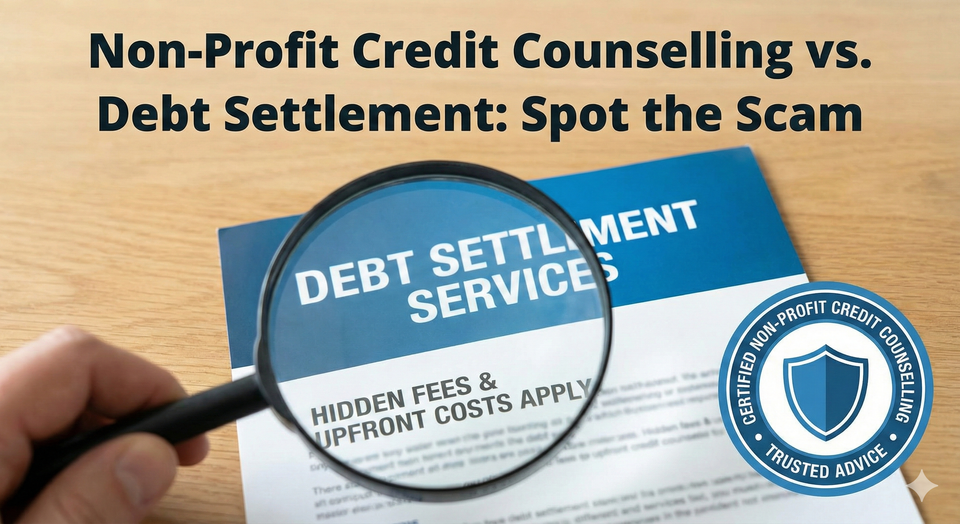
In 2026, the Canadian debt landscape has reached a boiling point. With interest rates remaining "higher for longer" and the cost of basic necessities at an all-time high, thousands of Canadians are searching for a way out. This desperation has created a gold rush for "Debt Consultants" and for-profit Debt Settlement companies. They promise to slash your debt by 80%, stop collection calls, and "fix" your credit score overnight.
The reality? Most of these for-profit companies are unnecessary "middlemen" who charge thousands of dollars for services that non-profit agencies or Licensed Insolvency Trustees provide for free. In the worst cases, they are predatory scams that tell you to stop paying your bills—leaving you with a ruined credit score and a lawsuit—while they disappear with your "setup fees."
As part of our Debt & Credit Series, this deep dive exposes the 2026 tactics of debt settlement predators. We compare the Debt Management Plan (DMP) offered by non-profits against the risky "Settlement" model, and provide the "Scam Hunter" checklist to ensure you never pay for a referral that should be free.
1. Non-Profit Credit Counselling: The Safe Zone
Legitimate non-profit credit counselling agencies exist to educate and provide a structured way to pay back 100% of your debt with significantly lower interest.
How a Debt Management Plan (DMP) Works
When you work with a member of Credit Counselling Canada (CCC) or the OACCS:
- The Negotiation: The counsellor contacts your creditors (banks, credit cards) and negotiates the interest rate down to 0% to 5%.
- The Payment: you make one monthly payment to the agency, which then distributes the money to your creditors.
- The Impact: You pay back the full principal over 3 to 5 years. Your credit report will show an R3 rating, which is far better than a bankruptcy (R9) or a proposal (R7).
The Cost: Non-profits are funded by the banking industry and small client fees (typically capped at 10% of your monthly payment or a small setup fee under $100). They will never turn you away if you cannot afford to pay.
2. For-Profit Debt Settlement: The Danger Zone
For-profit debt settlement companies operate on a "High-Risk, High-Reward" model that frequently backfires on the consumer.
The Risky Strategy
- Stop Paying: They tell you to stop paying your creditors and instead deposit that money into a "Savings Account" managed by them.
- The "Crush" Period: They wait until your accounts are 6 to 12 months in arrears, hoping the creditors will be "desperate enough" to settle for 40 cents on the dollar.
- The Result: During this time, your credit score is destroyed, interest and penalties continue to pile up, and you are at extreme risk of a Wage Garnishment.
The Catch: Creditors are not legally required to talk to these companies. Big banks like RBC, TD, and Scotiabank often have internal policies refusing to negotiate with for-profit settlement firms.
Scam Hunter Hacks
This deep dive identifies the specific "Predatory Scripts" that for-profit consultants use in 2026 to lure in victims. Use these hacks to protect your family's remaining savings.
1. The Upfront Fee Red Flag
A high-traffic query for 2026 is "debt settlement companies charging upfront fees."
- The Street Angle: Predatory firms ask for $1,000 to $5,000 as an "Administration Fee" or "Setup Fee" before they even talk to your creditors.
- The Hack: In provinces like Ontario and Alberta, it is illegal to charge a fee for debt settlement before a settlement has been reached and a payment has been made to the creditor.
- The Strategy: If a company asks for a "Commitment Fee" to "start the process," hang up the phone. Legitimate non-profits charge small, ongoing fees only after your Debt Management Plan is active.
2. The "LIT Referral" Scam (The $2,500 Lie)
Many users search for "debt consultant referral to trustee fee."
- The Street Angle: This is the most common scam in 2026. A "Debt Consultant" reviews your files and says, "You need a Consumer Proposal. Pay us $2,500 and we will prepare your application and refer you to our partner Trustee."
- The Hack: Licensed Insolvency Trustees (LITs) offer free initial consultations.
- The Strategy: You do not need a "Consultant" to talk to a Trustee. By going directly to a Trustee, you save the $2,500 fee.
- The Move: The Trustee is a federal officer of the court. Any consultant who claims they are "representing you" against the Trustee is simply adding an unnecessary, expensive layer of bureaucracy.
3. The "Government Approved" Myth
A common search is "new government debt forgiveness program 2026."
- The Street Angle: Scammers run Facebook and TikTok ads claiming a "New Government Initiative" or "Federal Debt Subsidy" will erase your debt.
- The Reality: There is no such thing. The only government-regulated programs are Bankruptcy and Consumer Proposals under the Bankruptcy and Insolvency Act.
- The Hack: If an ad mentions "Government Funding" for your personal credit card debt, it is 100% a lead-generation scam designed to sell your data to high-fee consultants.
4. The "Stop Communication" Warning
Many people search for "should I stop talking to my creditors."
- The Street Angle: Debt settlement companies say, "Let us handle the calls. Don't answer the phone."
- The Risk: When you stop communicating, creditors assume you are "skipping" out on the debt. This triggers the legal department to file a statement of claim.
- The Hack: Only a Consumer Proposal provides a "Stay of Proceedings" that legally forces creditors to stop calling and suing. For-profit settlement companies have zero legal power to stop a lawsuit.
5. Verifying the "Badge" (Accreditation Hack)
How do you know who to trust?
- The Strategy: Look for two specific associations: Credit Counselling Canada (CCC) and the Ontario Association of Credit Counselling Services (OACCS).
- The Move: Go to their official websites and search for the member firm. If they aren't on the list, they aren't a verified non-profit.
- The 2026 Update: Check the Better Business Bureau (BBB) specifically for "Pattern of Complaints." Many settlement companies change their name every 24 months to hide from bad reviews. Search for the owner's name, not just the company name.
4. Summary: The Debt Relief Comparison Table
| Feature | Non-Profit (DMP) | For-Profit Settlement | Consumer Proposal (LIT) |
| Fees | Small monthly (capped). | Huge Upfront Fees. | Paid from your monthly offer. |
| Legal Protection | None (Voluntary). | None (Voluntary). | Full Legal Protection. |
| Interest Rate | 0% to 5%. | High (accruing daily). | 0% Fixed. |
| Credit Rating | R3 (Fair). | R7/R9 (Poor). | R7 (Poor). |
| Debt Reduced? | No (Principal paid 100%). | Yes (If they agree). | Yes (Often 70-80%). |
Debt Settlement Scams Canada
How can I tell if a debt settlement company is a scam in 2026? The primary red flags of a debt relief scam are demanding upfront fees before settling any debt, making unrealistic promises to erase 80% of your debt without a legal process, and charging for a referral to a Licensed Insolvency Trustee. Legitimate help comes from non-profit credit counselling agencies (members of Credit Counselling Canada) who offer free consultations and transparent fee structures. Only a Licensed Insolvency Trustee can legally stop collections and lawsuits through a Consumer Proposal.
Frequently Asked Questions (FAQ)
Q: Is "Credit Counselling Society" a non-profit?
A: Yes. The Credit Counselling Society is a major, accredited non-profit member of Credit Counselling Canada. They are a safe and reputable choice for a DMP.
Q: Can a debt settlement company stop a wage garnishment?
A: No. Only a Licensed Insolvency Trustee can stop a garnishment through a Consumer Proposal or Bankruptcy. If a "Debt Consultant" says they can stop it, they are likely lying or simply referring you to a Trustee (and charging you for it).
Q: What if I already paid a fee to a scammer?
A: File a complaint with your Provincial Consumer Protection Branch and the Better Business Bureau. If they used "unscrupulous practices," you may be able to get a refund under provincial consumer protection acts.
Q: Do non-profits help with student loans?
A: Yes, they can help you budget for them, but they cannot negotiate the principal down. For student loan forgiveness, you generally need to look at the Repayment Assistance Plan (RAP) or wait 7 years to include them in a Consumer Proposal.
About the Author
Jeff Calixte (MC Yow-Z) is a Canadian labour market researcher and digital entrepreneur specializing in government benefit data and cost-of-living support. As the founder of CanadaPaymentDates.ca and BetterPayJobs.ca, Jeff helps newcomers, students, and workers navigate the Canadian social safety net—from tracking CRA payment schedules to finding entry-level work.
Sources
- Credit Counselling Canada: Accreditation Standards and Member Directory
- Office of the Superintendent of Bankruptcy (OSB): Debt Relief Scams and Fraud Alerts
- Financial Consumer Agency of Canada (FCAC): Debt Settlement Companies: Risks and Red Flags
- Better Business Bureau (BBB): 2026 Debt Relief Industry Report
Note
Credit score algorithms (Equifax/TransUnion) and lending criteria are determined by private financial institutions and are subject to change without notice. This guide is for informational purposes only and does not constitute professional financial advice. If you are facing insolvency or legal action regarding debt, we recommend consulting with a Licensed Insolvency Trustee (LIT) or a non-profit credit counsellor.