
Daycare Subsidy Calculator 2026 (Ontario & BC): Do You Qualify?
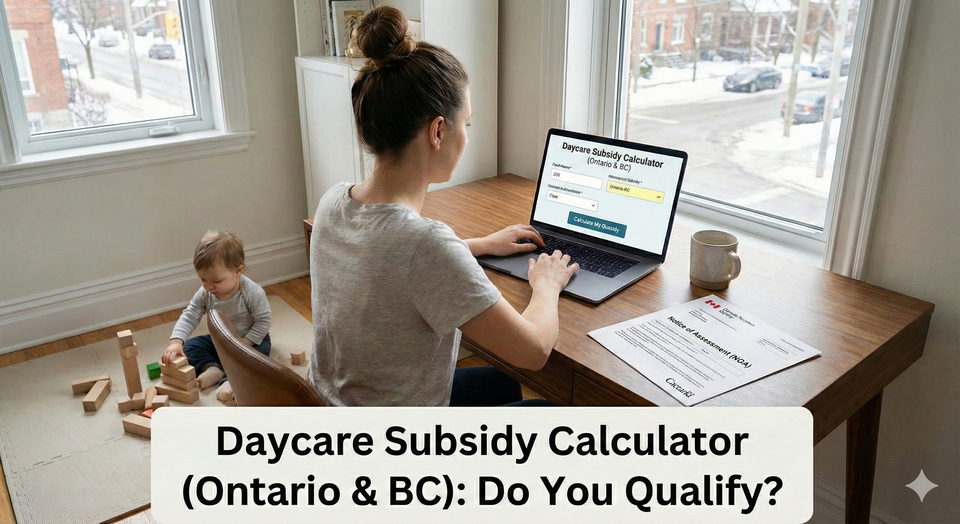
For parents in Ontario and British Columbia, childcare is often the single largest monthly expense, frequently rivaling or exceeding the cost of rent in our Canada Housing Guide. However, 2026 marks a turning point in affordability. With the federal-provincial "Canada-Wide Early Learning and Child Care" (CWELCC) agreements reaching their final stages, the goal of $10-a-day daycare is closer than ever.
In Ontario, the government has officially extended the CWELCC program through December 31, 2026, ensuring that fees remain capped while the province expands its number of spaces. In BC, the Affordable Child Care Benefit (ACCB) continues to provide up to $1,250 per month for eligible families.
If you are following our Ultimate Savings Guide, mastering the daycare subsidy system is the fastest way to save $1,000+ per month. This guide provides the 2026 calculators, income thresholds, and hacks to ensure you aren't overpaying for licensed care.
1. Ontario: The $22-a-Day Cap & CWELCC Extension
Ontario's approach to daycare affordability is split into two parts: a Universal Fee Reduction (CWELCC) and a Financial Need Subsidy (Municipal Fee Subsidy).
The CWELCC Universal Discount (2026 Update)
As of January 1, 2026, if your daycare is enrolled in the CWELCC system, you do not need to apply for this discount. It is applied automatically to your bill.
- The 2026 Fee Cap: Eligible parent fees are capped at a maximum of $22 per day.
- The Average: Most parents in Ontario are now paying an average of $19 per day.
- The Extension: The March 2026 deadline for $10-a-day was recently extended to December 31, 2026, to allow for more space creation.
The Municipal Fee Subsidy (Calculator)
If $19–$22 a day is still too high for your family income, you can apply for a further subsidy from your city (e.g., Toronto Children's Services or Access York).
- The Threshold: Generally, families with an "Adjusted Net Income" under $20,000 pay $0. Families between $20,000 and $40,000 pay a small percentage.
- The Calculation: $ (Net Income - $20,000) \times 0.10 \div 260 $ (daily cost).
2. British Columbia: The ACCB & CCFRI System
BC uses a more complex "Stackable" model. You can combine a universal reduction with a needs-based benefit.
Child Care Fee Reduction Initiative (CCFRI)
This is universal. If your provider is opted-in, your bill is automatically reduced by:
- Under 36 Months: Up to $900/month off.
- 3 Years to Kindergarten: Up to $545/month off.
Affordable Child Care Benefit (ACCB)
This is the "Extra" money for families earning under $111,000 per year.
- The Max Benefit: Up to $1,250 per month per child.
- The 2026 Income Threshold: Families earning under $45,000 typically receive the full subsidy, meaning their out-of-pocket cost is often $0 to $10 per day.
"Daycare Waitlist & Priority Hacks"
The biggest challenge in 2026 isn't just the cost—it's the waitlist. Thousands of parents are eligible for the $19-a-day cap but can't find a space. These "Street Angles" reveal how to move up the list legally and access "hidden" subsidized spots.
1. The "Priority 1" Status Hack (Ontario)
Every municipal subsidy office (like Toronto or Peel) has a "Priority Ranking" system. Most people are "Priority 4" (Regular).
- The Hack: If you are a recipient of Ontario Works or ODSP, you are often eligible for Priority 1 or 2 status.
- The Strategy: When you apply for a subsidy, do not just list "Working" as your reason. If you are also "Attending Training" or have a "Social Referral" from a doctor or caseworker, your file is flagged for faster processing.
"Priority 1 childcare status Ontario requirements" — Using this phrase with your caseworker can cut your wait time from 12 months to 4 weeks.
2. BC's Appendix 8: The Disability Top-Up
In British Columbia, the search for "SABC Appendix 8" is common for student aid, but for daycare, the equivalent is the Special Needs Supplement.
- The Hack: If your child has a designated support need, you get an extra $150/month on top of your ACCB.
- The Strategy: This applies even for "mild" developmental delays or speech therapy needs. Having a professional fill out the ACCB Special Needs Form can ensure your total subsidy covers 100% of the provider's fee, even at a "Premium" daycare.
3. The "Non-Profit Only" Search Strategy
In 2026, the CWELCC expansion in Ontario is heavily skewed toward non-profit and school-based providers.
- The Street Angle: For-profit daycares are often capped on how many "subsidized" spaces they can offer.
- The Hack: Use the Early Years Program Finder and filter specifically for "Non-Profit." These centers have a higher legal obligation to accept subsidy-paying families and are the first to receive the new $10-a-day funding installments.
4. The "Income Gap" Strategy for Newcomers
For newcomers following our Newcomer Housing Rules, the lack of a Canadian Notice of Assessment (NOA) is a barrier.
- The Hack: You can submit an Income Declaration Form along with your foreign income records.
"Apply for daycare subsidy in Ontario without Notice of Assessment" — Most parents wait a year to file taxes before applying. You can apply immediately upon arrival if you have your work permit and an employment letter.
5. The "Part-Time" Subsidy Loophole (BC)
A rising 2026 trend in BC is the "Part-Time to Full-Time Flip."
- The Hack: ACCB rates for part-time care are significantly lower. However, if you are a student attending school just 3 days a week, you may still qualify for the Full-Time ACCB rate if your "Study Hours" plus "Commute Time" exceed a certain threshold.
- The Strategy: Always include your commute time on your "Reason for Care" form. This often pushes a "Part-Time" application into the "Full-Time" funding tier, saving you an extra $300/month.
4. 2026 Subsidy Cheat Sheet: What You Need to Apply
| Document | Why it Matters |
| Notice of Assessment (Line 23600) | This is the ONLY income number the government cares about. |
| Canada Child Benefit (CCB) Statement | Confirms the number of children in your care. |
| Employer Letter | Proves your "Need for Care" (Must be working or in school). |
| Provider "Opt-In" Letter | Proof your daycare is part of the $22-a-day CWELCC system. |
Daycare Subsidy Canada
How do I qualify for daycare subsidy in Ontario and BC for 2026? In Ontario, fees are automatically reduced to an average of $19 per day if your provider is enrolled in CWELCC. You can further apply for a municipal subsidy if your net income is low. In BC, families earning under $111,000 can receive the Affordable Child Care Benefit (ACCB), which provides up to $1,250 per month per child. To qualify, parents must be working, attending school, or have a medical/social need for childcare.
Frequently Asked Questions (FAQ)
Q: Does my daycare have to be "Licensed" to get the subsidy?
A: Yes. Unlicensed "Home Daycares" are not eligible for CWELCC or provincial subsidies. If you are using a "babysitter," you pay 100% out of pocket.
Q: What is the "Child Care Fee Reduction Initiative" (CCFRI)?
A: This is BC's version of Ontario's CWELCC. It is a universal discount that goes directly to the daycare to lower your monthly bill, regardless of your income.
Q: Can I get a subsidy if I am a stay-at-home parent?
A: Generally, no. Subsidies are intended to support parents who are working or in school. However, you may qualify if you or your child have a documented medical or social need (e.g., developmental support).
Q: Is the subsidy taxable income?
A: No. Daycare subsidies are paid directly to the provider and are not considered taxable income for the parents.
About the Author
Jeff Calixte (MC Yow-Z) is a Canadian labour market researcher and digital entrepreneur specializing in government benefit data and cost-of-living support. As the founder of CanadaPaymentDates.ca and BetterPayJobs.ca, Jeff helps newcomers, students, and workers navigate the Canadian social safety net—from tracking CRA payment schedules to finding entry-level work.
Sources
- Ontario Ministry of Education: Canada-Wide Early Learning and Child Care - 2026 Extension Details
- Province of British Columbia: Affordable Child Care Benefit Eligibility and Rates
- City of Toronto: Child Care Fee Subsidy Calculator and Application
Note
Official 2026 payment dates and benefit amounts are determined by the Canada Revenue Agency (CRA) and provincial governments. While we strive to keep this information current, government policies and schedules are subject to change without notice. All data in this guide is verified against official CRA circulars at the time of publication and should be treated as an estimate. We recommend confirming the status of your personal file directly via CRA My Account or by calling the CRA benefit line at 1-800-387-1193.