
T2201 Form Guide: How to Get Your Doctor to Sign the Certificate
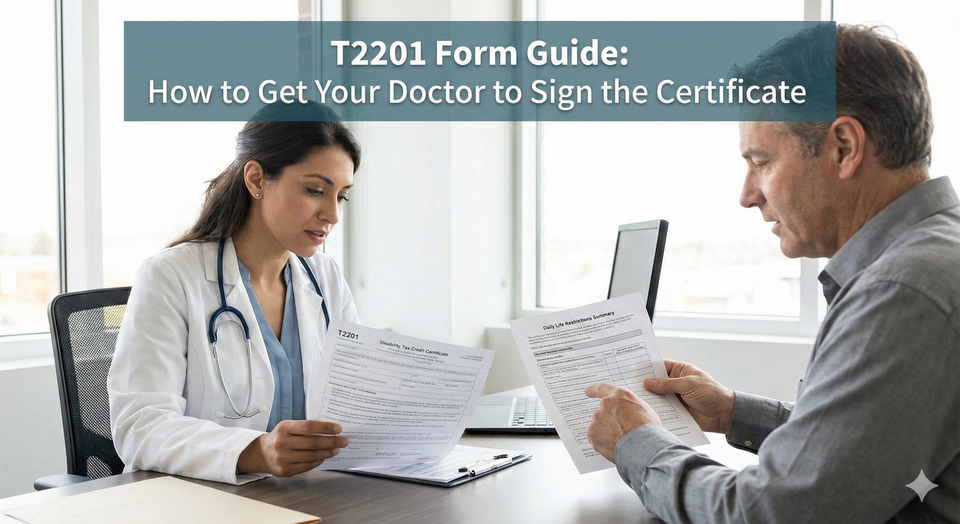
The T2201 Disability Tax Credit Certificate is the single most important document in the Canadian social safety net. It is the "Master Key" that unlocks the Disability Tax Credit (DTC), the RDSP, and the Canada Caregiver Credit. Yet, for many Canadians, getting a doctor to sign this form feels like an impossible hurdle.
In 2026, the CRA has modernized the process with a fully digital application, but the core challenge remains: translating your daily struggles into the rigid legal language of the Income Tax Act. Doctors are often hesitant to sign because they don't understand that the DTC is not about your "ability to work," but rather your "activities of daily living."
As a critical part of our Hidden Tax Credits Canada 2026 Master List, this guide provides the "Doctor’s Script" to ensure your form is filled out correctly the first time. We explain the new 2026 digital reference numbers, reveal why your Nurse Practitioner might be a better choice than your GP, and provide the strategies to overcome a doctor's refusal.
1. The 2026 Digital Application: A New Way to Apply
Gone are the days when you had to mail a 16-page paper packet and hope it didn't get lost. In 2026, the CRA's Digital DTC Application is the fastest and most reliable method.
How the Reference Number Works
- Step 1: You log into your CRA My Account and complete "Part A" online.
- Step 2: The CRA generates a unique Reference Number.
- Step 3: You give this number to your doctor. They log into their own CRA medical portal and complete "Part B" using your number.
- Step 4: The form is submitted instantly. You can track the progress in your account's Benefits and credits section.
The Advantage: Digital forms prevent doctors from leaving required fields blank—a leading cause of 2026 processing delays.
2. Who Can Sign Your T2201? (Beyond the MD)
Many people wait months for a specialist when a different professional could sign the form today. In 2026, the list of authorized practitioners includes:
- Medical Doctors & Nurse Practitioners: Can certify all categories.
- Psychologists: For Mental Functions.
- Optometrists: Specifically for Vision restrictions.
- Audiologists: Specifically for Hearing restrictions.
- Occupational/Physiotherapists: For Walking, Feeding, or Dressing.
- Speech-Language Pathologists: For Speaking.
Strategy: If your family doctor is hesitant about your mental health claim, see a Psychologist. Their specialized clinical notes carry significant weight with the CRA’s medical reviewers.
Doctor Negotiation Hacks
This deep dive identifies the specific "Street Angles" that turn a reluctant doctor into a supportive advocate.
1. The "15-Minute Consultation" Preparation
doctor refused to sign T2201.
- The Street Angle: Doctors often refuse because they are afraid of an "Audit" or they think you are asking them to lie about your ability to work.
- The Hack: Bring a "Daily Life Log."
- The Strategy: Do not walk in and say, "I'm disabled." Instead, give them a 1-page summary of how you are Slowed Down. Use the phrase: "I take 3 times longer than my peers to [Walk/Dress/Eat/Think] 90% of the time." This provides the doctor with the specific legal evidence they need to safely sign the form.
2. The RDSP Wealth Negotiation
Many doctors search for RDSP government match for seniors.
- The Hack: Emphasize the savings, not the tax credit.
- The Strategy: Tell your doctor, "If you sign this, I can open an RDSP and the government will give me a 3-for-1 match on my savings." Doctors are generally compassionate; when they realize their signature unlocks $20,000 to $70,000 in free government grants for your future, they are much more likely to prioritize the paperwork.
3. The Nurse Practitioner (NP) Speed Hack
A rising query in 2026 is "nurse practitioner disability tax credit signature."
- The Street Angle: Family doctors are overwhelmed. Nurse Practitioners often have more time to spend on the "Effects of Impairment" descriptions.
- The Hack: NPs are fully authorized by the CRA to sign the T2201 for any category.
- The Move: If you are at a community health center or use a primary care clinic, ask for an appointment with the NP specifically for "DTC Certification." They are often more familiar with the "Activities of Daily Living" criteria than surgeons or specialists.
4. Handling the OMA Suggested Fees
Users frequently ask: "How much do doctors charge for T2201?"
- The Reality: In 2026, the Ontario Medical Association (OMA) suggests a minimum fee of $150 to $200 for a T2201.
- The Strategy: This is a private, uninsured service. Do not fight the fee—it is a Medical Expense Tax Credit write-off.
- The Hack: Ask the receptionist for the price before the appointment. If the fee is a barrier, ask if the clinic has a "sliding scale" for low-income seniors.
5. The Cumulative Effect Safety Net
If you aren't "blind" or "unable to walk," but you struggle with both, you need the Cumulative Effect hack.
- The Hack: A doctor can sign if you have two or more restrictions that, when added together, are equivalent to one "Marked" restriction.
- The Strategy: Ask your doctor to fill out the Walking and Mental Functions sections if you have "Brain Fog" from a physical condition. The combined impact of taking 2x longer to walk and 2x longer to think is a "Winner" for approval.
6. The Follow-Up Questionnaire Defense
A common search is "CRA follow up questionnaire to doctor T2201."
- The Reality: The CRA often sends a 5-page follow-up to the doctor after the T2201 is submitted.
- The Move: Tell your doctor, "I am happy to pay for your time to respond to any CRA follow-ups." If the doctor knows they will be compensated for the extra work, they won't "tank" your application with a half-hearted response.
4. 2026 T2201 Category Checklist for Doctors
| Category | What the Doctor Must Confirm | Typical Specialist |
| Walking | Takes 3x longer or needs help 90% of time. | GP / PT / OT |
| Feeding | Cannot prepare food or feed themselves. | GP / OT |
| Dressing | Takes 3x longer or cannot dress self. | GP / OT |
| Mental Functions | Needs 24/7 supervision or 3x thinking time. | GP / Psychologist |
| Speaking | Takes 3x longer to be understood. | Speech Pathologist |
| Hearing | Cannot hear 90% of time even with aids. | Audiologist |
| Vision | Visual acuity is 20/200 or less in both eyes. | Optometrist |
T2201 Form Guide
How do I get my doctor to sign the T2201 form in 2026? To get a doctor to sign the T2201, provide them with a detailed "Daily Life Log" showing that you take three times longer than a peer to perform tasks (the 3x Rule) at least 90% of the time. Use the 2026 Digital DTC Application to generate a reference number for your doctor, which speeds up processing. Remember that Nurse Practitioners and Psychologists can also sign the form, often with shorter wait times than family doctors.
Frequently Asked Questions (FAQ)
Q: Can I fill out Part B for the doctor to sign?
A: No. The CRA is very strict: Part B must be completed by the medical practitioner. If the handwriting or digital signatures don't match the practitioner's profile, the application will be rejected for fraud.
Q: What if my doctor says I am "not disabled enough" because I have a job?
A: This is a common error. Show them the CRA Guide for Practitioners. Remind them that the DTC is based on "Activities of Daily Living," not "Ability to Work."
Q: How long does the T2201 approval take in 2026?
A: Digital applications are typically processed in 6 to 8 weeks. You can track the status in the CRA Progress Tracker in My Account.
Q: Can I apply for past years?
A: Yes. Ensure the doctor specifies the year your restriction began. You can claim the credit for up to 10 years retroactively.
About the Author
Jeff Calixte (MC Yow-Z) is a Canadian labour market researcher and digital entrepreneur specializing in government benefit data and cost-of-living support. As the founder of CanadaPaymentDates.ca and BetterPayJobs.ca, Jeff helps newcomers, students, and workers navigate the Canadian social safety net—from tracking CRA payment schedules to finding entry-level work.
Sources
- Canada.ca: How to apply - Disability tax credit (T2201)
- CRA: Digital application for medical practitioners
- Ontario Medical Association: Suggested Form Fees - 2026 Update
Note
Official 2026 payment dates and benefit amounts are determined by the Canada Revenue Agency (CRA) and provincial governments. While we strive to keep this information current, government policies and schedules are subject to change without notice. All data in this guide is verified against official CRA circulars at the time of publication and should be treated as an estimate. We recommend confirming the status of your personal file directly via CRA My Account or by calling the CRA benefit line at 1-800-387-1193.