First Home Savings Account (FHSA): Rules for Newcomers
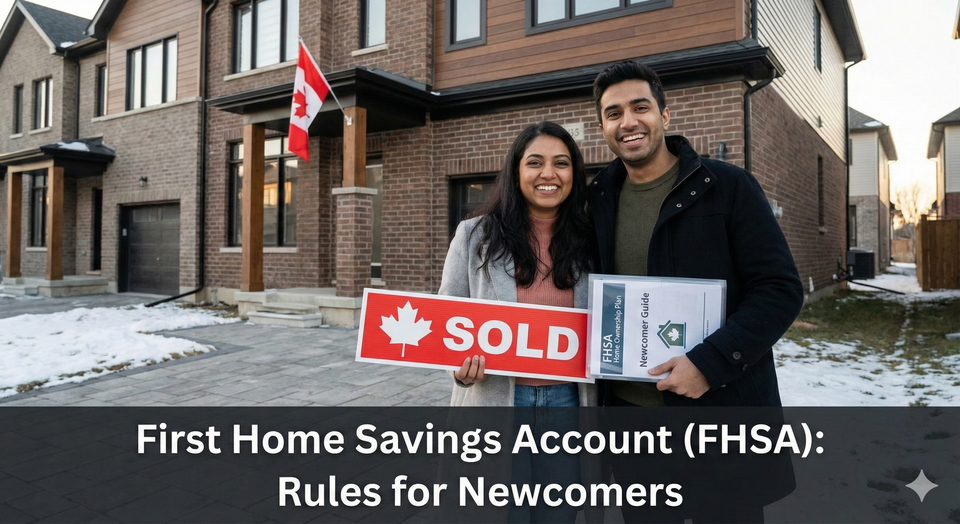
For newcomers arriving in Canada in 2026, the dream of owning a home often feels like a moving target. With housing prices in major hubs like Toronto and Vancouver remaining high, saving for a down payment is the single biggest hurdle to residency stability. However, the federal government’s First Home Savings Account (FHSA) has emerged as the most powerful tool for new residents to bridge the gap between renting and owning.
The FHSA is a "hybrid" account that combines the best parts of an RRSP and a TFSA. Like an RRSP, your contributions are tax-deductible, meaning they lower your tax bill and can trigger a significant refund. Like a TFSA, your withdrawals (including all investment growth) are 100% tax-free when used to buy a home.
If you are following our Ultimate Savings Guide or navigating the Canada Housing Guide, the FHSA is your #1 priority. This guide breaks down the specific rules for work permit holders and permanent residents, reveals the "90-Day Trap," and identifies the strategies to maximize your first year in Canada.
1. Eligibility: Can Work Permit Holders Open an FHSA?
The short answer is Yes. You do not need to be a Permanent Resident (PR) or a Citizen to open an FHSA.
The "Resident for Tax Purposes" Rule
To open an FHSA in 2026, you must meet three criteria:
- Age: You must be 18 or 19 years old (depending on your province).
- First-Time Home Buyer: You (or your spouse) must not have lived in a home that you owned at any time in the current calendar year or the previous four calendar years.
- Note for Newcomers: This includes homes you owned outside of Canada if they were your principal residence.
- Resident Status: You must be a resident of Canada for tax purposes. If you have a valid Social Insurance Number (SIN) and have established "residential ties" (like a lease or a Canadian bank account), you qualify. This applies to Work Permit holders, Study Permit holders (who are tax residents), and PRs.
2. The $8,000 Room Secret: Why You Must Open an Account Today
The most common mistake newcomers make is waiting until they have $8,000 to open the account. Do not wait.
- The Rule: FHSA contribution room only starts accumulating the year you open the account.
- The Math: If you arrive in Canada in 2026 and open an FHSA with $0, you gain $8,000 in contribution room. In 2027, you will have a total of **$16,000** in room ($8,000 carried forward + $8,000 new room).
- The Penalty of Waiting: If you wait until 2027 to open the account, you will only have $8,000 in room. By opening the account with $0 now, you "lock in" your ability to save twice as much next year.
3. FHSA vs. Home Buyers' Plan (HBP): Using Both
Many newcomers are familiar with the Home Buyers' Plan (HBP), which lets you withdraw up to $60,000 from your RRSP. In 2026, you can (and should) use both.
| Feature | FHSA | RRSP (HBP) |
| Max Withdrawal | Entire account balance (No limit) | $60,000 |
| Repayment | None Required | Must repay over 15 years |
| Holding Period | No minimum | Funds must be in RRSP for 90 days |
| Contribution Limit | $8,000/year ($40,000 life) | 18% of earned income |
The Strategy: Use the FHSA as your primary bucket because you never have to pay the money back. Use the HBP as your "Top-Up" if your FHSA hasn't reached the $40,000 limit by the time you're ready to buy.
MORE HELPFUL ARTICLES FROM US
- Canada Payment Guide (Browse All Payments )
- Can I Get EI if I Quit? (Just Cause Checklist)
- TFSA vs. RRSP for Low Income (The GIS Trap)
- Shared Custody CCB Rules (50/50 Split Guide)
- Warm Neighbor Programs (Heating Bill Help)
Newcomer FHSA Hacks
The following strategy identifies the specific hurdles immigrants face that mainstream bank brochures completely ignore. Mastering these "Street Angles" can save you thousands in taxes during your first three years in Canada.
1. The "First-Year Newcomer" Tax Deduction Strategy
A major search query with almost is "FHSA first year newcomer tax deduction."
- The Street Angle: Most newcomers arrive mid-year and have a lower "Canadian Income" in their first tax year. If you earn $30,000 in your first six months, an $8,000 FHSA deduction might drop you into a 0% tax bracket, "wasting" the deduction.
- The Hack: You can contribute the $8,000 now to grow it tax-free, but delay the deduction until a future year when your Canadian salary is higher (e.g., when you are earning $70,000).
- The Payoff: Taking the deduction at a 30% tax rate is worth $2,400. Taking it at a 15% rate is only worth $1,200. This is the ultimate "Wealth Move" for new immigrants.
2. The 90-Day RRSP Trap for Newcomers
Many immigrants are told to put their down payment into an RRSP to use the HBP.
- The Danger: For the HBP, your money must be in the RRSP for 90 days before you can withdraw it. If you find a "Dream Home" on day 45, you are trapped.
- The Hack: The FHSA has no minimum holding period. You can contribute $8,000 on Monday, sign a house deal on Tuesday, and withdraw the $8,000 tax-free on Wednesday. For newcomers who need to move fast in a competitive market, the FHSA is the only safe option.
Principal Residence Outside Canada: The Legal Loophole
FHSA international home ownership rules.
- The Rule: If you owned a home in your home country (India, UK, Philippines, etc.) and lived in it within the last 4 years, you are technically not a first-time home buyer for the FHSA.
- The Loophole: The "First-Time Buyer" status is verified at the time you open the account. If you have been renting in Canada for 4 years and 1 day, and you haven't lived in your international home during that time, you regain your first-time buyer status, even if you still own the international property as a rental.
4. The "Work Permit to PR" Transition
A common fear is: What happens to my FHSA if my Work Permit expires or I leave Canada?
- The Reality: Once the account is open, it remains a "Registered Account." Even if you become a non-resident of Canada, you can keep the account open.
- The Warning: You cannot make a qualifying (tax-free) withdrawal unless you are a resident of Canada at the time of the purchase. If you plan to buy a home, ensure your PR status or Work Permit extension is confirmed before you pull the money out.
5. Transferring RRSP to FHSA: The "No-Tax" Bridge
If you already started saving in an RRSP, you can move that money to an FHSA.
- The Street Angle: This is a "Direct Transfer." It uses up your FHSA room ($8,000) but it does not give you a new tax deduction.
- The Hack: Use this if you have money "stuck" in an RRSP that you want to withdraw for a home without the 15-year repayment requirement of the HBP. This is the #1 strategy for immigrants who realized too late that the HBP is actually a loan to yourself.
5. 2026 FHSA Summary Table for Newcomers
| Action Item | Deadline | Why it Matters |
| Open Account | December 31, 2026 | Triggers your first $8,000 in room. |
| Make Deposit | December 31, 2026 | To claim a deduction for the 2026 tax year. |
| Verify SIN | Immediate | Temporary SINs (starting with 9) are fully valid. |
| File Schedule 15 | April 30, 2027 | You MUST file this with your taxes to report the FHSA. |
FHSA for Newcomers
Can a newcomer to Canada open an FHSA? Yes. As long as you are a resident of Canada for tax purposes and have a valid SIN (including temporary SINs starting with 9), you can open a First Home Savings Account. You must also be a first-time homebuyer, meaning you haven't lived in a home you owned in the last four years. Opening an account with $0 immediately starts your **$8,000 annual contribution room**, allowing you to carry forward unused room to future years.
Frequently Asked Questions (FAQ)
Q: Can I use the FHSA to buy a home for my parents?
A: No. The FHSA must be used for a home that you intend to occupy as your principal residence within one year of buying it.
Q: What if I never buy a home?
A: You can transfer your FHSA savings (up to $40,000 plus growth) into your RRSP tax-free. This does not use up your RRSP room. It is essentially "Extra" RRSP room the government gives you for trying to buy a home.
Q: Can a couple both have an FHSA?
A: Yes. You and your spouse can each save $40,000, for a total of **$80,000 plus growth** toward a single down payment. When combined with the HBP, a newcomer couple could have over $200,000 in tax-advantaged funds for a home.
About the Author
Jeff Calixte (MC Yow-Z) is a Canadian labour market researcher and digital entrepreneur specializing in government benefit data and cost-of-living support. As the founder of CanadaPaymentDates.ca and BetterPayJobs.ca, Jeff helps newcomers, students, and workers navigate the Canadian social safety net—from tracking CRA payment schedules to finding entry-level work.
Sources
- Canada Revenue Agency (CRA): First Home Savings Account (FHSA) - Official Guide
- National Bank: I just immigrated to Canada. Can I open an FHSA?
- CIBC: Tax-Free First Home Savings Account for Newcomers
Note
Official 2026 payment dates and benefit amounts are determined by the Canada Revenue Agency (CRA) and provincial governments. While we strive to keep this information current, government policies and schedules are subject to change without notice. All data in this guide is verified against official CRA circulars at the time of publication and should be treated as an estimate. We recommend confirming the status of your personal file directly via CRA My Account or by calling the CRA benefit line at 1-800-387-1193.