Food Banks Near Me (2026): How to Access Help Without ID or Proof of Address
The single biggest fear for someone facing hunger in Canada is the fear of being turned away. You are standing in line, your stomach is empty, and you’re panicking because you don't have a Canadian ID, your passport is at home, or you are currently "between addresses." You ask yourself: "Will they judge me? Will they report my status? Will they tell me I don't qualify?"
In 2026, the reality of food insecurity in Canada has changed. Food banks have moved toward a "Dignity First" model. While many large warehouses have an "intake" process, there is a massive network of community fridges, religious pantries, and "no-questions-asked" hubs specifically designed for people who cannot or do not want to provide documentation.
This guide is the definitive resource on how to get food today, regardless of your paperwork, status, or housing situation.
Anonymous" Food Access in Canada
1. The "No Questions Asked" Philosophy
In 2026, organizations like Second Harvest and the Daily Bread Food Bank have trained their partner agencies to understand that hunger is an emergency. Under the 2026 "Food Dignity Charter," many local hubs have implemented a "First Visit" rule:
- The First Visit Rule: On your first visit to most community food banks, you are given a full hamper of food without any verification. The staff may ask for your name and postal code only to track their statistics, but you do not need to show proof.
- Status Neutrality: In Canada, food banks are not government agencies. They do not report to IRCC (Immigration) or the police. Whether you are a tourist, a student, or undocumented, you have a right to eat.
2. The Rise of Community Fridges (The 24/7 Solution)
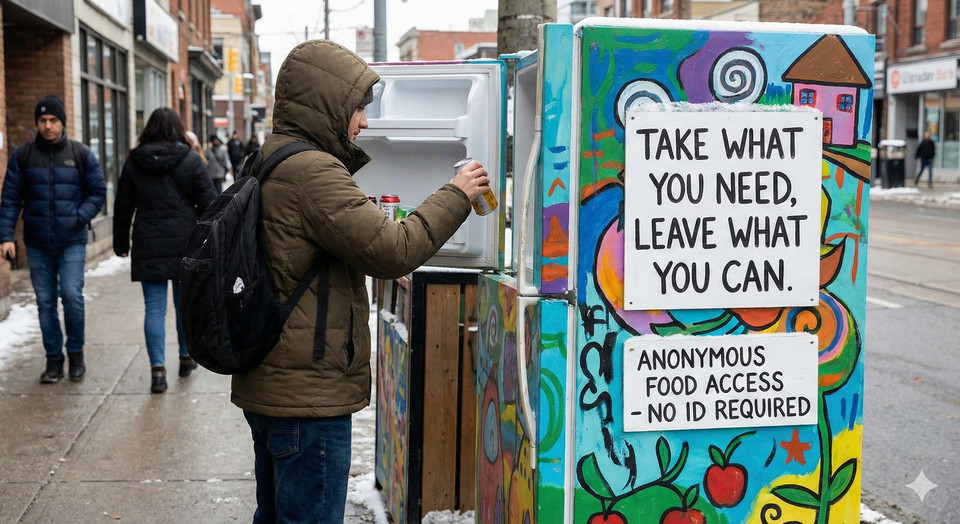
If you have high anxiety about talking to a volunteer or showing a face, Community Fridges are your best resource. These are outdoor, 24/7 refrigerators and pantries located on sidewalks.
- How it works: People leave fresh produce, milk, and bread. You simply walk up and take what you need. There are no forms, no cameras, and no one to talk to.
- Where to find them: Searching for "Community Fridges [Your City]" on Instagram or Google Maps is the fastest way to find a location that is active today.
Part 1: Food Bank Rules for 2026 (The "Real" Requirements)
While the goal is to provide food to everyone, understanding the "Tiered System" of Canadian food banks will help you decide where to go.
Tier 1: Large Regional Banks (Daily Bread, Greater Vancouver Food Bank)
These are large hubs. They usually ask for:
- Identification: To prove who you are (can be a foreign passport).
- Proof of Address: To ensure you are visiting a food bank in your "catchment area."
- Income Statement: To see if you are on Ontario Works or EI.
The Loophole: If you don't have these, you can ask for an "Emergency Referral." They will give you food for the day and connect you with a social worker who can help you get the ID you need (like an Ontario Photo Card).
Tier 2: Community & Faith-Based Pantries
These are smaller, located in churches, mosques, and community centers.
- The Rule: They are much more flexible. Many only require you to sign a piece of paper saying you need help. They rarely ask for tax returns or bank statements.
Tier 3: "Low-Barrier" Hubs
These include drop-in centers and street-level missions. They offer hot meals and small bags of groceries with zero documentation required.
City-Specific "No ID" Resources (2026)
| City | Resource Type | Best "No ID" Option | Location/Contact |
| Toronto | Community Fridges | Toronto Little Free Pantries | Multiple (Parkdale, Danforth, Etobicoke) |
| Toronto | Hot Meals | Scott Mission | 502 Spadina Ave (No ID for meals) |
| Vancouver | Emergency Food | Vancouver Food Not Bombs | Downtown Eastside (Public distributions) |
| Montreal | Student Help | The Midnight Kitchen | McGill University (Collectivist model) |
| Calgary | Mobile Help | The Mustard Seed | Various locations (Street outreach) |
Part 2: What to Say If You are Scared
The "Anxiety Trap" often keeps people away from help until they are starving. If you are worried about your first visit, use these "Dignity Scripts" to communicate with the volunteers:
- If you have no ID: "I am in an emergency situation and I don't have my ID with me today. Can I please access an emergency hamper?"
- If you are a newcomer: "I just arrived in Canada and I am still waiting for my documents. I need food for my family while I wait for my first CCB payment."
- If you are homeless: "I don't have a fixed address right now. Do you have 'no-cook' bags available?" (These contain pull-top cans and items that don't need a stove).
Food Banks No ID
To get food from a food bank in Canada without ID (2026): Look for "Community Fridges" or "Low-Barrier Food Pantries" in your city. Most large food banks (like Daily Bread or the Greater Vancouver Food Bank) will provide an Emergency Hamper on your first visit without requiring ID or proof of address. After the first visit, they may ask for a referral from a social worker, which you can obtain by calling 2-1-1.
Part 3: Stacking Food Support with Other Benefits
Food banks are a temporary solution. To solve hunger long-term, you must maximize the money coming into your household.
- Check Your Payment Dates: Ensure you haven't missed a GST/HST Credit or Ontario Trillium Benefit deposit. These small boosts are designed for grocery money.
- Apply for Ontario Works: If you are truly out of money, use our SADA Screen-by-Screen Guide to apply for welfare today.
- Use BetterPayJobs.ca: If you are working but still can't afford food, your wage is too low for the 2026 cost of living. Use BetterPayJobs.ca to find roles that pay above the living wage in your city.
Frequently Asked Questions (FAQ)
Q: Will the food bank take my information and give it to the government?
A: No. Food banks are independent charities. They protect your privacy. In 2026, most use a system called Link2Feed, which anonymizes your data so they can report "numbers" to the government for funding without giving your "name."
Q: Can I go to more than one food bank?
A: While each bank has a "once a month" or "once a week" rule, in an absolute emergency, you can visit different hubs. However, they prefer you stay with one so they can help you with other things like Rent Bank Grants.
Q: Do food banks have Halal or Kosher options?
A: Yes. In 2026, almost all major Canadian food banks ask about your dietary restrictions during intake. Religious pantries (like the JRCC Furniture Depot partners or Islamic Relief) offer specialized hampers.
Q: What if I have a baby?
A: Ask for a "Baby Pack." These include diapers, formula, and baby food. These are high-demand items, so it is best to call ahead or go early in the morning.
Q: I have a job but I'm still hungry. Can I still go?
A: Yes. In 2026, over 30% of food bank users have a job. You do not need to be unemployed to get help. If your rent takes up your whole paycheck, you are eligible.
About the Author
Jeff Calixte (MC Yow-Z) is a Canadian labour market researcher and digital entrepreneur specializing in government benefit data and cost-of-living support. As the founder of CanadaPaymentDates.ca and BetterPayJobs.ca, Jeff helps newcomers, students, and workers navigate the Canadian social safety net—from tracking CRA payment schedules to finding entry-level work.
Sources
- Daily Bread Food Bank: Who can use a food bank? (2026 Guidelines)
- Feed Ontario: Dignity and Access Standards for Member Banks
- Food Banks BC: Find a Food Bank Near You
- Community Fridges Toronto: Active Location Map and Guidelines
Note Eligibility for social programs, grants, and community support is determined by local municipalities and charitable organizations. Funding availability is subject to change without notice. This guide is a directory of resources verified at the time of publication. We recommend contacting the specific agency or food bank directly to confirm operating hours and intake requirements before visiting.