
GST/HST Registry Search & Business Number Setup: 2026 Small Business Guide
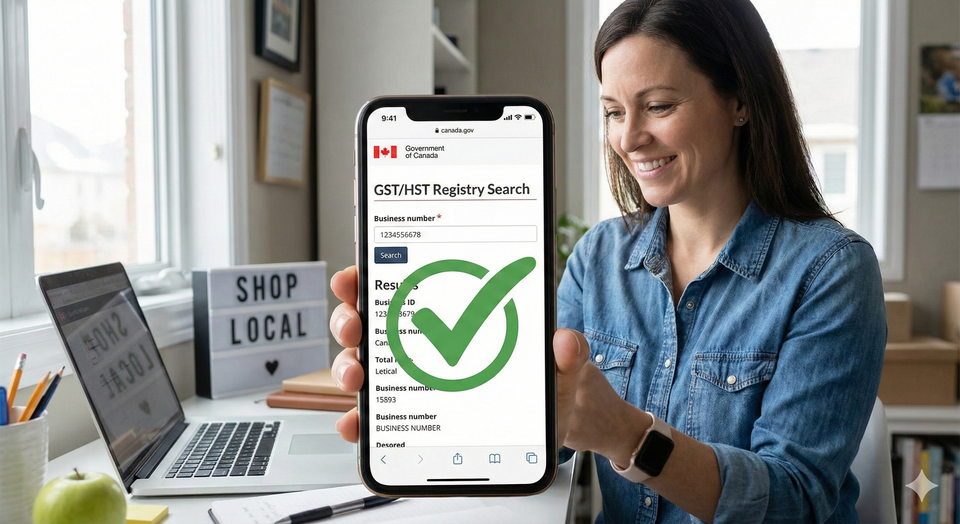
For most Canadians, the GST/HST Registry is a boring government database.
But for smart consumers and entrepreneurs in 2026, it is the ultimate "Lie Detector."
With online scams and "fake gurus" at an all-time high, checking a company's GST number is the fastest way to verify if they are a real, federally registered entity or just a guy with a Wix website.
Whether you are a freelancer wondering if you need to charge tax, or a customer trying to verify a suspicious receipt, the CRA Business Number is the key.
This is the Official 2026 GST/HST Guide. We break down how to use the Registry as a verification tool, the $30,000 Small Supplier Rule, and the "Uber Exception" that forces thousands of gig workers to register immediately.
RELATED
- [Link to: 2026 Canadian Tax Brackets: Federal & Provincial Rates (All Provinces)]
- [Link to: 2026 Uber and SkipTheDishes Tax Guide: What You Can Deduct]
- [Link to: Hidden Tax Credits Canada 2026: What You Might Be Missing]
- [Link to: CRA My Account Locked? How to Reset Your 2026 CRA Login Fast]
- [Link to: 2026 Sales Tax Chart: GST, HST, and PST Rates by Province]
1. The "Search Tool" Secret: How to Verify a Business
This is the #1 tool to catch fake businesses in 2026.
Every legitimate business in Canada that earns over $30,000 must have a GST/HST number. If a contractor, mechanic, or online store charges you tax but cannot provide a valid number, they are stealing that money. They are collecting "tax" from you and keeping it for themselves.
How to Use the "Lie Detector" (Step-by-Step)
- Get the Receipt: Look for the 9-digit number followed by "RT0001" (e.g., 12345 6789 RT0001).
- Go to the Registry: Visit the official CRA GST/HST Registry Search.
- Enter the Data: You must enter the Business Name (or part of it) and the Number.
- The Result:
- "Success/Valid": The business is real, and the tax money is going to the government.
- "Invalid/No Match": The number does not belong to that name. Do not pay the tax.
Tip: If you are hiring a contractor for a $20,000 renovation, run their number first. If they aren't registered for GST, it means they earn less than $30,000 a year (unlikely for a pro) or they are working under the table. This is a massive red flag for insurance and warranty issues.
2. The $30,000 Rule: Do You Need a Number?
Most side hustles do NOT need to register.
The CRA allows you to be a "Small Supplier" and ignore GST/HST entirely, as long as you stay under the revenue cap.
The Threshold
- The Limit: $30,000 in gross revenue (sales, not profit) over the last 4 consecutive quarters.
- Under $30k: You do not need to register. You do not charge tax. You keep 100% of your sales price.
- Over $30k: You must register immediately. You must start adding 5% to 15% (depending on the province) to your invoices.
The "Uber Exception" (Crucial for Gig Workers)
There is one massive exception to the $30,000 rule.
If you drive for Uber, Lyft, or provide commercial ride-sharing services, you must register for GST/HST from Dollar One.
- Why? The CRA has specific legislation for the "Taxi and Limousine" sector that includes app-based drivers.
- Food Delivery? Interestingly, Uber Eats and SkipTheDishes drivers are not taxi operators. They usually fall under the standard $30,000 rule. Check our 2026 Uber and SkipTheDishes Tax Guide to confirm your specific status.
3. The "Input Tax Credit" (ITC) Game
Why you might want to register VOLUNTARILY.
Even if you earn less than $30,000, you can choose to register. Why would you want the headache? To get money back.
When you are registered, you become a tax collector for the CRA. This gives you the right to claim Input Tax Credits (ITCs).
- The Concept: You can claim a full refund of all the GST/HST you paid on business expenses.
- Example: You are a freelance graphic designer earning $20,000 (Small Supplier). You buy a $4,000 MacBook Pro for work.
- If NOT Registered: You pay $4,000 + $520 Tax = $4,520. That $520 is gone.
- If Registered: You pay $4,520, but the CRA refunds you the $520 when you file your GST return.
- The Trade-off: You have to start charging your clients tax. If your clients are businesses, they don't care (because they get it back too). If your clients are regular people, your prices just went up 13%.
4. How to Register (Business Registration Online)
You don't need to call the CRA. Do it in 15 minutes.
In 2026, the entire process is digital via Business Registration Online (BRO).
The Steps:
- Go to BRO: Use the CRA's online portal.
- Verify SIN: You will need your Social Insurance Number.
- Get a BN: If you don't have one, the system will generate a 9-digit Business Number (BN) for you (e.g., 88888 8888).
- Add the RT Account: The system will ask which program accounts you need. Select RT (GST/HST).
- Effective Date: This is crucial. This is the date you must start charging tax.
- Receive Number: You will get your number instantly (e.g., 88888 8888 RT0001). Start putting this on your invoices immediately.
5. Charging Tax in Different Provinces
The "Place of Supply" Rule.
If you sell services online to clients across Canada, you do not charge your local rate. You charge the rate of the customer's province.
- You live in Alberta (5%) but sell to a client in Ontario: You charge 13% HST.
- You live in Ontario (13%) but sell to a client in Alberta: You charge 5% GST.
- The Reference: Use our 2026 Sales Tax Chart to ensure you are billing the correct amount.
Frequently Asked Questions (FAQ)
Q: Can I charge tax before I get my number?
A: Yes, technically. If you have applied but are waiting for the letter, you must collect the tax. However, you cannot show a number on the invoice yet. Tell your client "GST Number Applied For." Once you get the number, send them an updated invoice so they can claim their ITC.
Q: What if I forget to file a "Nil" return?
A: Even if you had $0 in sales and collected $0 in tax, you must file a return to tell the CRA that. If you forget, the CRA will lock your account and may hold back your other benefits (like your personal tax refund or Hidden Tax Credits).
Q: Does a Business Number cost money?
A: No. Registering for a BN and a GST/HST account is 100% free. If a third-party website asks for $50 to "register your business number," it is a scam service charging you for something you can do yourself in 10 minutes.
Q: What happens if I go over $30,000 and don't register?
A: The CRA will eventually audit you. They will calculate the tax you should have collected (e.g., 13% of your sales) and demand you pay it out of your own pocket, plus interest and penalties. It is always safer to register early if you are close to the line.
About the Author
Jeff Calixte (MC Yow-Z) is a Canadian labour market researcher and digital entrepreneur specializing in government benefit data and cost-of-living support. As the founder of CanadaPaymentDates.ca and BetterPayJobs.ca, Jeff helps newcomers, students, and workers navigate the Canadian social safety net—from tracking CRA payment schedules to identifying entry-level employment opportunities.
Sources
- Canada Revenue Agency: Confirming a GST/HST account number
- CRA: General Information for GST/HST Registrants
- Employment and Social Development Canada: Business Registration Online (BRO)
Note
Official 2026 tax regulations and registration thresholds are determined by the Canada Revenue Agency (CRA). While we strive to keep this information current, government policies are subject to change without notice. All data in this guide is verified against official CRA circulars at the time of publication. We recommend confirming the status of your business file directly via CRA My Business Account or by calling the CRA business line at 1-800-959-5525.