Home Accessibility Tax Credit (HATC): Get Paid to Renovate
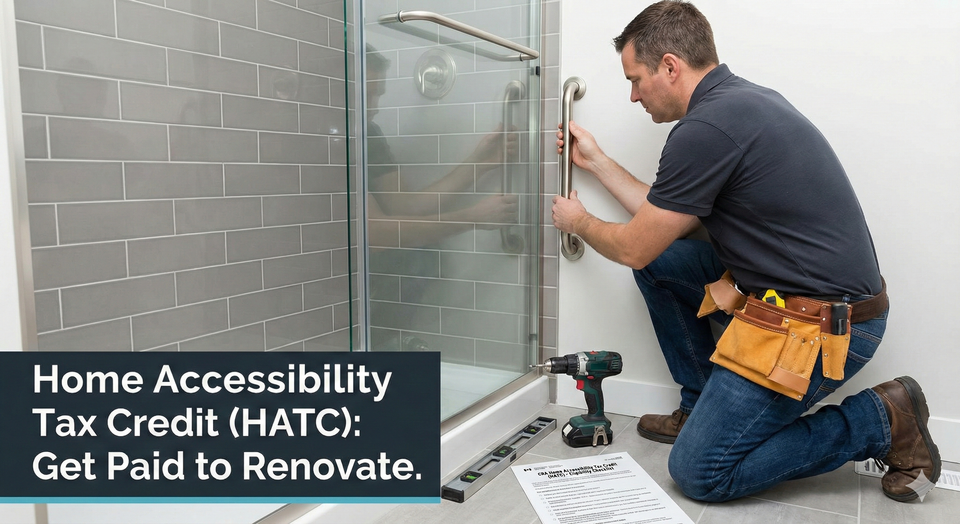
As Canadians age, the desire to stay in one’s own home—often called "aging in place"—has never been stronger. However, most Canadian houses were not built with mobility issues in mind. In 2026, the cost of modifying a home for a wheelchair or a walker can be prohibitive, ranging from $1,500 for a simple ramp to $15,000 for a walk-in bathtub.
This is where the Home Accessibility Tax Credit (HATC) becomes a financial game-changer. Unlike the Multigenerational Home Renovation Tax Credit, which is for building entirely new suites, the HATC is for modifying your existing space to make it safer and more functional. For the 2026 tax year, you can claim up to $20,000 in expenses, resulting in a non-refundable tax credit of $3,000.
As part of our Hidden Tax Credits Canada 2026 Master List, this guide breaks down the "enduring nature" rules, provides a checklist of eligible renovations, and reveals the "Street Hacks" to stack this credit with provincial benefits and medical expense claims.
1. Who Can Claim the HATC in 2026?
The HATC is available to two groups of people: "Qualifying Individuals" and "Eligible Individuals."
The Qualifying Individual
To be the person the renovation is for, you must:
- Be 65 years of age or older by the end of 2026; or
- Be eligible for the Disability Tax Credit (DTC) at any time during the year.
The Eligible Individual
If you are the caregiver or family member paying for the renovation, you can claim the credit if:
- You are the spouse or common-law partner of the senior/disabled person.
- You are a relative (parent, child, sibling, etc.) who has claimed the Canada Caregiver Credit for the qualifying individual.
2. The $20,000 Limit and the 15% Math
The HATC is a non-refundable credit calculated at the lowest federal tax rate (15%).
- Maximum Expense Limit: $20,000 per year.
- Maximum Tax Credit: **$3,000** ($20,000 x 0.15).
- The "Dwelling" Rule: The $20,000 limit is per eligible dwelling. If two seniors live in the same house, they cannot claim $20,000 each; the total for the house is capped at $20,000.
Accessibility Hacks
This deep dive identifies the specific "Street Angles" that most homeowners miss. These hacks allow you to turn a $3,000 credit into a $6,000+ total tax saving.
1. The "Double-Dipping" Master Strategy
HATC vs medical expense tax credit.
- The Street Angle: Most tax credits are "either/or." You can't claim an expense twice.
- The Hack: The HATC is a rare exception. If a renovation qualifies as both a home accessibility expense AND a medical expense, you can claim it for both credits.
- The Strategy: Suppose you spend $15,000 on a walk-in tub for a senior with severe arthritis. You claim $15,000 on Line 31285 (HATC) and the same $15,000 as a medical expense on Line 33099.
- The Payoff: This "Double-Dip" can effectively double your tax savings. For a senior in the 15% bracket, this one renovation could eliminate their entire federal tax bill.
2. The "Risk of Harm" Loophole for Mental Health
Many users search for "HATC risk of harm criteria."
- The Hack: The renovation doesn't have to be for mobility (like a ramp). It can be to "reduce the risk of harm."
- The Strategy: For a senior with early-stage dementia, installing high-contrast flooring (to prevent falls) or a stove with automatic shut-off valves qualifies.
- The Move: If the renovation makes the home safer for someone with a mental impairment (like an auto-locking door system to prevent wandering), it meets the HATC criteria. This is the way to get renovations covered for cognitive disabilities.
3. The "Family Labour" GST/HST Rule
Can your son or daughter do the work?
- The Street Angle: Normally, you cannot claim the value of your own labour or the labour of a relative.
- The Hack: If your relative is a professional contractor and is registered for GST/HST, you can claim their labour costs.
- The Strategy: If your nephew is a licensed plumber and installs your walk-in tub, you can claim his invoice as long as he charges you the market rate and includes his GST/HST number. If he does it for "free" and you just pay for parts, you can only claim the materials.
4. The "Integral to the Dwelling" Test
A common search is "can I claim a stairlift on my Canadian taxes."
- The Reality: To qualify for HATC, the item must be "integral to the dwelling" and "of an enduring nature."
- The Hack: A stairlift is considered integral because it is bolted to the house. However, a "portable" lift that you can move from room to room does not qualify for HATC (though it may qualify as a Medical Expense).
- The Strategy: Always choose "Built-in" over "Portable" if you want to claim the HATC. This includes built-in shower seats vs. portable shower chairs.
5. Provincial Stacking: BC and New Brunswick
If you live in British Columbia or New Brunswick, you are in luck.
- The Hack: These provinces have their own Home Renovation Tax Credits for seniors.
- The Strategy: In BC, you can claim 10% of your expenses (up to $1,000 back) on your provincial return.
- The Move: When you file your 2026 return, ensure you complete the provincial "Schedule 12" equivalent. Stacking the Federal 15%, the Medical Expense Credit, and the Provincial 10% can sometimes result in the government paying for 40% to 50% of your renovation costs.
4. 2026 HATC Eligible Expenses Checklist
| Category | Eligible (HATC) | Not Eligible |
| Mobility | Ramps, widened doorways, elevators. | Wheelchairs (claim as Medical). |
| Safety | Grab bars, handrails, non-slip floors. | Security cameras (Monitoring). |
| Bathroom | Walk-in tubs, wheel-in showers. | Standard toilet replacement. |
| Kitchen | Lowered counters, adjustable sinks. | New standard appliances. |
| Structural | Moving walls, electrical/plumbing for mods. | Routine roof or window repair. |
Home Accessibility Tax Credit 2026
What is the Home Accessibility Tax Credit (HATC) for 2026? The HATC is a non-refundable tax credit for seniors (65+) and those with the Disability Tax Credit to make their homes safer and more accessible. In 2026, you can claim up to $20,000 in eligible expenses, providing a tax credit of up to $3,000. Eligible renovations include wheelchair ramps, walk-in bathtubs, grab bars, and widened doorways. Crucially, most accessibility renovations can be "double-dipped" by claiming them as both an HATC expense and a medical expense on your tax return.
Frequently Asked Questions (FAQ)
Q: Do I need a doctor's note for HATC?
A: No. Unlike medical expenses, the HATC does not strictly require a prescription. However, the renovation must clearly meet the goal of improving accessibility or reducing risk. Keeping a doctor's note is highly recommended in case of an audit.
Q: Can I claim the cost of my own tools?
A: No. The cost of tools, equipment you buy (not rent), and your own labour are explicitly excluded from the HATC.
Q: Does the work have to be done by a professional?
A: Not necessarily, but you must have receipts for all materials. If you hire a contractor, they must be at "arm's length" (not a relative), unless that relative is a GST/HST registrant.
Q: Can a tenant claim the HATC?
A: Yes, if the tenant is a senior or disabled and they paid for the modifications to their rental unit. However, they must have the landlord’s permission for the permanent alterations.
About the Author
Jeff Calixte (MC Yow-Z) is a Canadian labour market researcher and digital entrepreneur specializing in government benefit data and cost-of-living support. As the founder of CanadaPaymentDates.ca and BetterPayJobs.ca, Jeff helps newcomers, students, and workers navigate the Canadian social safety net—from tracking CRA payment schedules to finding entry-level work.
Sources
- Canada Revenue Agency (CRA): Line 31285 – Home accessibility expenses
- CRA: Eligible Dwelling and Qualifying Renovation Criteria
- Government of British Columbia: Home Renovation Tax Credit for Seniors and Persons with Disabilities
Note
Official 2026 payment dates and benefit amounts are determined by the Canada Revenue Agency (CRA) and provincial governments. While we strive to keep this information current, government policies and schedules are subject to change without notice. All data in this guide is verified against official CRA circulars at the time of publication and should be treated as an estimate. We recommend confirming the status of your personal file directly via CRA My Account or by calling the CRA benefit line at 1-800-387-1193.