How Much CCB Will I Get? (2026-2027) Calculator & Payment Table
Calculating your Canada Child Benefit (CCB) can feel like a complex math project. Between income thresholds, clawback rates, and the "Age 6" transition, most parents just wait for the deposit and hope for the best.
However, knowing your exact entitlement is crucial for household budgeting, especially since the CRA adjusts these amounts every July to keep up with the cost of living. For the July 2025 to June 2026 benefit year, the government has increased the maximum amounts by roughly 2.7% to account for inflation.
Canada Child Benefit Calculator 2026-2027: Estimate Your New Increased Payments
Use our free Canada Child Benefit (CCB) Calculator for 2026 to see your new monthly payment amounts. Includes the latest 2.7% inflation increase, RRSP "double-dip" estimates, and calculations for the 2025-2026 and 2026-2027 benefit years. Simple, accurate, and optimized for Canadian families.
Canada Child Benefit Calculator 2026-2027
Live Auto-Updating Payment Schedule (Age 0-18)This is the Direct Payment Table for 2025-2026. Instead of using a complex calculator, use these tables to see the "Maximum" you can receive if your income is below the threshold, and how much you lose as your income rises.
Keep Track of Your Money
Knowing the amount is only half the battle. To see exactly when that money hits your bank account, check our Master Payment Calendar 2026 for all confirmed deposit dates.
The 2025-2026 CCB Maximum Payment Table
These amounts apply to the benefit year running from July 2025 to June 2026.
If your Adjusted Family Net Income (AFNI) from your 2024 tax return was $37,487 or less, you are entitled to the maximum amounts listed below.
| Age of Child | Maximum Yearly Amount | Maximum Monthly Payment |
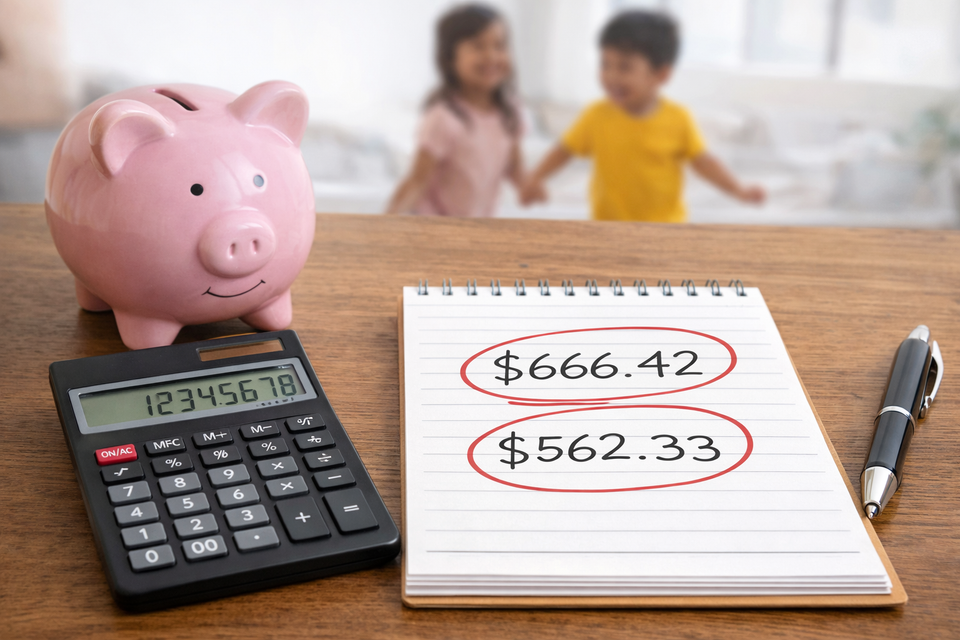
| Under 6 Years Old | $7,997.00 | $666.42 |
| 6 to 17 Years Old | $6,748.00 | $562.33 |
How Much Do I Lose? (The Income Thresholds)
The CCB is "income-tested," meaning as soon as your household earns more than $37,487, your monthly cheque begins to shrink. The CRA uses two main "Clawback" thresholds.
Threshold 1: Income between $37,487 and $81,222
In this bracket, your benefit is reduced by a set percentage of every dollar you earn over the $37,487 mark.
- 1 Child: 7.0% reduction
- 2 Children: 13.5% reduction
- 3 Children: 19.0% reduction
- 4+ Children: 23.0% reduction
Threshold 2: Income over $81,222
Once you cross the $81,222 mark, the clawback becomes steeper. For example, if you have one child, you lose **$3,061 plus 3.2%** of any income earned over that second threshold.
2025-2026 CCB Estimate Table (By Income Level)
This table shows an estimated annual total for a family with one child under 6 years old.
| Adjusted Family Net Income | Estimated Annual CCB | Estimated Monthly Payment |
| $37,487 or less | $7,997 | $666.42 |
| $45,000 | $7,471 | $622.58 |
| **$55,000** | $6,771 | $564.25 |
| **$65,000** | $6,071 | $505.92 |
| **$75,000** | $5,371 | $447.58 |
| **$90,000** | $4,656 | $388.00 |
| **$120,000** | $3,696 | $308.00 |
Cracking the Clawback: How Income Brackets Affect Large Families
The tables above give a snapshot of single-child families, but for families with three, four, or more children, the math shifts drastically. The Canada Revenue Agency (CRA) uses a "progressive clawback" system. This means that as you have more children, the government allows you to keep more of your benefit at higher income levels, but once you hit the second threshold, the reduction is much faster.
For a family with 3 children (all under 6) in the 2025-2026 benefit year:
- Maximum Benefit: **$23,991 per year** ($1,999.25 per month).
- The First Clawback: If your household income is $60,000, you are $22,513 over the base threshold. At a 19% reduction rate, you lose $4,277.
- The Result: Your annual payment becomes **$19,714** ($1,642.83 per month).
For a family with 4 or more children:
The clawback rate jumps to 23% for income between the two thresholds. While this sounds high, the starting maximum is so large (over $31,000/year for 4 kids under 6) that many large families still receive significant support even with a household income of $100,000.
MORE HELPFUL ARTICLES FROM US
- Can I Get EI if I Quit? (Just Cause Checklist)
- TFSA vs. RRSP for Low Income (The GIS Trap)
- Shared Custody CCB Rules (50/50 Split Guide)
- Warm Neighbor Programs (Heating Bill Help)
The RRSP "Double-Dip": How to Increase Your CCB Monthly
This is the most powerful financial "hack" for Canadian parents in 2026. Because your CCB amount is calculated using your Adjusted Family Net Income (AFNI) (Line 23600), any legal deduction that lowers that line will increase your child tax.
The Strategy:
When you contribute to your Registered Retirement Savings Plan (RRSP), you aren't just saving for the future; you are "hiding" that income from the CCB calculator.
The Example:
Imagine a family with two children under 6 earning $85,000 a year.
- Without RRSP: Their income is above the second threshold ($81,222). Their CCB is reduced by the standard 13.5% and 5.7% tiers.
- With a $10,000 RRSP Contribution: Their "Net Income" drops to $75,000.
- The Payoff: Not only do they get a massive tax refund (approx. $3,000 depending on the province), but their CCB monthly payment will increase by roughly $112 per month starting in July.
This is what financial planners call "The CCB Double-Dip." You get the tax savings and a monthly raise from the government.
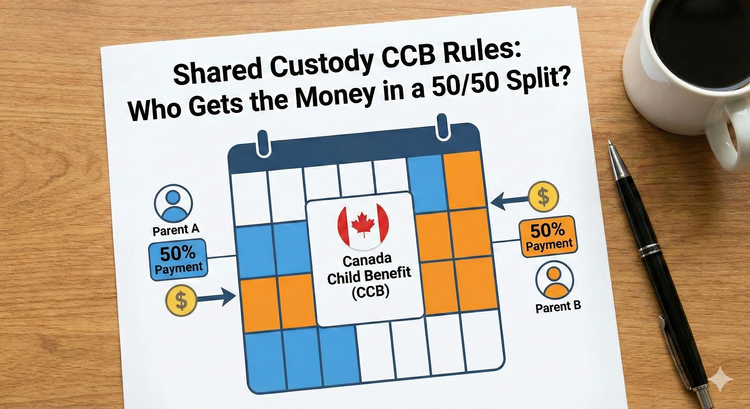
CCB Shared Custody: How the 40/60 Rule Divides the Table
If you are separated or divorced, the numbers in the maximum payment table are cut in half. The CRA is very strict about custody definitions in 2026.
- Full Custody (>60% time): You receive 100% of the CCB based on your income.
- Shared Custody (40% to 60% time): Both parents receive 50% of what they would have received if they had full custody.
- The Income Trap: In shared custody, the amounts are calculated based on each parent's own income. If Parent A earns $30,000 and Parent B earns $150,000, Parent A will get a large half-cheque, while Parent B may get a very small half-cheque (or zero).
Pro Tip: If your custody arrangement changes, you must notify the CRA immediately via CRA My Account. If you don't, and they find out you switched from full to shared custody, they will issue an "Overpayment Notice" and demand thousands of dollars back.
Retroactive Claims: The 10-Year Newcomer Rule
If you recently arrived in Canada on a Work Permit, you might have missed out on several months of payments because you didn't know you could apply.
The CRA allows you to claim CCB retroactively for up to 10 years.
- The Catch: You must have been a "Resident for Tax Purposes" during those years.
- The Newcomer Strategy: If you landed in 2024 but only filed your first tax return in 2026, the CRA will calculate your missed payments all the way back to your landing date. For a family with two kids, this "Back-Pay" deposit can easily exceed $5,000 in a single lump sum.
Provincial Top-Ups: Adding to the Federal Table
The table at the top of this post only shows the Federal portion of the CCB. Most provinces add their own money to this deposit, which the CRA distributes on their behalf.
- Ontario Child Benefit (OCB): Adds up to **$1,750 per year** ($145.83/month) for families earning under $25,000.
- BC Family Benefit: Adds up to $1,750 for the first child and $1,100 for the second. In 2026, BC has some of the highest combined child benefits in the country.
- Quebec (Allocation famille): This is the only province that does not use the CRA to pay. If you live in Quebec, you receive a separate cheque from Retraite Québec.
To see how these provincial additions change your total monthly cash flow, you can view the combined dates on our Master Payment Calendar.
2026-2027 Looking Ahead: The July Increase
While the current tables cover you until June 2026, the government has already announced the July 2026 inflation adjustment.
- New Maximum (Under 6): Rising to **$8,157 per year** ($679.75/month).
- New Maximum (6-17): Rising to **$6,883 per year** ($573.58/month).
- The Threshold Shift: The income level where you start to lose money is also rising to $38,237. This means families can earn a bit more in 2026 without seeing their child tax drop.
The "Age 6" Transition: Why Your Cheque Drops
One of the most frequent questions we receive is: "Why did my CCB drop by $100 this month?"
As shown in the table above, the government pays $1,249 less per year for a child aged 6 to 17 than they do for a child under 6.
- The change happens the month after your child's 6th birthday.
- If your child turns 6 in October, your November payment will be the first one at the lower rate ($562.33 instead of $666.42).
The Child Disability Benefit (CDB) Top-Up
If your child is eligible for the Disability Tax Credit, you receive an additional monthly supplement on top of your regular CCB.
- 2025-2026 CDB Maximum: **$3,411.00 per year** ($284.25 per month).
- Important: You do not need to apply for this separately. Once your DTC application is approved, the CRA will automatically add this to your next CCB deposit.
Factors That Change Your Payment Amount
While income is the biggest factor, these three situations will also change the numbers in the table for you:
1. Shared Custody
If you share custody of your children 50/50, you do not get the full amounts listed above. Instead, both parents receive 50% of what they would have received if they had full custody (based on their own individual income).
2. Moving Provinces
The table above shows the Federal CCB. Many provinces have their own "Child Benefits" that are added to this cheque.
- Ontario: The Ontario Child Benefit (OCB) adds up to **$1,680 per year** ($140/month) per child.
- Alberta: The Alberta Child and Family Benefit (ACFB) provides quarterly payments that are separate from your monthly CCB.
3. The RRSP "Boost"
Because the CCB is based on Net Income, contributing to your RRSP can actually increase your child tax. If you contribute $10,000 to an RRSP, your net income drops, which can move you into a lower clawback bracket and increase your monthly CCB cheque by $50–$100.
What to Do If Your Amount Is Wrong
If your deposit doesn't match the 2025-2026 tables and your income hasn't changed, check these three things:
- Uncashed Cheques: Did you miss a previous payment? Check your CRA My Account.
- Marital Status: Did you recently update your status to "Common-Law"? This combines your income and usually lowers your payment.
- Filing Delay: If you filed your 2024 taxes late, your July 2025 recalculation might be delayed.
Need to Bridge a Financial Gap?
Even with the maximum CCB, the "Back to School" or "Holiday" seasons can put a massive strain on family finances. If your monthly child tax isn't quite covering the bills this month:
👉 Find Daily Pay Jobs at BetterPayJobs.ca
About the Author
Jeff Calixte (MC Yow-Z) is a Canadian labour market researcher and digital entrepreneur specializing in government benefit data and cost-of-living support. As the founder of CanadaPaymentDates.ca and BetterPayJobs.ca, Jeff helps newcomers, students, and workers navigate the Canadian social safety net—from tracking CRA payment schedules to finding entry-level work.
Sources
- Canada Revenue Agency: CCB calculation sheet for July 2025 to June 2026
- CRA: How your CCB is calculated
- Government of Canada: Child Disability Benefit amounts 2026
Note
Official 2026 payment dates and benefit amounts are determined by the Canada Revenue Agency (CRA) and provincial governments. While we strive to keep this information current, government policies and schedules are subject to change without notice. All data in this guide is verified against official CRA circulars at the time of publication and should be treated as an estimate. We recommend confirming the status of your personal file directly via CRA My Account or by calling the CRA benefit line at 1-800-387-1193.