
2026 Northern Residents Deduction: New Daily Rates and Zone Maps
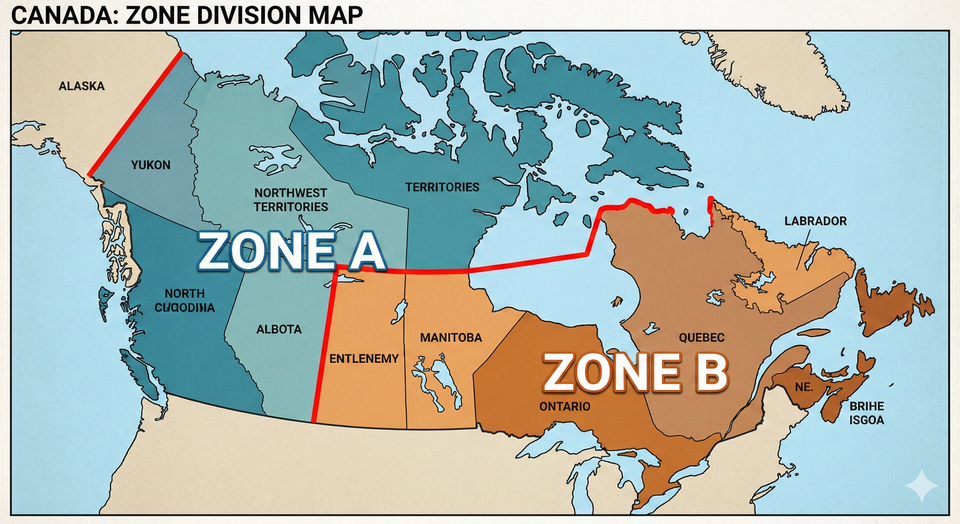
Living in the North is not just a lifestyle choice; it’s a financial endurance sport. When a jug of milk costs $15, high-speed internet is a luxury, and flying to the nearest major city costs more than a trip to Europe, you need every financial break you can get.
To compensate for the brutal cost of living in Canada's remote regions, the Canada Revenue Agency (CRA) offers one of the most generous tax breaks in the entire system: the Northern Residents Deduction (NRD).
This is not a small credit ($50 here, $100 there). For a qualifying resident in 2026, this deduction can knock over **$8,000** off your taxable income. For someone in a high tax bracket, that is equivalent to a $3,000 to $4,000 cash refund.
Yet, every year, thousands of northern residents under-claim. They confuse "Zone A" with "Zone B," they fail to claim the "Additional Amount" because they misunderstand the rules, or they leave travel money on the table because they lost their boarding passes.
This is the Official 2026 Master Guide to the Northern Residents Deduction. We break down the massive new Haida Gwaii Upgrade, explain the "Simplified Travel" method that ends receipt hoarding, and provide the definitive visual guide to who qualifies for the big money.
1. The "Zone A vs. Zone B" Visual Guide
The most important question in northern taxes: Which side of the line are you on?
The CRA does not treat all "North" equally. They divide the country into two distinct zones based on isolation and cost of living. Your address determines your zone, and your zone determines the size of your deduction.
- Zone A (The Gold Mine): Prescribed Northern Zones. Residents get the 100% deduction rate.
- Zone B (The Silver Mine): Prescribed Intermediate Zones. Residents get the 50% deduction rate.
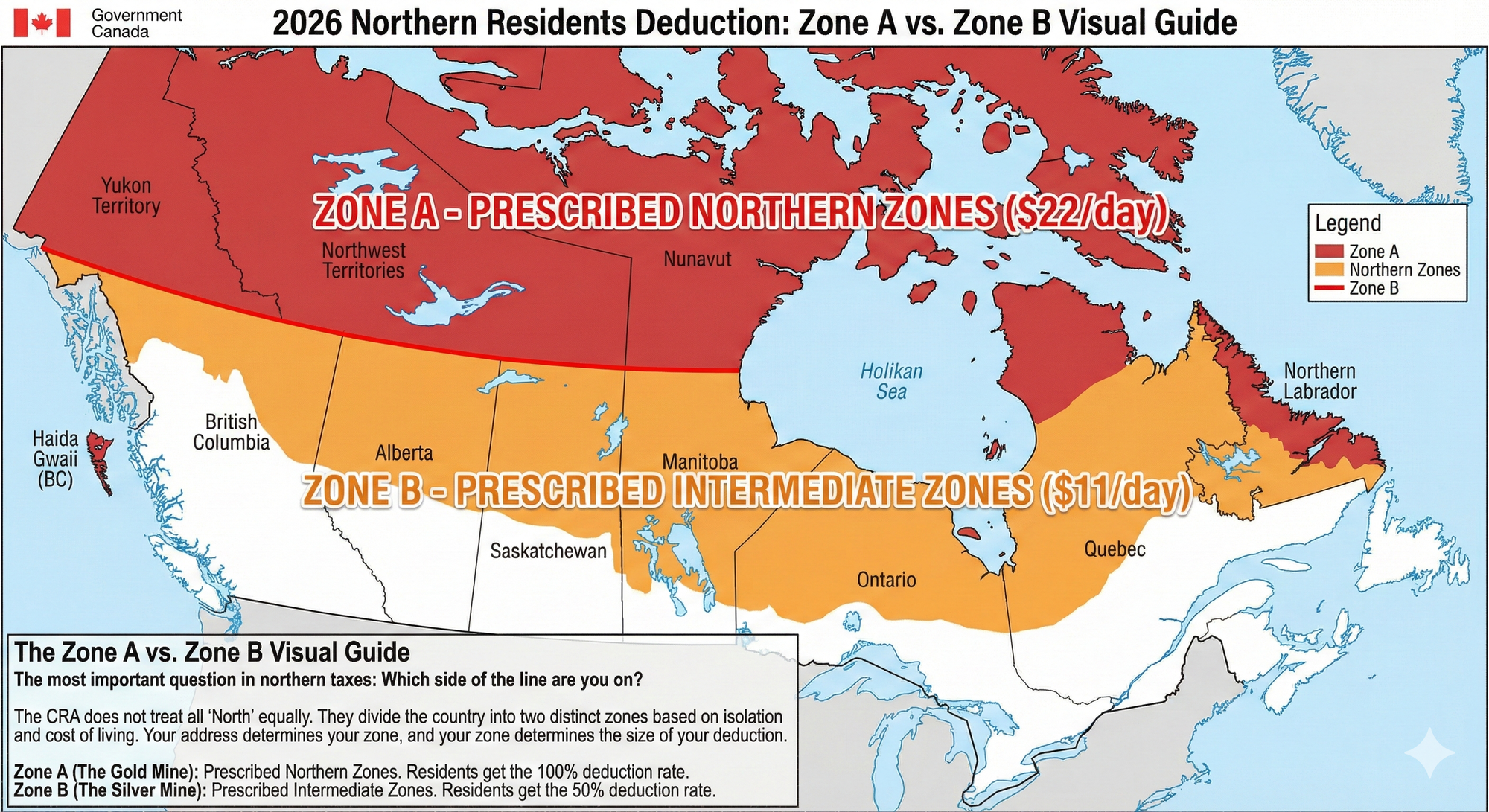
Visual map is crucial but, here is a text-based breakdown of the geographical divide for 2026.
ZONE A: The Full Deduction ($22/day Max)
These are the hardest-hit areas for cost of living. If you live here, you get the maximum possible amount.
- The Territories (The Big Three):
- Yukon: The entire territory, from Whitehorse to Old Crow.
- Northwest Territories (NWT): The entire territory, including Yellowknife, Inuvik, and Hay River.
- Nunavut: The entire territory, including Iqaluit and Rankin Inlet.
- British Columbia (The New Upgrade):
- Haida Gwaii: (Formerly Zone B, now Zone A for 2026). Includes Queen Charlotte, Masset, Skidegate, and Sandspit.
- Far North BC: Areas north of the standard line, such as Atlin and Dease Lake.
- Manitoba (Hudson Bay):
- Churchill and the surrounding deep northern regions.
- Quebec & Labrador (The Atlantic North):
- Nunavik: All of Quebec north of the 55th parallel (e.g., Kuujjuaq).
- Labrador: The entire coast of Labrador (e.g., Happy Valley-Goose Bay, Nain) and the interior.
ZONE B: The Half Deduction ($11/day Max)
These define the "Near North" or "Remote South." They are expensive and isolated, but not as extreme as Zone A.
- British Columbia (The Northwest Corridor):
- Major hubs like Prince Rupert, Terrace, Kitimat, Smithers, and Fort St. John.
- Alberta (The Northern Reach):
- High Level, Fort McMurray, Peace River, and Grande Prairie.
- Saskatchewan (The Shield):
- La Ronge, Creighton, and Stony Rapids.
- Manitoba (The Mining Belt):
- Thompson, Flin Flon, and The Pas.
- Ontario (The Remote North):
- Moosonee, Pickle Lake, Red Lake, and Sioux Lookout. (Note: Thunder Bay and Timmins are not in either zone).
Tip: Do not guess. Being one kilometer on the wrong side of the line cuts your deduction in half. Verify your exact status using your postal code on the official CRA site.
2. 2026 Daily Rates & The "Double-Up" Trick
Understanding how to turn the "Basic" amount into the "Additional" amount is the key to maximizing this claim.
The Residency Deduction is calculated daily. Every day you live in a prescribed zone, you earn a tax deduction.
The Basic Rate (Everyone Gets This)
If you lived in the zone for the full year (365 days), you are guaranteed this minimum deduction:
- Zone A: $11.00 per day x 365 = **$4,015**
- Zone B: $5.50 per day x 365 = **$2,007.50**
The "Additional" Amount (The Doubler)
This is where people lose money. The CRA offers a second deduction, equal to the basic amount, if you are the person "maintaining the dwelling."
You can claim this Additional Amount only if you are the only person in the household claiming the Basic Amount.
How It Works (The "Roommate Rule"):
To maximize family income, you need to strategize who claims what.
- Scenario 1: The Solo Renter (Zone A)
- You live alone in an apartment in Yellowknife and pay rent.
- You claim the Basic Amount ($11/day).
- Since nobody else lives there, you also claim the Additional Amount ($11/day).
- Total Deduction: $22/day = **$8,030 per year.**
- Scenario 2: The Couple (Zone A)
- You and your spouse live together in a house you own in Iqaluit. Both of you work.
- Option A (Split It): You both claim the Basic Amount ($11 each). Neither of you can claim the Additional Amount. Total household deduction: **$8,030**.
- Option B (Stack It): Your spouse claims the Basic Amount ($11). You claim nothing. Because you claimed nothing, your spouse can now claim the Additional Amount ($11). Total household deduction: $8,030.
- The Strategy: The total household deduction is the same either way. However, it is usually smarter to stack the full deduction onto the higher-income earner, as it will save them tax at a higher marginal bracket. Check our 2026 Canadian Tax Brackets to see whose income would benefit most from an $8,030 reduction.
- Scenario 3: The Roommates (Zone B)
- You live in Fort McMurray with two roommates in a rented house. All three of you have income.
- You all claim the Basic Amount ($5.50/day).
- Nobody can claim the Additional Amount because more than one person in the house is claiming the Basic.
3. The "Haida Gwaii" Upgrade (New for 2026)
A massive financial win for residents of BC's westernmost islands.
For decades, residents of Haida Gwaii have argued that their cost of living and isolation—reliant on expensive ferries and flights—rivalled the territories. The federal government agreed.
Effective for the 2025 tax year (which you file in Spring 2026), the entirety of Haida Gwaii has been reclassified from Zone B to Zone A.
The Financial Impact:
- Old Rule (2024 and prior): A resident of Queen Charlotte claiming the maximum would get an $11/day deduction (approx. $4,000).
- New Rule (2026): That same resident now gets the $22/day deduction.
- The Result: Their tax deduction doubles to $8,030, likely putting an extra $1,500 to $2,000 of actual cash back in their pocket compared to previous years.
4. The Travel Deduction Hack (No Receipts Needed)
Stop hoarding your boarding passes in a shoebox. The system has changed.
Living in the North means spending a fortune on flights to see family or get medical care in southern cities. The NRD allows you to deduct the cost of these trips.
Historically, this was a nightmare of calculating the "Lowest Return Airfare" (LRA) and keeping every receipt. In 2026, you should be using the Simplified Method.
How the Simplified Method Works
The CRA now publishes official Airfare Tables for designated northern airports. These tables provide a standard, flat-rate cost for a return flight to the nearest "designated city" (usually Vancouver, Edmonton, Winnipeg, or Montreal).
- The Limit: You can claim up to 2 personal trips per year per member of your household. (There is no limit on medical trips).
- The Claim: Instead of finding quotes or digging up receipts, you simply look up the CRA's "Medium" flight cost for your airport and claim that amount.
The "Box 32" Trap
Many northern employers provide a "Travel Allowance" or pay for your flights home. This benefit is added to your income on your T4 slip in Box 32.
- The Rule: You cannot double-dip. Your travel deduction is limited to the lesser of:
- The amount of the taxable travel benefit you received from your employer (Box 32).
- The actual cost of the travel (or the Simplified Table amount).
- The Strategy: If you have an amount in Box 32, you must file a travel claim on Form T2222. If you don't, you are paying income tax on that travel benefit without getting the offsetting deduction.
5. Eligibility Traps: The "6-Month Rule" & Camps
Two reasons the CRA denies these claims.
Trap 1: The 6-Month Requirement
You must live in a prescribed zone for a continuous period of at least six consecutive months.
- Moving In: If you moved to Whitehorse on October 1, 2025, you haven't hit 6 months by December 31. You cannot claim the NRD on your 2025 return. However, once you hit April 1, 2026 (6 months), you qualify. You can then file an adjustment to retroactively claim the days from 2025.
- Moving Out: If you lived in Yellowknife for 5 years and moved to Toronto on March 1, 2026, you can claim the deduction for the days you lived there in 2026, because your period of residency was longer than 6 months total.
Trap 2: Work Camps vs. "Dwelling"
To claim the deduction, you must maintain and reside in a "self-contained domestic establishment."
- The Rule: If you fly into a remote mining camp in Zone A for a 2-week rotation, stay in a bunkhouse provided by your employer, and eat at the mess hall, you generally do not qualify. You are not maintaining a dwelling; your employer is. Your principal residence is likely down south.
- The Exception: If you live in a self-contained unit (kitchen, bath, sleeping area) in a northern community and you pay for your own groceries and utilities, you qualify, even if the housing is subsidized by your employer.
Frequently Asked Questions (FAQ)
Q: Does living in the North affect my other benefits?
A: Yes, positively. Because of the high cost of living, residents of rural and small northern communities get a 20% top-up on the federal carbon tax rebate. Check our Carbon Tax Rebate 2026 (CCR) Guide to see the exact amounts and deposit dates for your province or territory.
Q: Can I claim the travel deduction if I drove out?
A: Yes. If you drove from Whitehorse to Vancouver, you can claim the expenses. Under the simplified method, you can often claim the equivalent airfare value from the CRA tables, even if you drove, provided it's reasonable.
Q: How do I file this claim?
A: You must complete Form T2222 (Northern Residents Deductions) and attach it to your T1 General tax return. Most tax software handles this automatically when you indicate your northern postal code. You can ensure your address is updated and check for past claims by logging into the CRA portal—if you're having trouble accessing it, use our CRA My Account Recovery Guide.
About the Author
Jeff Calixte (MC Yow-Z) is a Canadian labour market researcher and digital entrepreneur specializing in government benefit data and cost-of-living support. As the founder of CanadaPaymentDates.ca and BetterPayJobs.ca, Jeff helps newcomers, students, and workers navigate the Canadian social safety net—from tracking CRA payment schedules to identifying entry-level employment opportunities.
Sources
- Canada Revenue Agency: Line 25500 – Northern residents deductions
- Department of Finance Canada: Budget 2024 Measures (Haida Gwaii Reclassification)
- CRA: Simplified Northern Residents Travel Deduction Tables
Note
Official 2026 tax deductions, zone classifications, and daily rates are determined by the Canada Revenue Agency (CRA). While we strive to keep this information current, government policies are subject to change without notice. All data in this guide is verified against official CRA circulars at the time of publication. We recommend confirming the status of your personal file directly via CRA My Account or by calling the CRA benefit line at 1-800-387-1193.