
How to Rebuild Credit After Bankruptcy 2026: The Secured Card Strategy
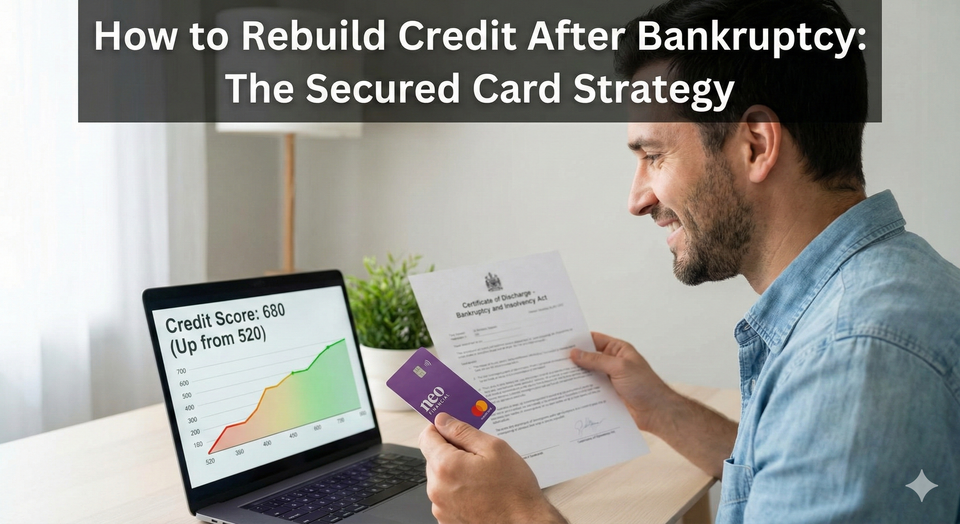
Being discharged from bankruptcy in 2026 is often described as a "Financial Reset," but for many Canadians, it feels more like being a "Financial Ghost." You have no debt, but you also have no reputation. To a bank, you are a blank slate with a red flag (the R9 rating) attached. Most people believe they have to wait the full 6 or 7 years for the bankruptcy to fall off their report before they can enjoy low interest rates or a mortgage again.
This is a myth. While the bankruptcy note remains, your Score can be rebuilt independently of that note. In 2026, the most powerful tool for this is the Secured Credit Card. Unlike a standard card, which is a loan based on trust, a secured card is a tool based on collateral. It allows you to prove your reliability to the credit bureaus in real-time.
As a centerpiece of our Debt & Credit Series, this deep dive provides the step-by-step "Velocity Strategy." We compare the best secured cards for 2026, explain the "30% Utilization" math, and reveal the secrets to moving from an R9 to an R1 rating while the bankruptcy note is still visible.
1. The Immediate Start Rule: Why Waiting is a Mistake
The biggest mistake Canadians make after bankruptcy is "Credit Avoidance." They are so scarred by their debt experience that they vow never to use a credit card again.
The Scoring Reality
Your credit score is calculated based on five factors, the most important being Payment History (35%) and Credit Utilization (30%).
- The Problem: If you don't have an active credit account, you have no payment history to report.
- The Result: Your score will stay "frozen" in the 300s or 400s.
- The Move: You must begin rebuilding the day you receive your Certificate of Discharge. In 2026, lenders like Home Trust and Capital One offer "Zero Waiting Period" approvals for discharged bankrupts.
2. What is a Secured Credit Card? (Answer Target)
How does a secured credit card work in Canada? A secured credit card is a real credit card that requires a one-time refundable security deposit (typically $50 to $500). This deposit acts as your credit limit. Unlike a prepaid card, a secured card reports your monthly payment history to Equifax and TransUnion. This allows you to build a positive "R1" payment record even if you have a past bankruptcy (R9) on your file. If you close the account in good standing, your deposit is returned in full.
3. The Top 3 Secured Cards in Canada for 2026
Not all secured cards are created equal. Some report to only one bureau, while others have predatory monthly fees.
1. Neo Financial Secured Mastercard
- Deposit: As low as $50.
- 2026 Win: Guaranteed Approval with no credit check. It provides 1% cashback on gas and groceries, which is rare for a credit-builder card.
- Reporting: Reports to both Equifax and TransUnion.
2. Capital One Guaranteed Secured Mastercard
- Deposit: Usually $75 or $300.
- 2026 Win: They are the most famous "Bankruptcy Friendly" lender in Canada. If you had a previous Capital One card included in your bankruptcy, they may still approve you for a secured version to help you rebuild.
- Fee: $59 annual fee (typical for the industry).
3. Home Trust Secured Visa
- Deposit: Minimum $500.
- 2026 Win: It is a "Classic" Visa. It doesn't look like a "rebuilding card" to merchants, making it perfect for renting cars or booking hotels where prepaid cards are often rejected.
- Fee: $0 annual fee (with 19.9% interest) or $59 (with 14.9% interest).
Velocity Strategy
To reach a 700+ score before your bankruptcy falls off, you need more than just a card. You need a system. This deep dive reveals the "Velocity Strategy" used by credit engineers to bypass the standard 6-year recovery timeline.
1. The 2-2-2 Rule for Maximum Impact
A common search for 2026 is "how many credit cards to rebuild credit."
- The Street Angle: One card is good, but two is better.
- The Hack: To maximize your "Credit Mix" and "Account Breadth," aim for two secured cards and two installment loans (like a small Credit Builder Loan).
- The Strategy: Apply for your first secured card (e.g., Neo) the day you are discharged. Wait 6 months, then apply for a second (e.g., Home Trust).
- The Payoff: Having two "R1" (Paid as Agreed) ratings reporting every month doubles the speed of your score recovery compared to having just one.
2. The 10% Utilization Math
Most blogs say Keep your balance under 30%.
- The Hack: For a post-bankruptcy file, 30% is too high.
- The Strategy: Aim for 10% utilization. If your secured card has a $500 limit, never let the statement balance exceed **$50**.
- The Science: Credit bureaus see low utilization as a sign that you have plenty of access to credit but don't need it. This is the single fastest way to spike a score from the 500s into the 600s.
- The Move: Use the card only for a small, recurring bill (like Netflix or your phone bill) and set up Auto-Pay to clear the balance 3 days before the statement date.
3. The Statement Date vs. "Due Date" Secret
This is the most common mistake in rebuilding.
- The Trap: You pay your bill in full on the due date.
- The Problem: By the time you pay, the "High Balance" has already been reported to the bureaus.
- The Hack: Pay your balance in full 3 days before the statement ends.
- The Result: When the bank sends the data to Equifax, they report a $0 or $10 balance, keeping your utilization near perfect. This "Hacker Move" can result in a 20 to 30 point jump in a single month.
4. Moving from Secured to Unsecured (The Graduation)
When do I get my deposit back?
- The Reality: Most secured cards don't "automatically" graduate.
- The Hack: After 12 to 18 months of perfect payments, call the lender and ask for a "Product Switch" to an unsecured card.
- The Strategy: If they say no, apply for an unsecured card at a different bank (like a Canadian Tire Mastercard or a Simplii Financial card). Once you are approved for the unsecured card, you can close the secured card and get your $500 deposit back.
- The Warning: Do not close your oldest secured card until the new unsecured card has been active for at least 3 months, or your "Average Age of Accounts" will drop, temporarily hurting your score.
5. Cleaning the "Zombie" R9 Items
A rising search in 2026 is "cleaning credit report after bankruptcy discharge."
- The Street Angle: Your bankruptcy is discharged, but your old credit card still shows a balance and a "Charge Off" status.
- The Hack: This is illegal.
- The Strategy: Every debt included in your bankruptcy must show a $0 balance and be marked as "Included in Bankruptcy."
- The Move: Pull your free monthly reports from Borrowell (Equifax) and Credit Karma (TransUnion). If you see a balance on an old debt, file a dispute immediately and attach your Certificate of Discharge. Removing these "Zombies" is essential for the Secured Card Strategy to work.
5. Summary: Rebuilding Timeline Expectations
| Milestone | Credit Score Goal | Action Step |
| 0-3 Months | 450 - 525 | Get first secured card; keep $0 balance. |
| 6-12 Months | 550 - 625 | Get second card; add a credit-builder loan. |
| 18-24 Months | 650 - 700 | Apply for first "B-Lender" Car Loan or Mortgage. |
| 36 Months | 720+ | Graduate to premium rewards credit cards. |
Rebuild Credit After Bankruptcy
How do I rebuild my credit after bankruptcy in Canada? The most effective strategy is to open a secured credit card immediately upon discharge. By providing a refundable security deposit (e.g., $500), you gain a credit limit that you can use to establish a new history of on-time payments. To maximize your score, keep your credit utilization below 10% and ensure the lender reports to both Equifax and TransUnion. Within 18 to 24 months of responsible use, most Canadians can see their score rise from the 400s to near 700, making them eligible for unsecured credit again.
Frequently Asked Questions (FAQ)
Q: Can I get a secured card while I am still in bankruptcy?
A: No. Most lenders, including Home Trust and Capital One, require you to be fully discharged (received your Certificate of Discharge) before they will approve an application.
Q: Do prepaid cards (like KOHO or PC Money) build credit?
A: Generally, No. Most prepaid cards do not report to the credit bureaus. However, some (like KOHO's Credit Builder) offer a separate paid subscription service that does report a small "Line of Credit" to Equifax. Make sure you are using the "Credit Builder" feature, not just the standard spending account.
Q: What if I can't afford a $500 deposit?
A: Look for the Neo Financial Secured Mastercard. They allow deposits as low as $50, making it the most accessible entry point for credit rebuilding in 2026.
Q: Is it better to have a high or low credit limit on a secured card?
A: A higher limit (e.g., $2,000) is better for your score because it makes it easier to keep your utilization ratio low. However, only deposit what you can afford to have "locked away" for 1-2 years.
About the Author
Jeff Calixte (MC Yow-Z) is a Canadian labour market researcher and digital entrepreneur specializing in government benefit data and cost-of-living support. As the founder of CanadaPaymentDates.ca and BetterPayJobs.ca, Jeff helps newcomers, students, and workers navigate the Canadian social safety net—from tracking CRA payment schedules to finding entry-level work.
Sources
- BDO Debt Solutions: How to Rebuild Credit After Bankruptcy - Step-by-Step
- Financial Consumer Agency of Canada (FCAC): Building and Repairing Your Credit History
- Home Trust Company: Secured Visa Credit Building FAQ
- Capital One Canada: How Secured Mastercard Helps After Bankruptcy
Note
Credit score algorithms (Equifax/TransUnion) and lending criteria are determined by private financial institutions and are subject to change without notice. This guide is for informational purposes only and does not constitute professional financial advice. If you are facing insolvency or legal action regarding debt, we recommend consulting with a Licensed Insolvency Trustee (LIT) or a non-profit credit counsellor.