RESP Rules: What Happens to the Money if My Kid Doesn't Go to College?
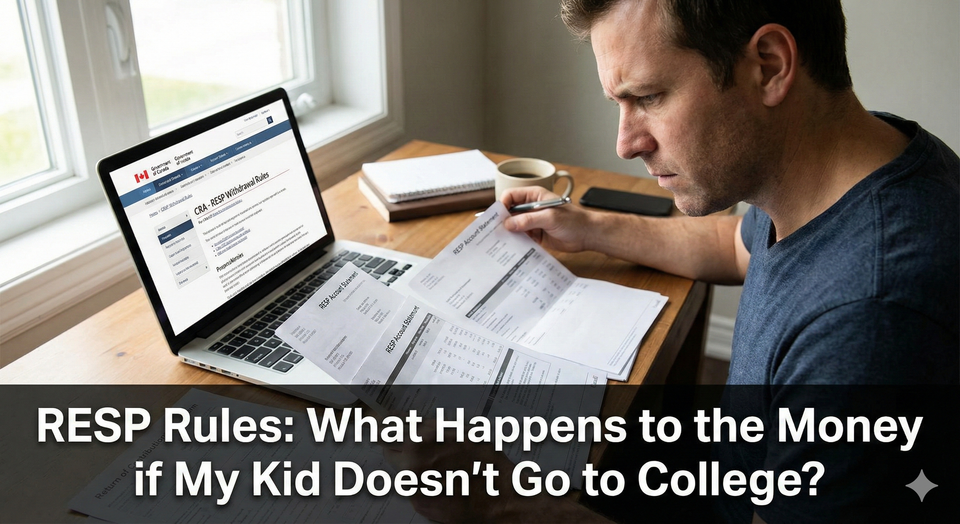
One of the biggest fears for parents saving in a Registered Education Savings Plan (RESP) is the "What If" scenario: What if my child decides not to go to university? Many believe the money is simply "lost" or heavily penalized by the government. In the 2026 economic landscape, where alternative paths like trades, entrepreneurship, or gap years are increasingly popular, knowing your exit strategy is as important as your contribution strategy.
If you have been following our Ultimate Savings Guide, you know that maximizing government matches is key. But the RESP is surprisingly flexible. You aren't "locked in" to a four-year degree. Whether your child chooses a trade school, a specialized apprenticeship, or decides to enter the workforce immediately, there are legal "off-ramps" that protect your principal investment.
This guide breaks down the "Exit Rules" for RESPs, explains the difference between EAPs and PSEs, and reveals the strategies to move that money into your own retirement without paying a 20% penalty.
1. The 36-Year Rule: Time is on Your Side
The most important thing to remember is that an RESP does not expire the day your child turns 18.
- The Lifespan: An RESP can remain open for up to 36 years.
- The Strategy: If your 18-year-old decides to take a five-year "soul-searching" journey or starts a business, you don't need to close the account. You can leave the money in the plan, where it continues to grow tax-deferred. They might decide to go to a trade school or specialized college at age 25, and the money will be waiting for them.
2. The Three Buckets of RESP Money
To understand what happens when you withdraw, you must see the RESP as three separate "buckets."
| Bucket | Source | If No School? |
| The Principal (PSE) | Your own contributions | Returned to you tax-free. |
| The Grants (CESG/CLB) | Government matches | Returned to the government. |
| The Growth (AIP) | Interest/Dividends/Gains | Taxed + 20% penalty (unless rolled over). |
3. Option 1: The "New Beneficiary" Swap
If you have more than one child, this is the easiest path.
- The Hack: You can transfer the money from one child's RESP to another's (usually a sibling) as long as the new beneficiary is under 21.
- The Perk: In a Family RESP, this is even easier. The grants and earnings can be shared among siblings, provided no one child receives more than the $7,200 lifetime CESG limit.
"RESP Rescue"
The following strategies are designed to protect your investment growth (the earnings) which is the most vulnerable part of the RESP if school is out of the picture.
1. The $50,000 RRSP Rollover Hack
The search term "RESP RRSP rollover conditions" is a lifeline for parents with large accounts.
- The Street Angle: If you withdraw the earnings as cash (an Accumulated Income Payment or AIP), the CRA hits you with your regular income tax rate plus a 20% penalty.
- The Hack: You can transfer up to $50,000 of these earnings directly into your (or your spouse's) RRSP.
- The Requirements: 1. The RESP must have been open for 10 years. 2. The child must be at least 21 and not in school. 3. You must have RRSP contribution room.
If you don't have enough room this year, stop contributing to your RRSP for a year to "create" the space needed for the rollover. Using Form T1171 allows the bank to move the money without withholding any tax at the source.
2. The "Trade School" Definition Expansion
Many parents close RESPs because they think "Post-Secondary" only means University.
- The Reality: In 2026, the list of "Designated Educational Institutions" has exploded.
- The Hack: If your child takes a 3-week specialized pilot training course, a certified hair styling program, or a licensed heavy equipment operator course, they are eligible for Educational Assistance Payments (EAPs).
- The Strategy: Before collapsing the plan, check the Master List of Designated Educational Institutions on the Canada.ca website. Even a part-time vocational course can "unlock" the grants and growth, saving you from the grant clawback.
3. The RDSP "Disability" Transfer
"Transfer RESP to RDSP."
- The Street Angle: If your child has a disability and qualifies for the Disability Tax Credit (DTC), you can move the RESP earnings into a Registered Disability Savings Plan (RDSP).
- The Benefit: This move is tax-deferred. While you still have to return the government grants (CESG), the growth stays within a tax-protected environment for your child's long-term care.
"RESP to RDSP rollover eligibility requirements 2026" — This is the only way to move growth to a child's account without them being in school.
4. The "6-Month Grace Period" Strategy
If your child starts university but drops out after one semester, you have a window of opportunity.
- The Hack: You can continue to make EAP withdrawals for up to 6 months after they leave school.
- The Move: If they are planning to quit, maximize the withdrawal of the "Grant and Growth" bucket immediately. This ensures the government’s money is used for their "living expenses" during their transition, rather than being clawed back the moment they de-register.
5. Gift to an Educational Institution
If you are in a high tax bracket and don't have RRSP room, the AIP penalty can be brutal.
You can choose to "bestow" (gift) the remaining earnings to a designated Canadian school (like your own alma mater).
- The Benefit: While you don't get a tax receipt for this, you avoid the 20% penalty and the tax bill. It’s a way to ensure the money supports education rather than disappearing into government penalties.
5. Summary: What to Do This Week
| Scenario | Immediate Action |
| Child is 18 and working | Do nothing. Leave the RESP open. It has 18+ years left. |
| Child is 21 and definitely not going | Check your RRSP room. Prep Form T1171. |
| You have younger children | Convert the Individual plan into a Family RESP. |
| Child has a DTC status | Look into the RDSP rollover option. |
Child Not Using RESP
What happens to my RESP if my child doesn't go to school? You can keep the RESP open for up to 36 years in case they change their mind. If they definitely won't attend, you can: 1. Transfer the money to a sibling under 21. 2. Withdraw your original contributions tax-free. 3. Transfer up to $50,000 of earnings to your RRSP to avoid the 20% penalty. Note that any government grants (CESG/CLB) must be returned to the government if no beneficiary pursues post-secondary education.
Frequently Asked Questions (FAQ)
Q: Do I lose my own money (the contributions)?
A: No. Your contributions (the principal) were made with after-tax dollars. You can take them back at any time, for any reason, with zero tax consequences. However, taking them out while the child is still under 18 may trigger a "Grant Clawback" for any remaining funds.
Q: What is the "AIP" penalty?
A: AIP stands for Accumulated Income Payment. It is the interest and growth earned in the account. If you take this as cash for non-school purposes, the government takes your marginal tax rate plus an extra 20%.
Q: Can I use the money for a gap year?
A: Not directly. To unlock the "Grant" bucket, you need Proof of Enrolment. You can use your contributions for their gap year travels, but the grants and growth must stay in the plan until they enroll in a qualifying program.
About the Author
Jeff Calixte (MC Yow-Z) is a Canadian labour market researcher and digital entrepreneur specializing in government benefit data and cost-of-living support. As the founder of CanadaPaymentDates.ca and BetterPayJobs.ca, Jeff helps newcomers, students, and workers navigate the Canadian social safety net—from tracking CRA payment schedules to finding entry-level work.
Sources
- CRA: Registered Education Savings Plans (RESPs) - 2026 Guide
- Employment and Social Development Canada: What to do with unused RESP funds
- GetSmarterAboutMoney: If your child doesn’t continue their education
Note
Official 2026 payment dates and benefit amounts are determined by the Canada Revenue Agency (CRA) and provincial governments. While we strive to keep this information current, government policies and schedules are subject to change without notice. All data in this guide is verified against official CRA circulars at the time of publication and should be treated as an estimate. We recommend confirming the status of your personal file directly via CRA My Account or by calling the CRA benefit line at 1-800-387-1193.