
RRSP to RRIF Conversion Guide 2026: Withholding Tax & Withdrawal Rules
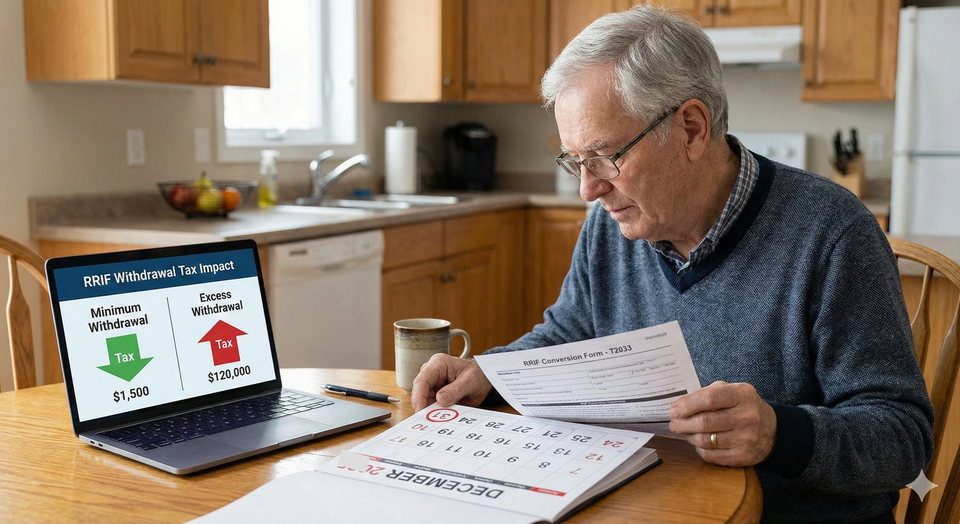
For decades, the RRSP has been your best friend. It lowered your taxes, grew tax-free, and sat quietly in the background.
But the year you turn 71, that friendship ends.
According to the CRA, the RRSP "Maturity Date" is December 31st of the year you turn 71. By this deadline, you must shut down the account. You cannot keep the money in an RRSP, and you can no longer contribute to it.
If you miss this deadline, the CRA will deregister the entire account. This means if you have $500,000 saved, the government will treat it as if you earned $500,000 in salary that day. You will lose nearly 53% of your life savings to tax instantly.
This is the Official 2026 RRSP to RRIF Guide. We explain the 3 choices you have before the deadline, the "Minimum Withdrawal" rules, and the "Optimization Secret" to avoid paying unnecessary withholding tax.
RELATED
- [Link to: 2026 Canadian Tax Brackets: Federal & Provincial Rates (All Provinces)]
- [Link to: RRSP Withdrawal Tax Calculator 2026: How Much Will the CRA Take?]
- [Link to: Are Gifts and Inheritances Taxable in Canada? 2026 CRA Rules]
- [Link to: Old Age Security (OAS) Payment Dates 2026]
- [Link to: CPP Payment Dates 2026: Official Schedule]
1. The Deadline: December 31 (Age 71)
Do not wait until December.
You must convert your RRSP by December 31st of the year you celebrate your 71st birthday.
- Example: If you were born in 1955, you turn 71 in 2026. Your deadline is December 31, 2026.
- The "Grace Period": You do not have to make a withdrawal in the year you turn 71. Your first mandatory withdrawal will be in 2027 (the year you turn 72).
2. The 3 Options: What to Do with the Money
You have three doors. Only one is the right choice for 95% of Canadians.
Option A: Cash Out (The "Suicide" Option)
You withdraw the entire balance in cash.
- The Result: The full amount is added to your income for 2026. You will likely hit the highest marginal tax bracket (53% in many provinces).
- Verdict: Never do this unless your balance is tiny (under $10,000).
Option B: Buy an Annuity (The "Safe" Option)
You give your savings to an insurance company. In exchange, they promise to pay you a fixed monthly income for the rest of your life.
- The Result: Security. You can never outlive your money.
- The Downside: You lose control. If you die two years later, the money is usually gone (depending on the contract). You cannot ask for "extra cash" for an emergency.
Option C: Convert to a RRIF (The "Smart" Option)
You transfer the funds tax-free to a Registered Retirement Income Fund (RRIF).
- The Result: Your investments stay invested (stocks, GICs, ETFs) and continue to grow tax-free.
- The Catch: The government forces you to withdraw a "Minimum Amount" every single year.
3. 2026 Minimum Withdrawal Rules
The government wants its tax revenue now.
Once your money is in a RRIF, you have no choice: you must withdraw a percentage of the account value every year. This percentage increases as you get older.
The 2026 RRIF Factors
These are the percentages of your total account value (on Jan 1st) that you must withdraw.
| Your Age (at start of year) | Minimum Withdrawal (%) |
| 71 | 5.28% |
| 72 | 5.40% |
| 73 | 5.53% |
| 74 | 5.67% |
| 75 | 5.82% |
| 80 | 6.82% |
| 90 | 11.92% |
| 95+ | 20.00% |
Note: If you have a younger spouse, you can use their age to calculate the minimum. This lowers the percentage, keeping more money in your account growing tax-free. See "Street Strategies" below.
4. The Optimization Secret: Withholding Tax Table
How to avoid the "Immediate Tax" trap.
Here is the secret most banks won't explain clearly: There is NO withholding tax on the "Minimum Amount."
If your RRIF minimum is $10,000 and you withdraw $10,000, the bank gives you the full $10,000. You will still owe tax on it in April (it is taxable income), but nothing is taken at the source.
However, the moment you withdraw $1 more than the minimum, the "Excess Withholding Tax" kicks in on the excess amount.
The 2026 Excess Withholding Table
Use this table to plan your "Extra Cash" withdrawals.
| Excess Amount Withdrawn | Withholding Tax Rate (All Prov. except QC) | Quebec Rate (Combined) |
| Up to $5,000 | 10% | 20% (5% Fed + 15% QC) |
| $5,001 to $15,000 | 20% | 25% (10% Fed + 15% QC) |
| Over $15,000 | 30% | 30% (15% Fed + 15% QC) |
Real-World Example (The Trap)
- Scenario: Your RRIF Minimum is $8,000. You need $20,000 for a renovation.
- The Math:
- First $8,000 (Minimum): $0 tax withheld.
- Remaining $12,000 (Excess): This falls into the 20% bracket.
- Bank Deducts: $2,400 (20% of $12k).
- You Receive: $17,600.
- The Strategy: If you can keep your "Excess" withdrawal under $5,000, you only lose 10% upfront. It is often better to make two smaller withdrawals in different years (if possible) than one large one that triggers the 30% hit.
5. Street Strategies: Beating the System
How to pay less tax on your mandatory withdrawals.
Strategy A: The "Younger Spouse" Hack
If you are 71 but your spouse is 60, you can elect to use their age for the RRIF Minimum calculation.
- Your Age (71): Minimum is 5.28%.
- Spouse Age (60): Minimum is 3.33%.
- The Savings: On a $500,000 portfolio, this reduces your forced income from $26,400 to $16,650. This keeps an extra **$9,750** in your account growing tax-free for another year.
- Note: You must make this election before you receive your first payment. You cannot change it later.
Strategy B: The "In-Kind" Withdrawal
You do not have to sell your stocks to make a withdrawal.
- The Move: If you love your Apple or RBC shares and don't want to sell them in a bear market, you can transfer the shares directly from your RRIF to your non-registered trading account.
- The Result: The value of the shares counts as your "Withdrawal." You get a T4RIF slip for the value, but you keep the shares. You just have to pay the tax bill with cash from elsewhere.
Strategy C: Pension Splitting
Once you convert to a RRIF, the income qualifies as "Pension Income" if you are 65+.
- The Move: You can allocate up to 50% of your RRIF withdrawal to your spouse on your tax return.
- The Benefit: If you are in a high bracket and your spouse is in a low bracket, this can save thousands in tax. It also doubles your access to the $2,000 Pension Income Amount tax credit.
Frequently Asked Questions (FAQ)
Q: Does RRIF income affect my OAS?
A: Yes. RRIF withdrawals count as "Net Income." If your total income (including RRIF, CPP, and OAS) exceeds $93,454 (2026 threshold), the government will "claw back" your Old Age Security. Check our Old Age Security (OAS) Payment Dates guide to understand the recovery tax limits.
Q: Can I convert back to an RRSP?
A: Yes, but only if you are under 71. If you retired early at 60, converted to a RRIF, and then went back to work at 65, you can convert your RRIF back to an RRSP to stop the mandatory withdrawals until you turn 71.
Q: What happens if I die with a RRIF?
A: Just like an RRSP, the full balance is taxable on your final return unless you have a "Successor Annuitant" (Spouse) or "Qualifying Survivor" (Disabled Child). Read our guide on Are Gifts and Inheritances Taxable? to plan for this "Final Tax Bill."
About the Author
Jeff Calixte (MC Yow-Z) is a Canadian labour market researcher and digital entrepreneur specializing in government benefit data and cost-of-living support. As the founder of CanadaPaymentDates.ca and BetterPayJobs.ca, Jeff helps newcomers, students, and workers navigate the Canadian social safety net—from tracking CRA payment schedules to identifying entry-level employment opportunities.
Sources
- Canada Revenue Agency: Transferring from an RRSP to a RRIF
- CRA: RRIF Minimum Withdrawal Factors (Chart)
- TurboTax Canada: RRIF Withdrawals and Tax
Note
Official 2026 tax brackets, RRIF factors, and withholding rates are determined by the Canada Revenue Agency (CRA). While we strive to keep this information current, government policies are subject to change without notice. All data in this guide is verified against official CRA circulars at the time of publication. We recommend confirming the status of your personal file directly via CRA My Account or by calling the CRA benefit line at 1-800-387-1193.