
Can You Collect Severance and EI in 2026? (New Rules)
For Canadian workers navigating a layoff in 2026, the interaction between severance packages and Employment Insurance (EI) has fundamentally changed. Historically, any "separation monies"—including severance and vacation pay—were allocated to specific weeks, effectively delaying EI benefits until those funds were "exhausted."
However, under Employment Insurance Regulation SOR/2025-205, the federal government has introduced a temporary exemption to support workers during current economic shifts.
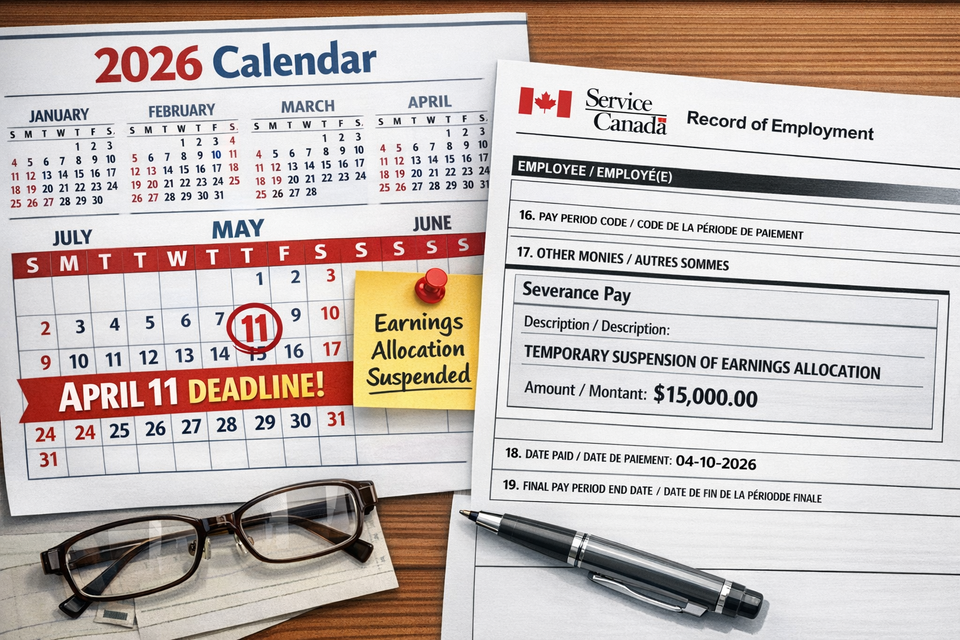
Until April 11, 2026, Service Canada has suspended the allocation of separation earnings. This regulatory change means that for a limited window, eligible claimants may receive their full severance payout and weekly EI benefits concurrently, without the standard deferral period.
This guide outlines the technical application of this temporary measure, the compliance requirements for reporting separation payments, and the tax implications for high-income earners in 2026.
MORE HELPFUL ARTICLES FROM US
- Canada Payment Guide (Browse All Payments)
- Can I Get EI if I Quit? (Just Cause Checklist)
- TFSA vs. RRSP for Low Income (The GIS Trap)
- Shared Custody CCB Rules (50/50 Split Guide)
- Warm Neighbor Programs (Heating Bill Help)
Employment Insurance Master Guide
1. Regulatory Change: Allocation of Earnings (2025–2026)
To understand your entitlement, it is necessary to distinguish between the standard Employment Insurance regulations and the temporary measures currently in force.
The Standard Rule (Pre-2025 / Post-April 2026)
Under standard EI legislation, severance pay is defined as "earnings" arising from employment. Service Canada allocates these earnings starting from the week of layoff.
- Impact: If a worker receives a severance package equivalent to 10 weeks of salary, their EI claim is postponed for 10 weeks. The claimant is expected to live on their severance before accessing government benefits.
The Temporary Exemption (Current Regulation)
Effective Period: March 30, 2025 – April 11, 2026
Under the temporary measures responding to tariff disputes and economic adjustments, the requirement to allocate separation monies has been suspended.
- Impact: Separation payments—including severance, pay in lieu of notice, and accrued vacation pay—are not deducted from EI benefits during this period.
- Result: A claimant may receive a lump-sum separation payment and begin their EI benefit period in the same week, provided they meet all other eligibility criteria.
Answer Target: Between March 30, 2025, and April 11, 2026, earnings paid due to separation from employment are exempt from allocation rules. This allows claimants to receive severance pay without delaying the start of their Employment Insurance regular benefits. Additionally, the standard one-week waiting period is waived for all new claims established within this window.
2. Critical Deadlines and Eligibility Windows
This exemption is not a permanent amendment to the EI Act; it is a temporary relief measure with a hard sunset date. The timing of your Record of Employment (ROE) is the deciding factor for eligibility.
The April 11, 2026 Cut-Off
The suspension of allocation rules applies strictly to claims established on or before April 11, 2026.
- Compliance Note: If a claim is established on April 12, 2026, the standard allocation rules reinstate immediately. In this scenario, any severance pay will once again delay EI benefits.
- Strategic Implication: Workers currently negotiating departure dates should ensure their last day of work and subsequent EI application fall prior to the April 11 deadline to utilize the concurrent payment provision.
Waiver of the Waiting Period
Typically, all EI claimants must serve a one-week unpaid "waiting period" (deductible) before benefits commence.
- Current Status: For all claims established between March 30, 2025, and April 11, 2026, the one-week waiting period is waived.
- Financial Impact: This creates a seamless transition from employment income to insurance benefits, preventing the typical one-week income gap at the start of a claim.
3. Reporting Compliance: Separation Payments
A common error among applicants is the incorrect reporting of severance on bi-weekly declarations. Improper reporting can trigger an automated "stop payment" on the file.
Separation vs. Earned Income
Service Canada distinguishes between money earned for work performed and money received due to separation.
- The Error: Claimants often report their severance lump sum as "earnings" during their bi-weekly Internet Reporting session. This signals to the system that the claimant worked that week, resulting in a clawback of benefits.
- The Correct Procedure: Severance must be disclosed only once—either during the initial application or by submitting the Record of Employment (ROE) to Service Canada.
- Exemption Status: Once the ROE is on file (specifically Block 17: Separation Payments), the system will automatically apply the SOR/2025-205 exemption. Claimants should not re-report this amount on their bi-weekly reports, as it is not considered "employment income" for the purpose of the 50% "Working While on Claim" deduction rule.
4. Tax Planning: The RRSP Transfer Option
Because claimants may receive severance, EI benefits, and potentially new employment income within the same tax year, 2026 tax liabilities may be significantly higher than average.
Tax Bracket Implications
Receiving a concurrent payout (Severance + EI) can push a claimant into a higher marginal tax bracket. Unlike the standard rule where severance replaces income, the 2026 rule layers EI on top of severance.
The Direct Transfer Method
To mitigate immediate tax withholding, employees may request a direct transfer of eligible retiring allowances to a Registered Retirement Savings Plan (RRSP).
- The Mechanism: By instructing the employer to transfer funds directly to an RRSP (up to the claimant’s contribution limit), the employee avoids the mandatory 30% withholding tax typically applied to lump-sum payments over $15,000.
- EI Eligibility: Because the allocation rules are suspended, transferring severance to an RRSP does not impact EI eligibility. It is purely a tax deferral strategy.
5. Treatment of Accrued Vacation Pay
Vacation pay issued upon termination is treated identically to severance under the temporary measures.
- Standard Rule: Accrued vacation pay delays the start of an EI claim (e.g., 2 weeks of vacation pay = 2-week delay).
- 2026 Temporary Rule: Accrued vacation pay is exempt from allocation.
- Outcome: Claimants receive their accumulated vacation pay as a cash payout and remain eligible for EI benefits starting the following week.
Summary Table: 2026 Separation Payment Rules
| Payment Type | Standard Procedure (Post-April 2026) | Temporary Measure (Until April 11, 2026) |
| Severance Pay | Delays EI Benefits (Allocated) | No Delay (Concurrent Receipt) |
| Vacation Pay | Delays EI Benefits (Allocated) | No Delay (Concurrent Receipt) |
| Pay in Lieu of Notice | Delays EI Benefits | No Delay |
| Waiting Period | 1 Week Unpaid | Waived (0 Weeks) |
| RRSP Cash-out | No Effect on EI | No Effect on EI |
Frequently Asked Questions (FAQ)
Q: If I received severance in 2025 and my EI was delayed, can I request a retroactive adjustment?
A: Yes. If your claim began after March 30, 2025, and benefits were deferred due to separation monies, you may request a "Request for Reconsideration." The legislation is retroactive to the start date of the temporary measures.
Q: Does a court settlement for wrongful dismissal affect my EI if received later?
A: Under the temporary measures, settlement monies awarded for wrongful dismissal or severance are not allocated if the claim falls within the exempt period. Therefore, they should not trigger an overpayment requirement for benefits already received.
Q: Do these rules apply to Maternity and Parental benefits?
A: Yes. The suspension of earnings allocation applies to all EI benefit categories, including Regular, Sickness, Maternity, Parental, and Caregiving benefits.
Q: Has the qualifying hours requirement changed?
A: No. The suspension of earnings allocation does not alter the entrance requirements. Claimants must still accumulate the required number of insurable hours (typically between 420 and 700, depending on the regional unemployment rate) to establish a claim.
👉 View Current Job Opportunities at BetterPayJobs.ca
About the Author
Jeff Calixte (MC Yow-Z) is a Canadian labour market researcher and digital entrepreneur specializing in government benefit data and cost-of-living support. As the founder of CanadaPaymentDates.ca and BetterPayJobs.ca, Jeff helps newcomers, students, and workers navigate the Canadian social safety net—from tracking CRA payment schedules to identifying entry-level employment opportunities.
Sources
- Service Canada:Temporary EI measures to respond to major changes in economic conditions
- Government of Canada:Digest of Benefit Entitlement Principles - Chapter 5.12 (Moneys paid on separation)
- Canada Gazette:Regulations Amending the Employment Insurance Regulations (SOR/2025-205)
Note
Employment Insurance (EI) eligibility and benefit rates are determined by Employment and Social Development Canada (ESDC). Policies regarding earnings exemptions, severance, and training referrals are subject to change. All data in this guide is verified against official Service Canada circulars. We recommend confirming the status of your personal claim directly via My Service Canada Account (MSCA) or by calling the EI telephone reporting service at 1-800-206-7218.