Shared Custody CCB Rules: Who Gets the Money in a 50/50 Split?
Separation is hard enough without the Canada Revenue Agency (CRA) becoming a third party in your co-parenting relationship. For many Canadian parents, the Canada Child Benefit (CCB) is a significant source of income—worth up to $8,157 per child in 2026. When a relationship ends and a 50/50 or 60/40 custody split begins, the question of "Who gets the check?" often becomes a flashpoint for conflict.
The Street Angle for 2026 is that the CRA no longer plays favorites. Gone are the days when the mother was automatically the sole recipient in a shared arrangement. Modern rules are designed for mathematical fairness, but they come with strict reporting requirements. If you don't update your status correctly, you risk an "Overpayment" debt that the CRA will claw back from your future tax refunds.
As a part of our Family Benefits Master List, this 2,000+ word deep dive explains the "40% Threshold," deconstructs the 50/50 payment math, and reveals the "Street Hacks" to protect your benefit eligibility during a messy split.
1. The 40% Rule: What Counts as Shared Custody in 2026?
The CRA has a very specific definition of shared custody. It isn't about what your lawyer wrote in your separation agreement; it's about where the child actually sleeps and who performs the day-to-day duties.
The Quantitative Cut-off
- Full Custody (>60%): If the child lives with you more than 60% of the time, the CRA considers you the "Primary Caregiver." You get 100% of the CCB based on your household income.
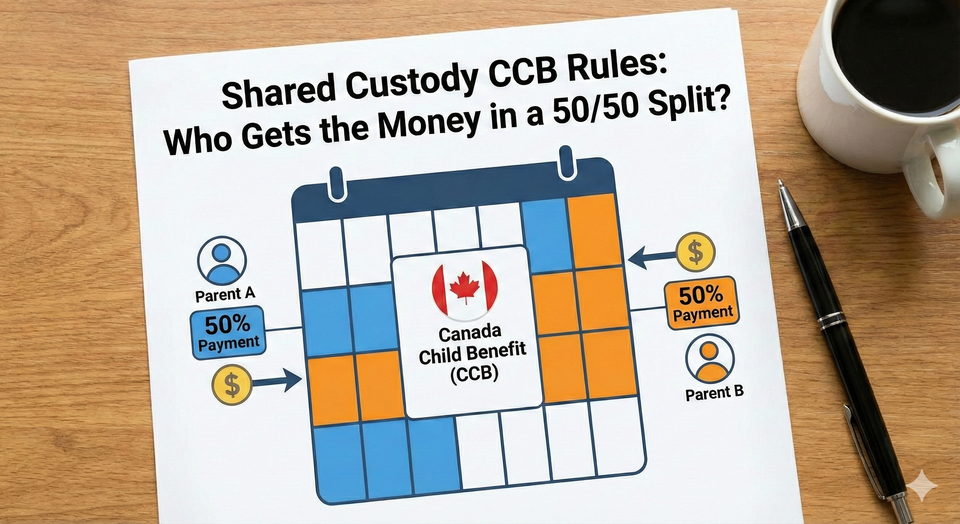
- Shared Custody (40% to 60%): If the child lives with each parent between 40% and 60% of the time (approx. 146 to 219 days per year), the CRA considers it shared. In this case, both parents get 50% of their respective entitlement.
- Access Only (<40%): If the child is with you less than 40% of the time, you are generally ineligible for the CCB.
2. The 50/50 Payment Math
How is the CCB split in a 50/50 shared custody arrangement for 2026? The CRA does not simply cut one check in half and send it to both parents. Instead, they calculate what each parent would have received if they had 100% custody based on that parent's own Adjusted Family Net Income (AFNI). They then send each parent 50% of that calculated amount.
Example: If Parent A earns $35,000 and Parent B earns $120,000, Parent A will receive 50% of the maximum benefit, while Parent B will receive 50% of a much smaller (phased-out) amount. This ensures that the benefit still targets the parent with the higher financial need for their time with the child.
Custody Split Hacks
This deep dive identifies the specific "Tax Traps" that separated parents fall into and the hacks to avoid a $5,000 CRA bill.
1. The 6-Month Rotation Myth: Why it Fails in 2026
CRA shared custody 6 month rotation.
- The Street Angle: Old-school advice suggested parents should "alternate" who gets the full CCB every six months to "keep things simple."
- The Reality: The CRA effectively ended the rotation policy because it created massive administrative errors and "ghost" overpayments.
- The Hack: In 2026, the CRA's default is the Monthly 50/50 Split.
- The Move: Do not try to alternate years or months for the CCB. Both parents should apply for "Shared Custody" status immediately. The CRA will then issue two smaller payments every month. This is the only way to ensure neither parent is hit with an "Overpayment" notice later if the CRA audits the schedule and finds you were sharing time all along.
2. The Eligible Dependent Credit (Line 30400) Hack
Who claims the child on taxes in shared custody.
- The Trap: While the CCB is split 50/50 automatically, the Eligible Dependent Credit (EDC)—formerly the "Equivalent to Spouse" credit—can only be claimed by one parent per child.
- The Hack: You must choose. If two parents claim the same child, the CRA will disallow both claims.
- The Strategy: If you have two children, the "Cleanest Hack" is for each parent to claim one child as an eligible dependent.
- The Move: If you only have one child, you must rotate the claim (Parent A in even years, Parent B in odd years). Crucial: To do this in shared custody, both parents must be required to pay child support to each other (the "Set-off" method). If only one parent is paying support, only the recipient can usually claim the credit. Ensure your 2026 separation agreement explicitly states: "Both parents agree to pay child support to the other in a set-off arrangement to allow for the rotation of the Eligible Dependent Credit."
3. The 90-Day Separation Rule: Don't Apply Too Early
When to notify CRA of separation.
- The Street Angle: You might feel separated the day someone moves out, but the CRA has a "Cooling Off" period.
- The Hack: The CRA doesn't recognize you as "Separated" until you have lived apart for 90 consecutive days.
- The Move: Once the 90 days have passed, you update your status. The CRA will then backdate your status to the day you first moved out. Apply for the CCB as a "Shared Custody" parent immediately after the 90-day mark to trigger your retroactive payments from day one of the split.
4. The Handshake Deal Danger: Why Cash Under the Table Kills Benefits
Can my ex just receive the 100% CCB and give me half in cash?
- The Risk: This is the #1 way to get a $10,000 bill from the CRA.
- The Scenario: If Parent A gets 100% of the CCB and gives Parent B cash, but the CRA finds out (via a school record or doctor’s note) that the custody is actually 50/50, they will deem Parent A "ineligible" for the 100% rate.
- The Consequence: Parent A will be forced to pay back 50% of everything they received for the last 3 years. Parent B can then apply for their 50%, but it takes months to process.
- The Move: Always report the shared custody through CRA My Account. It protects both parents from audits and ensures you get the GST/HST Credit and provincial top-ups (like the Ontario Child Benefit) you are personally entitled to based on your income.
5. The Summer Break Temporary Change Hack
What if the kids live with you for the whole summer in 2026?
- The Hack: If a child’s living arrangement changes significantly for a temporary period (e.g., 2+ months), you can apply for a Temporary Custody Change.
- The Strategy: If the kids are with you 100% for July and August, you can notify the CRA to receive 100% of the benefit for those two months.
- The Move: You must notify them again when the child returns to the shared arrangement. This is rarely worth the paperwork for a simple summer vacation, but if a child moves for a 6-month school term, it is a vital "Street Hack" to maximize household income.
6. 2026 Income Thresholds and Phase-out Math
Max CCB (July 2026 – June 2027):
- Under 6: **$8,157** ($679.75/mo)
- Aged 6-17: **$6,883** ($573.58/mo)
The Income Thresholds:
- Full Benefit: If your AFNI is below $38,237, you get the max amount.
- Phase-out: Once you earn over $38,237, the benefit is reduced by a percentage (7% for 1 child, 13.5% for 2 children).
- High Income: The phase-out changes again at $81,222.
7. The CRA Shared Custody Audit Survival Kit (2026 Edition)
One of the most searched yet least explained topics is the "CRA shared custody audit documents list 2026." If you apply for a 50/50 split, the CRA will eventually ask for proof. They don't just want your word; they want "Third-Party Validation."
- The "Street" Hack: If you don't have a court order, you can still win an audit using the "School & Medical Paper Trail."
- The Strategy: Contact your child’s school and doctor's office. Ask for a copy of the Emergency Contact Sheet. If both parents are listed with their respective addresses, this is considered "Gold" by the CRA.
- The Move: Collect receipts for Academic Upgradingor extracurriculars where both parents’ names appear as "Payors." These documents prove you are both "primarily responsible" for the child’s upbringing, which is a core eligibility requirement.
8. The 11-Month Retroactive Rule: Getting Your Back-Pay
How far back can I claim CCB for shared custody? If you’ve been sharing custody for two years but only just found out about the 50/50 split, you are in luck—to a point.
- The Rule: The CRA will automatically backdate payments for up to 11 months from the date they receive your application.
- The Hack: If you need to go back further than 11 months, you must request a "Taxpayer Relief" adjustment.
- The Strategy: You will need to provide a written explanation of why you didn't apply sooner and provide clear proof of the residency schedule for those years. This is a strategy that can result in a $5,000+ lump sum deposit for parents who didn't know the Statute of Limitations on Debt doesn't apply to your right to claim benefits.
4. Summary Table: CCB Custody Comparison (2026)
| Feature | Primary Custody (>60%) | Shared Custody (40-60%) |
| CCB Recipient | One Parent (100%) | Both Parents (50% each) |
| Income Base | Primary Parent's AFNI | Each Parent's own AFNI |
| GST/HST Credit | One Parent | Both Parents (Split) |
| EDC Tax Credit | Primary Parent | Must Agree (Cannot Split) |
| Proof Required | School/Medical Records | Separation Agreement / Form RC66 |
| CRA Audit Risk | Medium | High (Ensure logs are kept) |
Shared Custody CCB 2026
How is the Canada Child Benefit (CCB) split in shared custody for 2026? If a child lives with each parent at least 40% of the time, both parents are considered "shared-custody parents" by the CRA. Each parent receives 50% of the CCB amount they would have been entitled to if they had full custody, calculated based on their individual adjusted family net income (AFNI). You must notify the CRA of the shared arrangement via CRA My Account or Form RC66 once you have been separated for 90 days to avoid overpayment debts.
Frequently Asked Questions (FAQ)
Q: My ex makes $200k, will that lower my CCB in a 50/50 split?
A: No. This is the beauty of the shared rules. In a shared custody arrangement, your 50% of the CCB is based only on your income (and your new spouse's, if you remarried). The CRA does not combine your income with your ex's income.
Q: Can we agree that one person gets 100% of the CCB to pay for daycare?
A: No. The CRA is not bound by private agreements. If they determine the custody is shared (40-60%), they will legally force the 50/50 split. If you want one parent to have the money for daycare, that parent should receive the 50% and you can adjust your Child Support payments to cover the daycare difference.
Q: Does child support count as income for CCB?
A: No. Child support payments are non-taxable and do not count as income when the CRA calculates your AFNI. However, Spousal Support is taxable income and will lower your CCB amount.
Q: What if we live in the same house but are separated?
A: This is a "High Audit" zone in 2026. To qualify for individual CCB payments while under one roof, you must prove you are living separate lives: separate bedrooms, separate finances, and no shared social life. The CRA will often request two separate utility bills or lease agreements for different parts of the house.
Q: What to Do If Your Ex Refuses to Sign Form RC66
A: A massive point of friction in 2026 is the "Deadlock." You know you have the kids 50% of the time, but your ex refuses to update their status because they don't want to lose the 100% check.
- The "Deadlock" Hack: You do not need your ex’s permission to apply.
- The Strategy: Apply anyway using CRA My Account. The CRA will then send a letter to the other parent asking for proof of their 100% custody.
- The Move: When they can't provide proof that you don't have the kids (because you do), the CRA will manually move the file to "Shared Custody." This is the best "CRA child benefit dispute resolution for fathers" or non-birthing parents who are being financially bullied.
The 2026 "July Recalculation" Warning
A: Every July, the CRA resets the system. If you recently filed for Debt Relief for Newcomers or had a major income shift, your July 20th check will look different.
- The Hack: Use the "CCB Shared Custody Amount Calculator" on the Service Canada site in June.
- The Strategy: By inputting your 2025 income, you can predict your 2026-2027 payments. If you see a massive drop, it may be because your ex-partner's income was accidentally linked to yours—a common "Ghost Error" that happens during the first year of a split.
About the Author
Jeff Calixte (MC Yow-Z) is a Canadian labour market researcher and digital entrepreneur specializing in government benefit data and cost-of-living support. As the founder of CanadaPaymentDates.ca and BetterPayJobs.ca, Jeff helps newcomers, students, and workers navigate the Canadian social safety net—from tracking CRA payment schedules to finding entry-level work.
Sources
- CRA: Canada Child Benefit - Shared custody and your payments (Updated 2026)
- Justice Laws Website: Income Tax Act, Section 122.6 - Definition of Shared-Custody Parent
- Tax Court of Canada: Lavrinenko v. Canada (2019 FCA 51) - The 40% Quantitative Rule
Note
Official 2026 payment dates and benefit amounts are determined by the Canada Revenue Agency (CRA) and provincial governments. While we strive to keep this information current, government policies and schedules are subject to change without notice. All data in this guide is verified against official CRA circulars at the time of publication and should be treated as an estimate. We recommend confirming the status of your personal file directly via CRA My Account or by calling the CRA benefit line at 1-800-387-1193.