Allowance for the Survivor: How to Get Money if You are Widowed (Age 60-64)
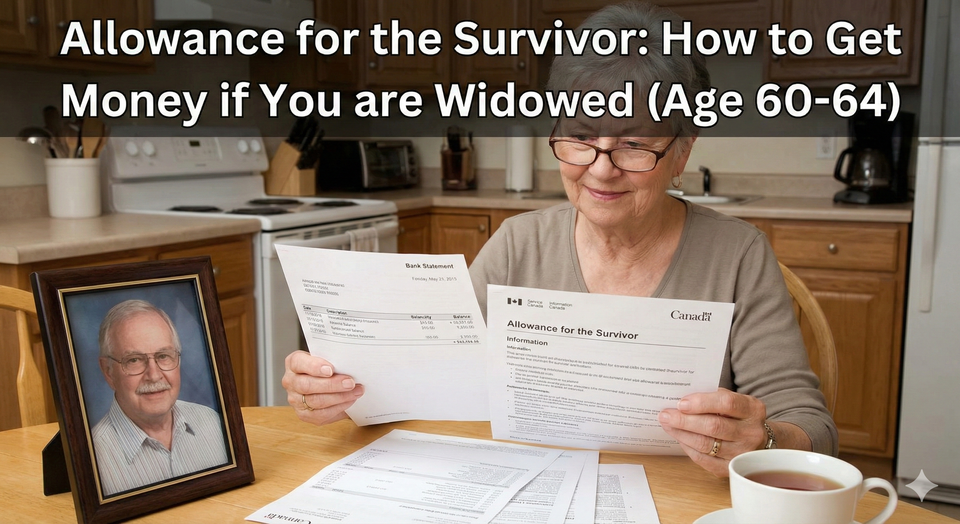
For many Canadians, the loss of a spouse is not only an emotional tragedy but a sudden financial crisis. If you are between the ages of 60 and 64 and have lost your partner, you are in a "benefit gap" where you are too young for Old Age Security (OAS) but may be struggling to survive on a single income.
The Allowance for the Survivor is a non-taxable monthly benefit designed specifically to bridge this gap. In 2026, as inflation continues to pressure retirees, this benefit has become a critical lifeline. Despite its value, it remains a "Hidden Gem" because many survivors assume they must wait until age 65 to receive any federal support beyond the CPP Death Benefit.
As part of our Ultimate Savings Guide, this guide provides the exact 2026 income cutoffs, payment amounts, and the "Street Hacks" to ensure your application is processed without delay.
What is the Allowance for the Survivor?
The Allowance for the Survivor is a monthly payment available to low-income Canadians aged 60 to 64 whose spouse or common-law partner has died. It is part of the Old Age Security program but acts as a "pre-retirement" supplement.
2026 Maximum Payment Amounts
For the first quarter of 2026 (January to March), the maximum monthly payment is:
- Maximum Monthly Amount: $1,680.47
- The Benefit Type: Non-taxable (This money does not count toward your taxable income).
This benefit is intended to provide a similar level of support to what you would receive under the Guaranteed Income Supplement (GIS) if you were already 65.
Eligibility Requirements: Do You Qualify in 2026?
To receive the Allowance for the Survivor, you must meet five strict criteria:
- Age: You must be between 60 and 64 years old.
- Marital Status: Your spouse or common-law partner must be deceased, and you must not have remarried or entered into a new common-law relationship.
- Residency: You must be a Canadian citizen or legal resident and have lived in Canada for at least 10 years after the age of 18.
- Income: Your annual income must be below the federal threshold.
- Status: You must not be under a current sponsorship agreement (though there are exceptions if your sponsor has passed away or declared bankruptcy).
2026 Income Cutoffs for the Survivor Allowance
The amount you receive is based on your "Net Income" from the previous year. Unlike other benefits, the Allowance for the Survivor has a very specific "phase-out" threshold.
| Status | 2026 Annual Income Limit | Max Monthly Payment |
| Widowed Senior (Ages 60–64) | Less than $30,312 | Up to $1,680.47 |
Note: OAS and GIS payments do not count as income for this calculation. However, CPP Survivor Pensions, employment income, and RRSP withdrawals do count.
Survivor Benefit Hacks
1. The "ISP3008" Application Secret
form ISP3008 survivor allowance. The Street Angle: Service Canada does not always send this form automatically after a death is reported. You often have to ask for the "Application for the Allowance or Allowance for the Survivor" kit specifically.
- The Hack: You can apply as early as 11 months before your 60th birthday if you are already widowed.
- The Move: If your spouse passes away when you are 58, you won't get the money yet, but you should flag your file for the "OAS Survivor" stream immediately to ensure your payments start the month you turn 60.
2. CPP Survivor Pension vs. OAS Allowance: The "Offset" Trap
Many users search for "difference between CPP survivor pension and OAS allowance." * The Reality: They are two different pots of money. The CPP Survivor's Pension is based on how much your spouse contributed to the Canada Pension Plan. The OAS Allowance for the Survivor is based on your current financial need.
- The Trap: The OAS Allowance is "Income-Tested." This means for every dollar you receive from a CPP Survivor Pension, your OAS Allowance may be reduced.
- The Strategy: Always claim the CPP Survivor's Pension first. Then, apply for the Allowance. The government will automatically calculate the best "Net" amount for you.
3. The "Retroactive Payment" Window
A rising search in 2026 is "retroactive survivor allowance payments."
- The Hack: If you didn't know about this benefit and you are now 63, you can claim up to 11 months of retroactive payments.
- The Math: At $1,680/month, an 11-month retroactive check is worth over **$18,000**. If you have been widowed for years and are just now finding this article, this could be the single largest "Windfall" of your retirement.
4. The $5,000 "Working Income" Exemption
For survivors who are still working part-time, there is a hack.
- The Hack: In 2026, the first $5,000 of employment income is completely ignored when calculating your Allowance for the Survivor. For earnings between $5,000 and $15,000, only 50% of the income is counted.
- The Strategy: This allows you to work a small part-time job to stay active without losing your non-taxable government support.
5. Transitioning to OAS at Age 65
Users frequently ask: "What happens to my allowance when I turn 65?"
- The Hack: It stops automatically. However, it is replaced by your regular Old Age Security (OAS) and potentially the Guaranteed Income Supplement (GIS).
- The Move: You must ensure you have a "Pillar Post" application in for OAS/GIS at age 64 to avoid a one-month gap in your payments.
Allowance for the Survivor
How much is the Allowance for the Survivor in 2026? Widowed seniors aged 60 to 64 can receive a non-taxable monthly payment of up to $1,680.47 in 2026. To qualify, your annual net income must be less than $30,312, and you must not have remarried or entered a new common-law relationship. This benefit is designed to bridge the gap until you become eligible for Old Age Security at age 65.
Frequently Asked Questions (FAQ)
Q: Does my spouse's income from last year count against me?
A: No. In the year of a spouse's death, Service Canada can calculate your benefit based on your estimated income as a single person rather than the previous year's combined "Couple" income. Use Form ISP3026 to request this adjustment.
Q: What if I remarry?
A: Your Allowance for the Survivor will stop immediately. You are legally required to notify Service Canada within 30 days of remarrying or entering a common-law relationship.
Q: Is the Allowance for the Survivor taxable?
A: No. Like the GIS, the Allowance for the Survivor is a non-taxable benefit. You do not have to pay income tax on this money, though you must still report it on your tax return.
About the Author
Jeff Calixte (MC Yow-Z) is a Canadian labour market researcher and digital entrepreneur specializing in government benefit data and cost-of-living support. As the founder of CanadaPaymentDates.ca and BetterPayJobs.ca, Jeff helps newcomers, students, and workers navigate the Canadian social safety net—from tracking CRA payment schedules to finding entry-level work.
Sources
- Canada.ca: Allowance for the Survivor: Overview
- Service Canada: ISP3008 - Application for the Allowance or Allowance for the Survivor
- Old Age Security Act: Benefit Rates for January to March 2026
Note
CPP and OAS payment schedules and eligibility are determined by Employment and Social Development Canada (ESDC). While the CRA administers the tax recovery (clawback), the benefits themselves are managed by Service Canada. We recommend confirming your payment status via My Service Canada Account (MSCA) or by calling the pension line at 1-800-277-9914.