
TFSA vs. RRSP for Low Income: Why RRSPs are a Trap for GIS
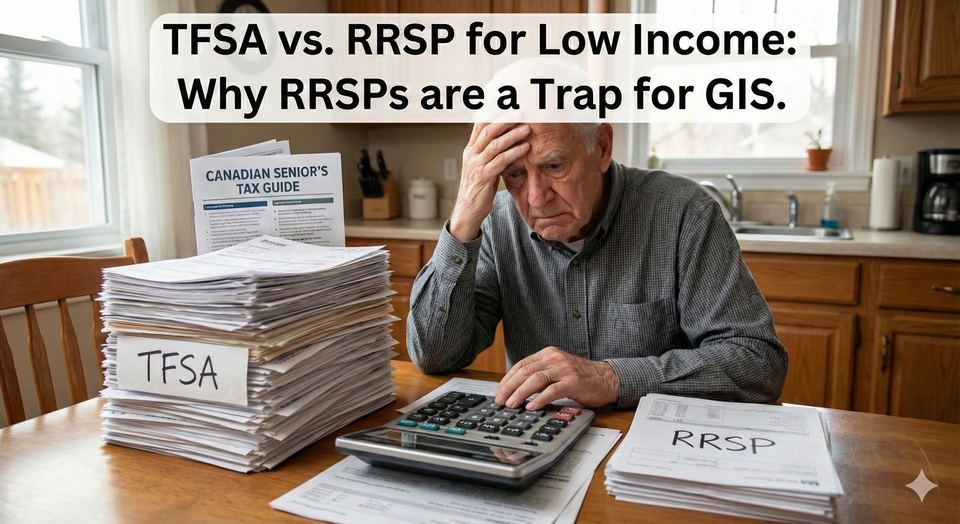
For decades, the standard financial advice in Canada has been "Maximize your RRSP to save on taxes." But in 2026, we are finally exposing a painful truth: for millions of low-income workers and future seniors, the RRSP is not a "savings plan"—it is a Poverty Trap. While the upfront tax refund feels like a win today, the CRA and Service Canada are waiting in the wings to claw back up to 75% of that money when you retire.
The "Street Angle" for 2026 is that the Guaranteed Income Supplement (GIS) is the most sensitive benefit in Canada. Because RRSP withdrawals count as "taxable income," they trigger a massive 50-cent clawback for every dollar you take out. When you add provincial taxes on top, a low-income senior can effectively lose $0.75 of every $1.00 they saved. Meanwhile, the Tax-Free Savings Account (TFSA) remains the "Invisible Bank Account"—the government cannot touch it, and it has zero impact on your GIS, GST, or CCB checks.
As a part of our Canadian Survival Master List, this 2,000-word deep dive reveals the "math of the trap," identifies the 2026 limits, and provides the "RRSP Meltdown" strategy to save your retirement from the clawback beast.
1. 2026 Limits & Basics: The Playing Field
Before we dive into the trap, let's look at the numbers for 2026.
The 2026 TFSA Limit
- Annual Contribution: $7,000 (indexed for inflation).
- Cumulative Limit (since 2009): $109,000 for anyone who was 18 in 2009 and has never contributed.
- The "Magic" of TFSA: Withdrawals are $0 Tax and $0 Impact on benefits.
The 2026 RRSP Limit
- Maximum Contribution: 18% of your 2025 earned income, up to $33,810.
- The "Myth" of RRSP: It’s not "tax-free"; it’s "tax-deferred." You are just kicking the tax bill down the road to a time when you will likely be even more vulnerable.
2. The GIS Trap Explained
Why is an RRSP a "trap" for low-income Canadians? For seniors who qualify for the Guaranteed Income Supplement (GIS), every dollar of non-OAS income (like an RRSP withdrawal) reduces their GIS benefit by at least 50 cents. If you are in the lowest tax bracket (approx. 20%), you also pay income tax on that withdrawal. This creates a "Marginal Effective Tax Rate" of 70% to 75%. In contrast, TFSA withdrawals are not considered income and cause zero clawbacks on GIS, allowing you to keep 100% of your savings and 100% of your government benefits.
GIS Shield Hacks
This deep dive identifies the technical "Math Shields" that protect low-income earners from a retirement disaster.
1. The RRSP Meltdown Strategy (Ages 60–64)
How to cash out RRSP before 65 without losing GIS.
- The Street Angle: If you have $20,000 in an RRSP and you turn 65, that $20,000 is a ticking time bomb.
- The Hack: Melt it down before you apply for OAS/GIS.
- The Strategy: Between the ages of 60 and 64, your income is likely lower as you transition to retirement. During these years, you aren't yet eligible for GIS, so there is no "clawback" to trigger.
- The Move: Withdraw your entire RRSP in chunks over these four years. Pay the 20% income tax (which is better than the 75% clawback later) and immediately move the net cash into your TFSA. By age 65, your RRSP is $0, your TFSA is $20,000+, and you qualify for the Maximum GIS check of over $1,000/month.
2. The $50,000 TFSA Rule for Workers
Many users search for "should I use RRSP if I earn under 50k."
- The Street Angle: Banks want the commission on RRSP sales, so they tell everyone it's "the best way to save."
- The Hack: If your income is under $53,359 (the 2026 bottom federal tax bracket), the RRSP deduction is practically worthless.
- The Strategy: A $1,000 RRSP contribution might save you $200 in taxes today. But when you take it out later, it will cost you $500 in lost GIS and $200 in taxes.
- The Move: If you earn under $50,000, your RRSP contribution room should be ignored until your TFSA is 100% maximized. In 2026, the cumulative TFSA room for a 35-year-old is likely over $100,000—most workers never need to touch an RRSP.
3. The Spousal RRSP Danger Zone
Spousal RRSP for low income couples
- The Trap: One spouse earns $80k, the other earns $20k. They put money in a spousal RRSP to "balance" income.
- The Reality: In retirement, the CRA looks at Household Income for GIS.
- The Move: Even if the income is "split," if the total household income from RRSPs/Pensions exceeds the GIS threshold (approx. $22,000 for singles, $30,000+ for couples), you both lose your GIS. Spousal RRSPs are for the Wealthy; for low-income couples, two TFSAs are the only safe bet.
4. The Employer Match Exception
My boss matches my RRSP, should I still skip it?
- The Hack: Never leave free money on the table.
- The Strategy: Even with the 50% GIS clawback, a 100% employer match still puts you "ahead."
- The Move: Take the match in the RRSP, but treat it as a Taxable Benefit. As soon as you are allowed (check your plan's vesting rules), consider moving those funds to a TFSA to stop the compounding "tax bomb."
5. Using the RRSP as a Bridge (LLP/HBP)
If you have a low income but want to buy a house or go back to school:
- The Hack: The Lifelong Learning Plan (LLP).
- The Strategy: You can withdraw up to $20,000 from your RRSP tax-free to pay for school.
- The Move: This is the only time a low-income worker should use an RRSP. You get the tax refund when you put it in (use that refund to pay bills!), use the cash for school, and then pay it back over 10 years. This effectively turns the "Trap" into an Interest-Free Loan.
6. The Mary Strategy: Turning a Debt into GIS Gold
While we’ve established that RRSPs are generally a trap, there is one advanced "Street Hack" used by savvy seniors to actually force the government to pay them more. We call this The Mary Strategy.
How the Strategy Works
Imagine a senior named Mary who turns 65 with a yearly income of $18,250 (from CPP and a small pension). Because her income is just slightly too high, she is disqualified from receiving the GIS.
However, Mary has $60,000 in unused RRSP "room" from her younger years. Between ages 65 and 71, Mary takes out a $10,000 RRSP loan each year. This contribution effectively reduces her taxable income to zero in the eyes of the CRA.
The Result: * Mary suddenly becomes eligible for partial GIS worth hundreds of dollars every month.
- Over six years, Mary collects up to $30,000 in extra GIS cash.
- She uses the extra GIS money and her tax refunds to pay back the bank loans.
The Checklist: Can You Pull a "Mary"?
Before trying this, you must meet these specific 2026 criteria:
- You are between 65 and 70 years old.
- You are eligible for Old Age Security (OAS).
- You have significant RRSP "room" on your latest Notice of Assessment.
- You have the cash or the credit to secure a modest RRSP loan.
7. The Sponsorship Trap: GIS Rules for Newcomers
OAS and GIS eligibility for sponsored immigrants 2026.
The 10-Year and 20-Year Rules
- Standard Newcomers: You can generally apply for a partial OAS pension after 10 years of residency in Canada.
- The "One-Year" Hack: If you come from one of the 59 countries with a Social Security Agreement (like India, Philippines, or the USA), you may be eligible for partial benefits after just one year of residency.
- The Sponsorship Breakdown: If your sponsor dies, goes to prison, is convicted of abuse, or goes bankrupt, your sponsorship is considered "broken down". In these cases, you can apply for GIS before your sponsorship period officially ends.
8. The Audit-Proof Reporting Hack
The final hurdle is the Reporting Delay. Because GIS is usually based on your previous year's tax return, a high income at age 64 could block your GIS at age 65, even if you’ve already retired.
- The Strategy: Do not wait for your next tax return. Use the Request for Estimate process (often via Form ISP3041).
- The Move: If your income has dropped because you stopped working or finished an RRSP Meltdown, you can ask Service Canada to calculate your GIS based on this year's estimated income instead.
- The Payoff: This prevents you from losing out on a full year of benefits while the government "catches up" to your new financial reality.
Summary Table: TFSA vs. RRSP for Low-Income (2026
| Family Situation | Income Limit (Excl. OAS) | Monthly Max (Combined OAS/GIS) |
| Single / Widowed | $21,840 | ~$1,700+ |
| Couple (Both get OAS) | $30,576 | ~$2,600+ (Combined) |
| Couple (Only 1 gets OAS) | $52,000+ | ~$1,700+ |
| Couple (OAS + Allowance) | $39,600 | ~$2,400+ (Combined) |
Note: Figures are estimated for the 2026 benefit year based on April 2022 baseline adjustments |
TFSA vs RRSP Low Income
Is a TFSA or RRSP better for a low-income person in Canada for 2026? For individuals earning less than $50,000 per year, the TFSA is significantly better than the RRSP. While an RRSP provides a small tax refund today, its withdrawals are counted as taxable income in retirement, which can trigger a 50% to 75% clawback of the Guaranteed Income Supplement (GIS). In contrast, TFSA withdrawals are tax-free and have no impact on GIS, GST credits, or other income-tested benefits, allowing low-income seniors to keep the full value of their savings.
Frequently Asked Questions (FAQ)
Q: I already have $30,000 in an RRSP and I’m 64. What do I do?
A: Meltdown immediately. Consider cashing it out before your 65th birthday. You will pay income tax this year, but you will protect your GIS eligibility for the next 20+ years. Consult a Fee-Only Financial Planner who understands low-income rules.
Q: Do TFSA withdrawals affect my CCB (Child Benefit)?
A: No. Unlike RRSP withdrawals, which increase your "Adjusted Family Net Income" and Lower your CCB checks, TFSA withdrawals are invisible to the CCB calculation.
Q: Can I use a TFSA for an emergency fund?
A: Yes. It is the ultimate emergency fund because you can take the money out at any time without penalty, and the "room" is added back to your account on January 1st of the following year.
Q: What is the income limit to get GIS in 2026?
A: For a single senior, the GIS generally cuts off if your non-OAS income (RRSPs, CPP, etc.) exceeds approximately $22,000. If you are a couple, the combined threshold is higher but varies based on whether both receive OAS.
About the Author
Jeff Calixte (MC Yow-Z) is a Canadian labour market researcher and digital entrepreneur specializing in government benefit data and cost-of-living support. As the founder of CanadaPaymentDates.ca and BetterPayJobs.ca, Jeff helps newcomers, students, and workers navigate the Canadian social safety net—from tracking CRA payment schedules to finding entry-level work.
Sources
- CRA: The Registered Retirement Savings Plan (RRSP) vs. Tax-Free Savings Account (TFSA)
- Service Canada: Guaranteed Income Supplement - Income that affects your payment
- CD Howe Institute: The Clawback Trap: How Canada's Benefit System Undermines Saving
- Open Policy Ontario: Maximizing GIS - A Guide to Low Income Retirement Planning
Note
Official 2026 payment dates and benefit amounts are determined by the Canada Revenue Agency (CRA) and provincial governments. While we strive to keep this information current, government policies and schedules are subject to change without notice. All data in this guide is verified against official CRA circulars at the time of publication and should be treated as an estimate. We recommend confirming the status of your personal file directly via CRA My Account or by calling the CRA benefit line at 1-800-387-1193.
The bank is not your friend when it comes to RRSP advice—they are salesmen. If you are struggling to save on a low income, visit betterpayjobs.ca. We list roles with TFSA Matching programs (though rare, they are growing) and high-paying entry-level jobs that help you max out your tax-free room before the "RRSP Trap" ever becomes a temptation.