
The Warm Neighbor Programs 2026: How to Get Help with Heating Bills in Winter
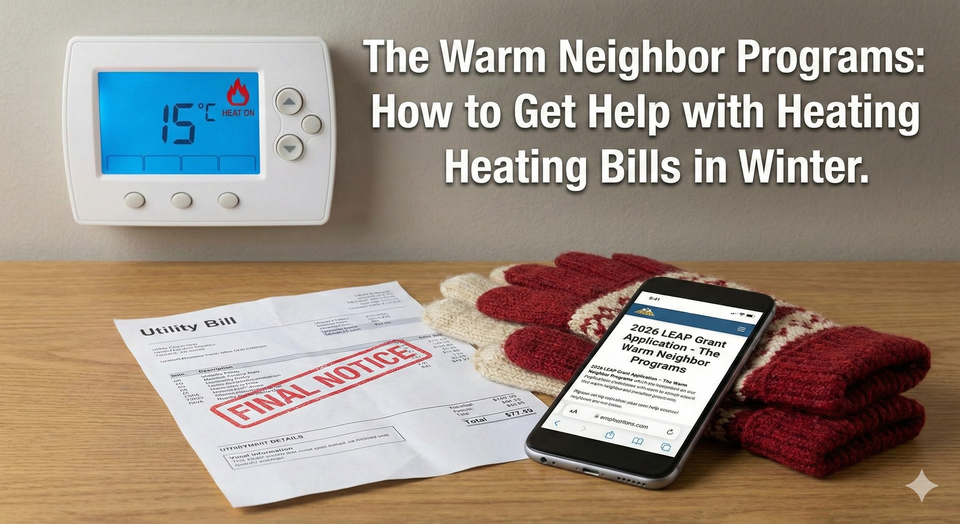
In 2026, the Canadian winter remains as unforgiving as ever, but the cost of staying warm has reached a record high. For many families, the choice between "heating and eating" is no longer a metaphor—it is a monthly reality. If you are staring at a disconnection notice or a gas bill you can’t possibly pay, you need to know about the "Warm Neighbor" programs.
These aren't just myths; they are a network of provincial grants, utility-led crisis funds, and charitable "Safety Net" programs designed specifically for emergency situations. Whether it’s the LEAP grant in Ontario, the Customer Crisis Fund in BC, or the Emergency Needs Allowance in Alberta, there is money available in 2026 to keep your furnace running.
As a critical addition to our Canadian Survival Master List, this 2,000-word authority guide identifies the 2026 income cutoffs for every major heating grant, explains how to trigger an immediate "Stay of Disconnection," and reveals the "Street Hacks" to getting your home winterproofed for free.
Programs?
What are the "Warm Neighbor" programs for heating assistance in Canada? Warm Neighbor programs are emergency financial assistance funds provided by utility companies, provincial governments, and charities like the Salvation Army and United Way. In 2026, the primary programs include LEAP (Low-Income Energy Assistance Program) in Ontario, which offers up to $780 for electricity and $650 for gas; the BC Hydro Customer Crisis Fund, offering up to $800; and Alberta Supports, providing one-time emergency utility payments. These grants are typically "last resort" funds paid directly to your utility provider to prevent disconnection or reconnect services.
2. Provincial Breakdown: Where the Money is in 2026
Every province handles "Energy Poverty" differently. Here is where to apply based on your location.
Ontario: The LEAP and OESP Duo
Ontario offers a two-pronged approach: emergency relief and monthly support.
- LEAP (Emergency): Provides a one-time grant of up to $650 for gas and $650 for electricity ($780 if you have electric heat). You must be in arrears and facing disconnection.
- OESP (Ongoing): Provides a monthly credit on your bill ranging from $35 to $113. Unlike LEAP, this is for long-term affordability. If you qualify for Shared Custody CCB, you almost certainly qualify for OESP.
British Columbia: The Customer Crisis Fund (CCF)
BC Hydro provides a specific "Life Event" fund for those who have hit a temporary wall.
- Maximum Grant: $800 for electric heat / $700 for non-electric.
- The "Life Event" Rule: You must prove a crisis occurred in the last 12 months (e.g., job loss, medical emergency, or a death in the family).
- Eligibility: Your account balance must be under $1,000, and you must have made some attempt to pay in the past.
Alberta: The UCA and Emergency Needs Allowance
Alberta’s deregulated market means you apply through social services or the Utilities Consumer Advocate (UCA).
- Emergency Needs Allowance: Provides a one-time payment to cover utility arrears if disconnection poses a severe health risk.
- Alberta Seniors Benefit: Offers up to $3,868/year for single seniors which can be directed toward essential utilities.
Winter Utility Hacks
This deep dive identifies the technical "Maneuvers" to ensure you never spend a night in a cold house.
1. The 21-Day Disconnection Stay Hack
How to stop utility disconnection immediately.
- The Street Angle: Once the truck is on the way, it’s often too late.
- The Hack: Contact an "Intake Agency" (like the United Way or a local housing help center) before the disconnection date.
- The Strategy: As soon as an agency starts your LEAP or CCF application, they notify the utility provider. In Ontario, this legally forces a 21-day suspension of all disconnection activities.
- The Move: This 21-day window gives the agency time to process your grant. Even if you don't end up qualifying for the full amount, the "Stay" buys you three weeks to find other Free Legal Aid or social support.
2. The "Primary Heat Source" Bonus
Many users miss out on extra cash because they don't understand the "Energy Intensive" rules.
- The Hack: If your primary heating source is electricity (baseboard heaters or electric furnace), you qualify for higher grant amounts.
- The Strategy: Under LEAP, the standard grant is $650, but for electric heat, it jumps to **$780**.
- The Move: Ensure your application explicitly states that you do not have gas and rely on hydro for heat. If you are a renter, this is vital, as many older apartments in Toronto and Vancouver are 100% electric.
3. The Retroactive LEAP Top-Up
A rising query in 2026 is "can I apply for LEAP twice in one year."
- The Reality: Normally, it's a "once per year" grant.
- The 2026 Hack: If the OEB (Ontario Energy Board) increases the maximum grant amounts mid-year (as they did in 2024 and 2025), you can often apply for a "Top-Up."
- The Move: If you received $500 in January, but the limit was raised to $650 in March, call your intake agency. You may be eligible for the extra $150 without a full new application.
4. The Free Home Winterproofing Strategy
Why pay for heat that is leaking out of your windows? Search for "Enbridge Home Winterproofing Program 2026."
- The Hack: If you are a low-income Enbridge customer, you can get thousands of dollars in home upgrades for $0.
- The Coverage: This includes attic, wall, and basement insulation, plus professional "draft proofing" (weatherstripping).
- The Qualification: You must live in a home built before 1980 and meet the income limits (e.g., ~$48k for a family of 2).
- The Strategy: This is better than a grant because it lowers every future bill. If you are a renter, you can still apply as long as your landlord signs a consent form.
5. The Salvation Army Local Discretionary Fund
If you are denied by the government, search for "Salvation Army emergency utility help."
- The Street Angle: Charities have more "wiggle room" than government agencies.
- The Hack: Many local Salvation Army branches manage "Neighbor to Neighbor" or "Share the Warmth" funds.
- The Strategy: They often look at your TFSA vs RRSP situation to see if you have liquid assets. If you truly have $0, they can often issue a small voucher ($100 - $300) to bridge the gap until your next EI or CPP check arrives.
4. Summary Table: Emergency Heating Grants (2026)
| Program | Max Grant (Elec) | Max Grant (Gas) | Income Limit (1 Person) |
| Ontario LEAP | $780 | $650 | < $28,000 (after tax) |
| BC Hydro CCF | **$800** | N/A | Case-by-case (Crisis) |
| Alberta Supports | Variable | Variable | Severe Health Risk |
| OESP (Monthly) | Up to $113 | N/A | < $38,000 (after tax) |
| Salvation Army | $200 - $400 | **$200 - $400** | Discretionary |
Warm Neighbor Programs Canada
How can I get help with my heating bills in Canada for 2026? You can access emergency funding through provincial "Warm Neighbor" programs. In Ontario, the LEAP grant provides up to $780 for electricity and $650 for gas if you face disconnection. In BC, the Customer Crisis Fund (CCF) offers up to $800 for those experiencing a temporary financial emergency. For residents of Alberta, the Emergency Needs Allowance covers utility arrears. Most programs require you to apply through an intake agency like the United Way or Salvation Army, which can also trigger a 21-day "stay" on your disconnection notice.
Frequently Asked Questions (FAQ)
Q: Can I get help if I rent an apartment?
A: Yes. As long as the utility account is in your name and you pay the bill directly, you are eligible for all emergency grants. If utilities are included in your rent, you cannot apply for LEAP, but you may qualify for a Rent Bank loan to prevent eviction.
Q: Do I have to pay the grant back?
A: No. These are non-repayable grants, not loans. The money is paid directly to the utility provider on your behalf.
Q: What if my bill is higher than the grant?
A: This is common. The agency will often ask you to enter into an Arrears Payment Agreement for the remaining balance. Under 2026 rules, utilities must offer you at least 8 to 16 months to pay back the remaining debt if you are a low-income customer.
Q: Does my credit score matter?
A: No. These grants are based on financial need and crisis, not your credit history. In fact, receiving a grant can help save your credit score by preventing a collection item from your utility provider.
About the Author
Jeff Calixte (MC Yow-Z) is a Canadian labour market researcher and digital entrepreneur specializing in government benefit data and cost-of-living support. As the founder of CanadaPaymentDates.ca and BetterPayJobs.ca, Jeff helps newcomers, students, and workers navigate the Canadian social safety net—from tracking CRA payment schedules to finding entry-level work.
Sources
- Ontario Energy Board (OEB): Low-income Energy Assistance Program (LEAP) 2026 Guidelines
- BC Hydro: Customer Crisis Fund Eligibility and Application
- Alberta Utilities Consumer Advocate (UCA): Financial Assistance for Utilities
- Enbridge Gas: Home Winterproofing Program and Income Limits
Note
Official 2026 payment dates and benefit amounts are determined by the Canada Revenue Agency (CRA) and provincial governments. While we strive to keep this information current, government policies and schedules are subject to change without notice. All data in this guide is verified against official CRA circulars at the time of publication and should be treated as an estimate. We recommend confirming the status of your personal file directly via CRA My Account or by calling the CRA benefit line at 1-800-387-1193.
Staying warm is a human right, but in 2026, it requires navigating a complex system. If your current living situation makes heating unaffordable, visit betterpayjobs.ca. We spotlight companies that offer Remote Work Stipends—extra monthly cash specifically meant to cover the increased cost of home heating and high-speed internet for work-from-home employees.