
Welfare Funeral Coverage: How to Pay for a Funeral with No Money
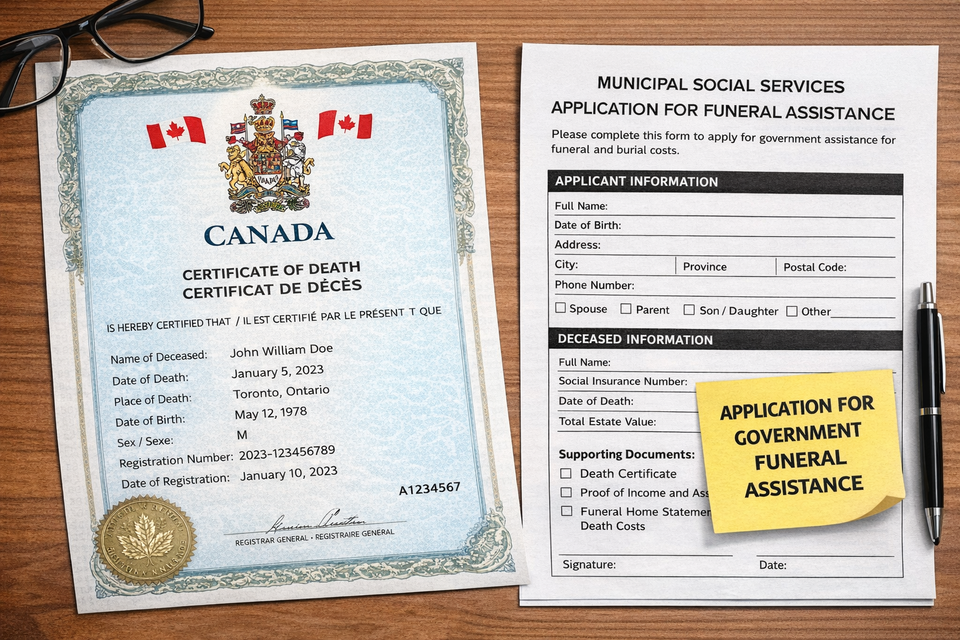
Losing a loved one is a crushing emotional weight, but in 2026, the skyrocketing cost of end-of-life services has added a terrifying financial dimension to grief. For many Canadian families, a basic funeral—which can easily cost $5,000 to $10,000—is simply financially impossible.
If the deceased’s estate has insufficient funds to cover these costs, you need to know about Indigent Burial Assistance (often referred to as "Social Services Funerals").
Almost every municipality in Canada is legally mandated to provide Funeral & Burial Assistance for residents who die without the means to pay. These are "last resort" funds designed to ensure every resident receives a dignified burial or cremation. You do not necessarily need to be on social assistance (Ontario Works/AISH) to qualify, but the estate must pass a strict Asset Test.
As a vital part of our Canadian Survival Master List, this guide identifies the 2026 income cutoffs for major cities, explains how the $2,500 CPP Death Benefit interacts with these funds, and reveals the "Contract Clause" that can disqualify you immediately.
Related Links
- Link to: CPP Death Benefit Application Guide
- Link to: Survivor’s Allowance (Age 60-64)
- Link to: Ontario Works Payment Schedule
- Link to: AISH Payment Dates & Rates
1. 2026 Municipal Income & Asset Limits: Who Qualifies?
Eligibility is strictly based on the liquid assets of the deceased person and their spouse. In 2026, most cities follow a "Break-Even" rule: if the estate has enough cash, insurance, or savings to pay for a basic service, the application will be denied.
Toronto (Employment & Social Services)
- The Rule: The deceased must be a Toronto resident with "insufficient funds" in their estate to cover a basic funeral.
- Asset Limit: Generally, if the estate has less than $5,000 in total liquid assets (bank accounts, RRSPs, Cash), the city may cover the difference.
- The Coverage: Covers the transfer service, a basic casket/urn, cremation or burial fees, and a modest service.
Ottawa (Essential Health & Social Supports - EHSS)
Ottawa uses a defined Low-Income Cut-Off (LICO) for eligibility in 2026.
| Family Size | Monthly Net Income Limit | Annual Asset Limit |
| 1 Person | $2,159.08 | $5,000 |
| 2 Persons | $2,627.75 | $7,500 |
| 3 Persons | $3,272.08 | $8,000 |
Calgary (Alberta Supports Funeral Benefits)
- Standard Eligibility: Automatic coverage for recipients of AISH or Income Support.
- Low-Income Provision: Non-recipients can apply if their bank statements for the 30 days prior to death demonstrate "Financial Need."
- Max Coverage: Up to $3,815 for cremation/burial and up to $550 for a cemetery plot.
2. The $2,500 CPP Death Benefit Rule
The Canada Pension Plan (CPP) provides a one-time, tax-free payment of $2,500 to the estate of a deceased person who contributed to CPP for at least 3 years.
The "Clawback" Rule
If you are applying for municipal funeral coverage, the city views the CPP Death Benefit as an asset of the estate.
- How it works: The city will usually pay the funeral home upfront but will require you to sign an assignment form. This authorizes Service Canada to send the $2,500 CPP payment directly to the city to reimburse them for the costs. You generally cannot keep both the municipal funding and the CPP Death Benefit.
3. Critical Application Steps (Must Read)
To ensure the municipality approves the application, you must follow a specific order of operations. One mistake here can result in a permanent denial.
1. The Pre-Approval Requirement (Do Not Sign Contracts)
This is the most common reason for denial.
- The Risk: Most families rush to a funeral home and sign a standard contract in their grief.
- The Rule: Social Services considers a signed contract as proof that you have "accepted financial responsibility." They will deny reimbursement requests for contracts that are already signed.
- The Correct Step: Tell the funeral director immediately: "I am applying for municipal assistance; please do not start the contract yet." You must wait for the Letter of Intent or purchase authorization number from the city before signing any paperwork.
2. Residency Rules
Municipalities only pay for their own residents.
- The Scenario: If an Ottawa resident passes away in a Toronto hospital, you must apply to Ottawa Social Services, not Toronto.
- The Proof: Ensure you have proof of the deceased’s address (a utility bill, lease agreement, or driver's license) ready to prevent delays between jurisdictions.
3. The Last Post Fund (For Veterans)
If the deceased served in the Canadian Armed Forces, you should bypass municipal welfare entirely.
- The Program: The Last Post Fund provides significantly higher coverage (up to $7,371 + tax) for a funeral and military marker.
- The Eligibility: This is available for veterans whose estate is under roughly $36,000 (excluding the family home). This option is far more comprehensive and dignified than municipal assistance.
4. The "Common Ground" Burial
For families choosing burial over cremation in Toronto or other major cities.
- The Option: If the city pays for burial, they typically utilize "Common Ground" or "Single Graves" in municipal sections (e.g., Beechwood in Ottawa, Pine Hills in Toronto).
- The Reality: This ensures a respectful, marked resting place, but the family usually cannot choose the specific spot. You are permitted to purchase a headstone or marker later at your own expense once your financial situation stabilizes.
Summary Table: Where to Apply in 2026
| Region | Program Name | Application Rule |
| Ontario | Discretionary Benefits (OW/ODSP) | Apply through local municipality (e.g., Toronto ESS). |
| Alberta | Funeral Benefits (AISH/Income Support) | Apply via Alberta Supports Contact Centre. |
| BC | Indigent Burial Program | Apply via the Ministry of Social Development (MSDPR). |
| Veterans | Last Post Fund | Apply directly via lastpostfund.ca. |
| Indigenous | ISC Burial Assistance | Apply through your local Band Office or ISC regional office. |
Frequently Asked Questions (FAQ)
Q: Can I choose any funeral home?
A: Generally, Yes. However, the funeral home must be willing to accept the "Social Services Rate," which is significantly lower than the retail rate. Major providers (such as Arbor Memorial or Dignity Memorial) often have specific agreements in place for assisted services.
Q: What if the deceased has a life insurance policy?
A: If the policy is worth more than the cost of a basic funeral, the city will deny the application. Life insurance is considered a liquid asset of the estate and must be used to pay for the funeral first.
Q: Does the city pay for a headstone?
A: Typically, No. Welfare coverage pays for the "Necessary" items: the transfer, the casket/urn, and burial/cremation fees. Items like flowers, obituaries, and headstones are considered "extra" expenses and fall to the family to cover.
Q: What happens if there is no next of kin?
A: If a person dies with no family and no funds, the Public Guardian and Trustee (PGT) will take over the estate and arrange for a "Public Funeral" via the municipal fund to ensure a dignified end-of-life service.
About the Author
Jeff Calixte (MC Yow-Z) is a Canadian labour market researcher and digital entrepreneur specializing in government benefit data and cost-of-living support. As the founder of CanadaPaymentDates.ca and BetterPayJobs.ca, Jeff helps newcomers, students, and workers navigate the Canadian social safety net—from tracking CRA payment schedules to identifying emergency financial resources.
Sources
- City of Toronto: Financial assistance for funerals, burials and cremations
- Government of Alberta: Funeral Benefits - Eligibility and Rates 2026
- Veterans Affairs: Last Post Fund - Funeral & Burial Program
- City of Ottawa: Essential Health and Social Supports (EHSS) - Burial Services
Note
Eligibility for social programs, grants, and community support is determined by local municipalities and charitable organizations. Funding availability is subject to change without notice. This guide is a directory of resources verified at the time of publication. We recommend contacting the specific agency or food bank directly to confirm operating hours and intake requirements before visiting.