
Why Did My CCB Payment Go Down? (5 Common Reasons Explained)
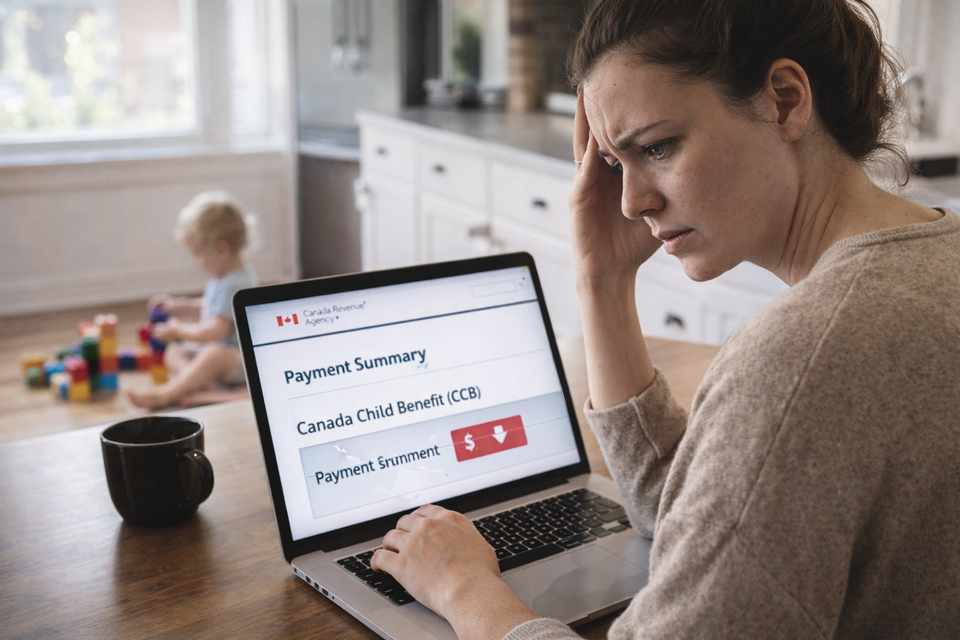
Waking up on the 20th of the month to find a smaller-than-expected deposit from the CRA is a heart-sinking moment for any parent. For many Canadian households, the Canada Child Benefit (CCB) isn't just a "bonus"—it is the money that covers the grocery bill, the daycare fees, and the seasonal clothes your kids outgrow every three months.
When that amount drops without warning, it can feel like a financial emergency.
The good news is that the CRA rarely makes "random" mistakes. CCB reductions are almost always triggered by specific life events or tax-year shifts. Understanding these triggers can help you predict when a decrease is coming—or help you identify a mistake that needs fixing.
This is the Direct Problem Solver Guide to CCB reductions in 2026. We breakdown the "July Recalculation" math, the "Age 6 Cliff," and the specific income thresholds that could be clawing back your monthly support.
Stay Ahead of the Schedule
To ensure you never miss a deposit, check our Master Payment Calendar 2026 for every confirmed federal and provincial payment date.
CCB Payment Troubleshooter: Find Out Exactly Why Your Money Dropped
Waking up to a smaller CCB deposit? Use our 2026 Troubleshooter to find out exactly why your Canada Child Benefit decreased. We break down the "Age 6 Cliff," the July recalculation math, and the "RRSP Hack" to help you get your family budget back on track.
CCB Reduction Troubleshooter
Compare 2025, 2026, and 2027 Benefit Cycles📅 The Recalculation Rule: Because the CRA always looks at your most recently finished tax return, the money you receive in early 2027 is actually determined by the income you earned way back in 2025.
Quick Answers: CCB Reductions
Why did my CCB go down in July?
The most common reason for a CCB decrease in July is the Annual Recalculation. Every July, the CRA resets your benefit based on your family's net income from the previous tax year. If your 2025 household income was higher than your 2024 income, your payments will automatically decrease starting in July 2026.
Does the Canada Child Benefit decrease when a child turns 6?
Yes. The CCB is paid at a higher rate for children under 6. The month after your child's 6th birthday, your payment will automatically drop by approximately $104 per month (based on 2026 maximums). This reflects the government's assumption that childcare costs decrease once a child enters full-time schooling.
What is the income limit for CCB in 2026?
For the benefit year starting July 2026, families with an adjusted family net income (AFNI) below $38,237 receive the maximum benefit. Once your income exceeds this threshold, your payments are "clawed back" at a rate of 7% (for 1 child) or up to 23% (for 4+ children) until your income reaches the second threshold of approx. $82,847, where steeper reduction rates apply.
MORE HELPFUL ARTICLES FROM US
- Canada Payment Guide (Browse All Payments )
- Can I Get EI if I Quit? (Just Cause Checklist)
- TFSA vs. RRSP for Low Income (The GIS Trap)
- Shared Custody CCB Rules (50/50 Split Guide)
- Warm Neighbor Programs (Heating Bill Help)
Reason 1: The "July Recalculation" (Tax Year Shift)
If your payment was fine in June but dropped in July, this is the reason.
The CCB operates on a Benefit Year that runs from July to June.
- January to June 2026: Your payments are based on your 2024 Tax Return.
- July to December 2026: Your payments are based on your 2025 Tax Return.
The "Raise" Trap:
If you or your spouse got a better job, worked more overtime, or received a significant bonus in 2025, the CRA "sees" that extra money when you file your taxes in the spring of 2026. Because the CCB is income-tested, that higher income results in a lower monthly cheque starting in July.
| Tax Year Filed | Benefit Period Affected |
| 2024 Income | July 2025 – June 2026 |
| 2025 Income | July 2026 – June 2027 |
Reason 2: The "Age 6 Cliff"
The CRA classifies children into two age brackets: Under 6 and 6 to 17.
- Under 6 Maximum (2026): Approx. **$679.75/month** ($8,157/year)
- 6 to 17 Maximum (2026): Approx. **$573.58/month** ($6,883/year)
The Drop:
The moment your child turns 6, you lose roughly $106 per month.
- The Timing: The reduction happens the month after the birthday. If your child turns 6 in September, you will receive the full "Under 6" amount in September and October, and the lower amount will begin in November.
Street Reality: This drop often catches parents off guard because their expenses (extracurriculars, food, clothing) actually increase as kids get older. If your child is turning 6 this year, adjust your budget now for that $100+ monthly loss.
Reason 3: Change in Marital Status
This is the most dangerous reason for a reduction because it often leads to overpayments you have to pay back.
The CCB is a "Family" benefit. Only one person in a household can receive it.
- If you get married/move in with a partner: Your incomes are now combined. If your new partner earns a high salary, your combined income might push you over the threshold, drastically reducing your cheque.
- If you separate: You might actually see your payment increase, as the CRA will now only look at your individual income.
The "Common-Law" Trap:
In the eyes of the CRA, you are common-law after living together for 12 consecutive months. If you don't update your status and they find out later, they will recalculate your past 12 months, declare you were "overpaid," and seize your future cheques (and your GST/HST Credit) until the debt is settled.
Reason 4: Shared Custody Adjustments
If your living situation changes and you start sharing custody (40% to 60% of the time), your payment will be cut exactly in half.
- The Rule: Both parents receive 50% of what they would have received if they had full custody.
- The Calculation: This is based on your income, not your ex's.
- The Delay: If your ex-partner notifies the CRA that they now have shared custody, the CRA will often pause your payments entirely while they "investigate" the claim. This can take 2-3 months to resolve.
Reason 5: The "Review Letter" (Audit)
The CRA frequently conducts "Benefit Validation Reviews." They send a letter (usually by mail or to your CRA My Account inbox) asking you to prove your children still live with you.
Common documents they ask for:
- A letter from the school or daycare confirming the child's address.
- A letter from a doctor or dentist.
- A copy of your lease or utility bills.
The Consequence:
If you do not reply to this letter by the deadline (usually 30-45 days), the CRA will stop your payments entirely. They assume you are no longer the primary caregiver or that you have moved out of the country.
Street Reality: The "Ghost" Reduction (Government Debts)
Sometimes your entitlement hasn't changed, but the amount hitting your bank account has. This is usually due to a set-off.
If you owe the government money for other programs, they can "garnish" your CCB.
- Common Debts: Old CERB/CRB overpayments, defaulted Canada Student Loans, or unpaid Income Tax.
- How to Check: Log in to CRA My Account and check your "Statement of Account." Look for a transaction that says "Credit Transferred" or "Set-off."
The Hidden Math: How "Clawback Rates" Slash Your Cheque
Many parents assume that if they earn $1,000 more per year, their CCB will only drop by a few dollars. In reality, the CRA uses a tiered "clawback" system that can be quite aggressive. Understanding these percentages helps you predict exactly how a raise or a new job will impact your monthly budget.
For the benefit year starting July 2026, the "Safe Zone" (the threshold for the maximum benefit) is an adjusted family net income (AFNI) of $38,237. Once you earn a single dollar over that, the following reduction rates apply:
| Number of Children | Reduction Rate (Income $38k - $82k) | Reduction Rate (Income Over $82,847) |
| 1 Child | 7% of income over threshold | **$3,061 + 3.2%** of income over $82k |
| 2 Children | 13.5% of income over threshold | **$5,904 + 5.7%** of income over $82k |
| 3 Children | 19% of income over threshold | **$8,310 + 8%** of income over $82k |
| 4+ Children | 23% of income over threshold | **$10,059 + 9.5%** of income over $82k |
The "Working Parent" Reality:
If you have 3 children and your income rises from $40,000 to $50,000, you don't just pay income tax on that $10,000. The CRA will also reduce your CCB by 19% of that $10,000. That is a **$1,900 loss** in tax-free child support per year.
The "RRSP Hack": How to Artificially Increase Your CCB
Since the CCB is based on Net Income (Line 23600), any legal deduction that lowers your net income will increase your CCB payment. This is the single most effective way to "get back" the money you lost.
How it works:
- In February 2026, you contribute $5,000 to your RRSP.
- When you file your 2025 taxes, your "Adjusted Family Net Income" drops by $5,000.
- Starting in July 2026, your CCB is recalculated.
- The Result: Because your income looks $5,000 lower, the CRA stops "clawing back" a portion of your benefit. If you have 2 kids, that $5,000 RRSP contribution could result in an extra **$675** in CCB payments over the next year ($56/month), plus your standard tax refund.
Street Reality: For families in the $50k–$80k income bracket, an RRSP contribution is essentially "double-dipping." You get the tax refund and an increase in your monthly CCB payments.
The 2026 "Automatic Filing" Relief
A major reason CCB payments go down—or stop entirely—is that parents forget to file their taxes. In 2026, the federal government has fully rolled out Automatic Tax Filing for low-income Canadians with simple tax situations.
If you received an invitation letter for "SimpleFile by Phone" or the new automated pilot, do not ignore it.
- If the CRA automatically files for you, your CCB, GST/HST Credit, and the new Canada Disability Benefit will continue without interruption.
- If you usually file late, this program is your best protection against the "August Payment Freeze."
The "Age 6 Cliff" Calculation: Predicting the Drop
We mentioned that the payment drops after age 6, but many parents are confused about the exact timing. The CRA calculates your child's age based on their status at the beginning of the month.
- Scenario: Your child's 6th birthday is September 15, 2026.
- September 20th Payment: You still get the "Under 6" rate (approx. $679.75) because the child was 5 at the start of the month.
- October 20th Payment: You drop to the "6 to 17" rate (approx. $573.58).
Why this matters:
If you live in a province with extra support like the Alberta Child and Family Benefit, the provincial portion may also drop at the same time. This "Double Drop" can result in a $150–$200 monthly hole in your budget starting the month after a birthday.
The "Grieving Parent" Rule (New 2025/2026 Update)
In the past, one of the most heartless parts of the CRA system was that if a child passed away, the CCB stopped the very next month. As of January 2025, a new compassionate rule is in effect for all of 2026.
The 6-Month Grace Period:
If a child passes away, the CCB payments (and any related Child Disability Benefits) will now continue for six months following the month of death.
- This is intended to help families cover funeral costs and provide a financial cushion during a period of intense grief.
- The Action: You must still notify the CRA of the passing, but the system is now programmed to continue the payments automatically for the half-year "Grace Period."
What Documents to Send for a "Benefit Review"
If you received a letter saying your CCB is "under review," the CRA is questioning your status as the "Primary Caregiver." If you don't send the right documents, they will demand you pay back the last 12 months of benefits.
The "Big Three" documents that win every review:
- School/Daycare Letter: A signed letter on official letterhead stating the child's address and the name of the parent who picks them up.
- Medical/Dental Record: A printout from a doctor's office showing the child’s home address matches yours.
- Third-Party Affidavit: A letter from a landlord, social worker, or religious leader confirming the child lives with you full-time.
Warning: Avoid using "Lease Agreements" alone. The CRA knows people can be on a lease without living there. They want proof of daily life (school and doctors).
What to Do If Your Payment Is Wrong
If you believe the reduction is a mistake, don't just wait for it to "fix itself."
- Check your 2025 Tax Assessment: Was there an error? Did you accidentally report a one-time capital gain as regular income?
- Verify the Number of Children: Does the CRA still show all your children on the "Benefits" tab?
- Submit a Re-calculation: If your income has dropped significantly this year (e.g., you lost your job), the CRA generally won't adjust your CCB until next July. However, if you have a new child or a change in status, update it immediately via the "RC66" form or the "Change my Address/Status" tool in My Account.
Need to Replace That Missing Income?
A $200 or $300 drop in your CCB can break a tight family budget. If the CRA math has left you short this month, the fastest way to bridge the gap is finding a flexible, immediate income source.
👉 Find Daily Pay Jobs at BetterPayJobs.ca
About the Author
Jeff Calixte (MC Yow-Z) is a Canadian labour market researcher and digital entrepreneur specializing in government benefit data and cost-of-living support. As the founder of CanadaPaymentDates.ca and BetterPayJobs.ca, Jeff helps newcomers, students, and workers navigate the Canadian social safety net—from tracking CRA payment schedules to finding entry-level work.
Sources
- Canada Revenue Agency: How CCB is calculated
- Government of Canada: CCB age and income thresholds 2026
- Service Canada: Reporting changes to your family status
Note
Official 2026 payment dates and benefit amounts are determined by the Canada Revenue Agency (CRA) and provincial governments. While we strive to keep this information current, government policies and schedules are subject to change without notice. All data in this guide is verified against official CRA circulars at the time of publication and should be treated as an estimate. We recommend confirming the status of your personal file directly via CRA My Account or by calling the CRA benefit line at 1-800-387-1193.